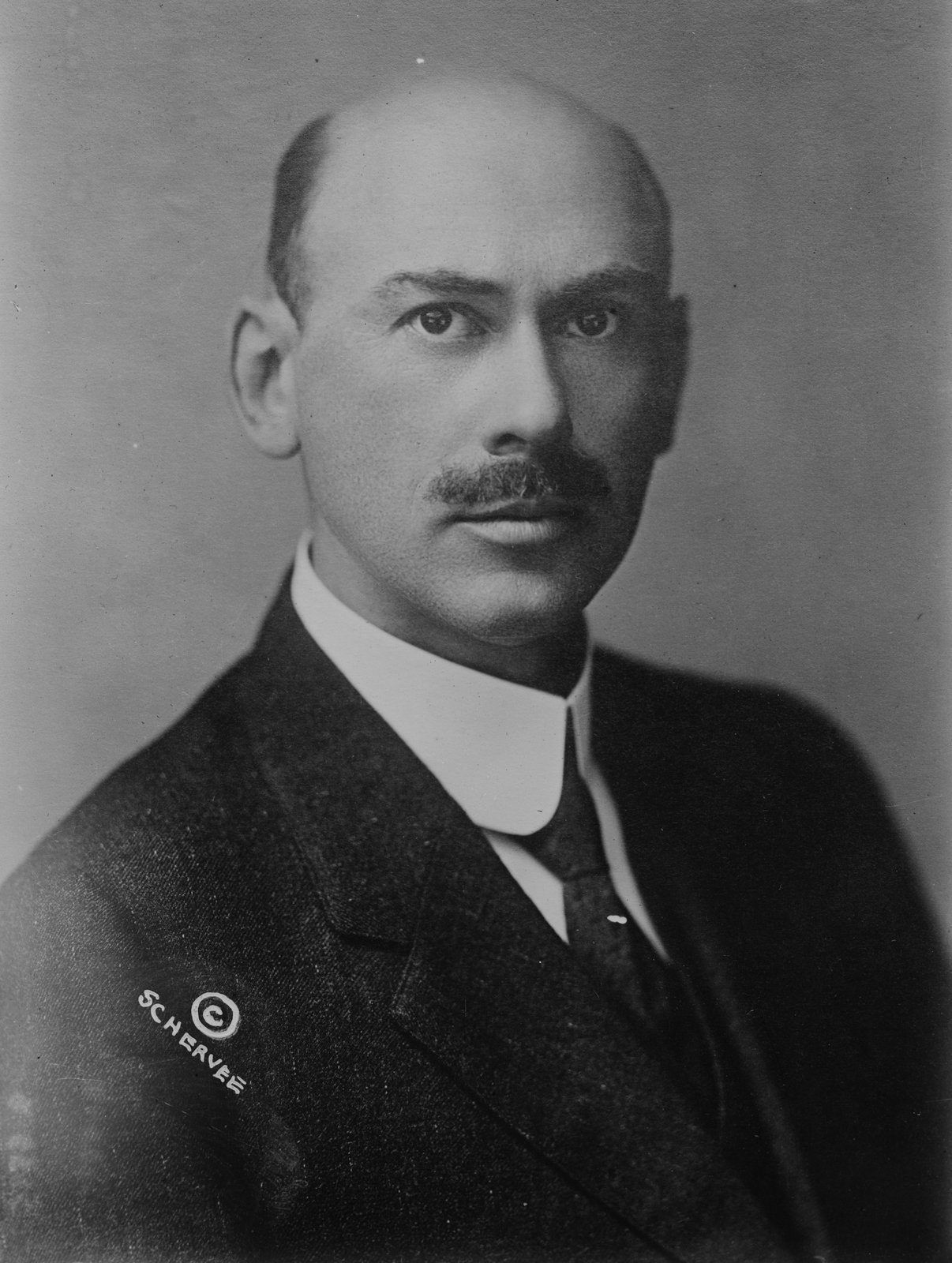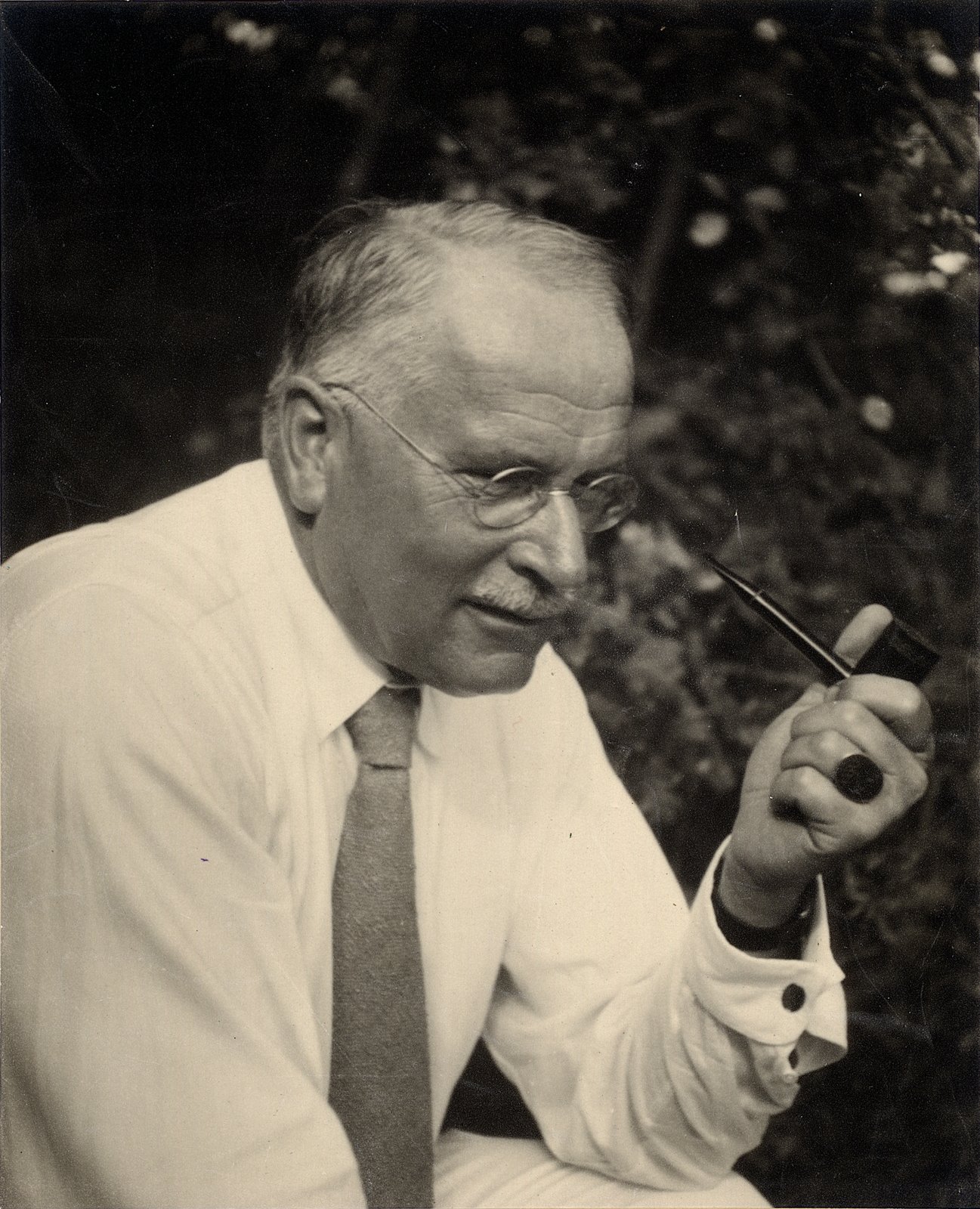

Dr. Rob't H. Goddard, Bain News Service, [between ca. 1915 and ca. 1920], glass negative, George Grantham Bain Collection, Library of Congress (LC-DIG-ggbain-30106); the print carries the studio mark 'Schervee' (Commons credits Herman Schervee, 1867-1923); public domain (published before 1931); cropped to the portrait and downscaled · Bain News Service, George Grantham Bain Collection, Library of Congress Prints and Photographs Division (LC-DIG-ggbain-30106; call no. LC-B2- 5133-14), via Wikimedia Commons · Public domain (PD-US-expired)
Trait Constellation
Key Achievements
In 1915-16 Goddard measured the thrust of commercial powder rockets on a ballistic pendulum and, according to David Stern, found that only about 2% of the fuel's energy went into jet speed; with de Laval-type nozzles he obtained efficiencies of up to 63%. These results, and a test showing that recoil continued in a vacuum, were set out in the Smithsonian's 1919 treatise 'A Method of Reaching Extreme Altitudes', which was released to the public in January 1920.
On 16 March 1926 Goddard launched a gasoline and liquid-oxygen rocket from a farm in Auburn, Massachusetts; it rose about 41 feet in roughly 2.5 seconds and came down 184 feet from the launch frame. Damond Benningfield reports that a later launch there, on 17 July 1929, carried a camera, a thermometer and a barometer and climbed about 90 feet before crashing.
Tom Crouch writes that by spring 1935 Goddard, working near Roswell, New Mexico, was concentrating on a gyroscopic control system; a letter he quotes has Goddard telling Clark's president that the latest flight was the best of the whole research. The A-series rocket Goddard sent to the Smithsonian that November was assembled from parts of several surviving rockets, and Goddard wrote that the greatest height reached by these rockets was somewhat over a mile.
Moments That Reveal Them
After the Smithsonian released his treatise in January 1920, a New York Times editorial of 13 January said Goddard 'seems to lack the knowledge ladled out daily in high schools'. In a Boston Herald article of 14 January, as Frank Winter reports it, Goddard handed the reporter a copy of the treatise, saying 'That tells the whole story', and added 'In self-defense I have to fight shy of the newspaper men'; Benningfield, citing David Clary's biography, says he paid the editorial no more attention than other coverage. The Times printed a correction on 17 July 1969.
In a 1968 article, adapted for Caltech's Engineering & Science in 1986, Frank Malina, then a Caltech graduate assistant, recalled speaking with Goddard on 28 August 1936 and visiting him at Roswell the next month. He was shown the shop (though no components of the sounding rocket), the launch tower and a 2,000-pound-thrust test stand, but Goddard would give no technical details beyond his published 1936 Smithsonian report; Malina took the impression that Goddard regarded rockets as his private preserve.
This is consistent with the profile's below-midpoint collaboration score, which concerns his dealings with outside parties rather than his close work with a small team. Malina was himself a would-be collaborator recalling the visit some thirty years later, and Benningfield's article says Goddard showed off much of his work on the visit. Collaboration
Turning Points
After the launch of 17 July 1929 brought a police car and an ambulance to the Auburn field, Tom Crouch says Goddard was in effect barred from flying his rockets in the area. On 22 November Charles Lindbergh telephoned him after reading a Popular Science article and they met the next day; Lindbergh brought the work to Harry Guggenheim, who agreed to an initial grant of $50,000. Goddard's rocket work was then based near Roswell, New Mexico, from 1930, a site he chose on a meteorologist's suggestion.
The sequence illustrates the profile's persistence score in that the work continued after the Massachusetts ban, though the funding and the move depended on Lindbergh's and Guggenheim's initiative as much as on Goddard's. Persistence
Similar People
People whose overall profiles resemble theirs.
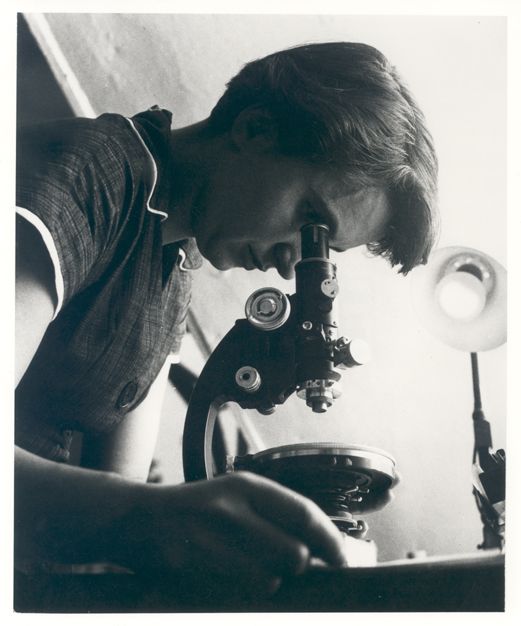

Rosalind Franklin

Bertrand Russell

Marie Curie

Benjamin Franklin

Alan Turing
Opposite Profile
Not a rival — a different profile shape worth a look.
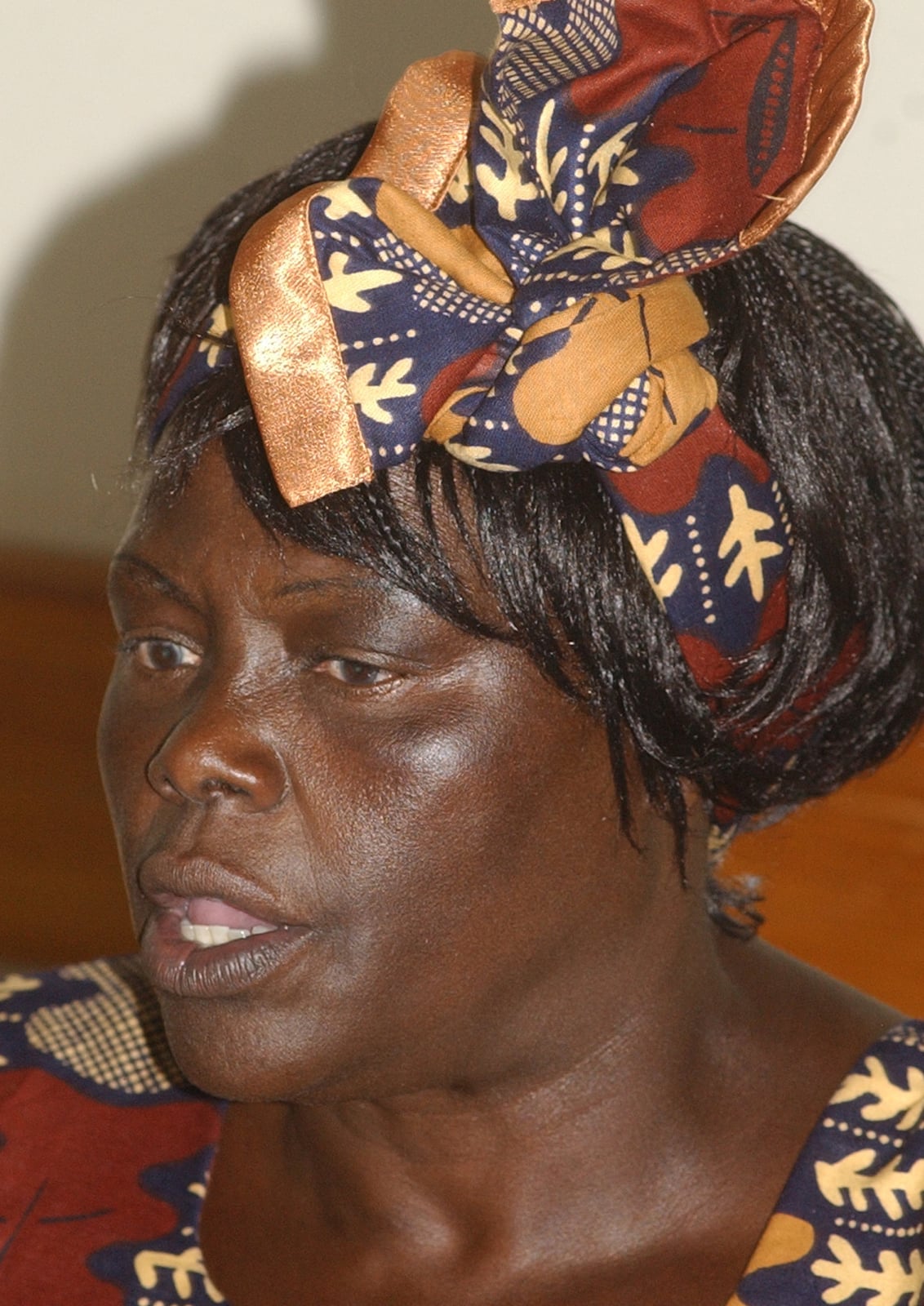
Wangari Maathai
Sources
- Robert H. Goddard (English Wikipedia; lead section fetched via the MediaWiki API) -- orientation only (identity, dates, occupations); not used as support for any scored row. The Korean Wikipedia article title 'ko:로버트 고더드' was confirmed through the Wikidata sitelink and the ko.wikipedia API (title only).
- Robert H. Goddard (Q182546) -- identity verified live through the Wikidata API (wbgetentities: labels, descriptions, claims, sitelinks): en label 'Robert H. Goddard', en description 'American physicist', ko label '로버트 고다드' (kowiki sitelink title '로버트 고더드'), born 1882-10-05, died 1945-08-10, citizenship Q30 (United States), P18 'Dr. Robert H. Goddard - GPN-2002-000131.jpg' (not used; see provenance). Orientation only.
- Damond Benningfield, 'Who Was the Original Rocket Man?', National Air and Space Museum, Air & Space Quarterly (Summer 2026 issue; posted 17 June 2026) -- journalist's centenary feature built on interviews with museum and NASA historians (Neufeld, J. Anderson, C. Anderson) and quotations from Clary's biography and Goddard's diary. Non-self, secondary, critical in tone. Fetched with curl and read in full.
- Michael J. Neufeld and Frank H. Winter, 'Robert Goddard: Secret Space Visionary', National Air and Space Museum (16 March 2026) -- two retired NASM rocketry curators reading Goddard's 1919-1920 Smithsonian papers, his March 1920 confidential report to Abbot and his January 1918 essays. Non-self, scholarly secondary, critical of his secrecy. Fetched and read in full.
- Frank H. Winter, 'The Misunderstood Professor', Air & Space (Smithsonian), May 2008 -- curator emeritus's account of the January 1920 press flap (Boston Herald exchange of 14 Jan 1920, the New York Times editorial of 13 Jan 1920 and its 17 July 1969 correction), Goddard's press policy and his assistants. Non-self, scholarly secondary (same author as one half of the Neufeld/Winter piece, so ONE Winter perspective). Fetched and read in full; several statements (e.g. assistants' agreements) are given without a cited document.
- Tom D. Crouch, 'Reaching Toward Space', Smithsonian Magazine / Air & Space (February 2001; byline read in the page's markup) -- Smithsonian curator's narrative of Goddard's relations with the Smithsonian, the 17 July 1929 launch and its aftermath, Lindbergh's visit of 23 Nov 1929, the Guggenheim grant and Roswell, the September 1935 visit and the November 1935 donation of an A-series rocket (quotes Goddard's letters, Lindbergh's autobiography and von Karman). Non-self, scholarly secondary. Fetched and read in full.
- Tom Crouch, 'Robert Goddard and the Smithsonian', National Air and Space Museum (3 Dec 2010; excerpt from 'Smithsonian National Air and Space Museum: An Autobiography') -- Goddard's September 1916 letter to Abbot, the $5,000 grant and the 1919 treatise. Same author as src_goddard_crouch_reaching (ONE Crouch perspective). Fetched and read in full.
- David P. Stern, 'Robert Goddard and His Rockets', NASA Goddard Space Flight Center (ISTP historical pages 'From Stargazers to Starships', archival page updated 2005, edited 2016) -- a NASA physicist-educator's technical account of the 1913 diary list, the 1915-16 ballistic-pendulum, nozzle and vacuum measurements, the switch to liquid fuel in 1922, the 1926 flight and later gyroscope/vane control. Non-self secondary that draws on Goddard's own papers; reads as sympathetic but factual. Fetched and read in full.
- Frank J. Malina, 'The Rocket Pioneers', Caltech Engineering & Science (November 1986; adapted from Malina's 1968 E&S article) -- FIRSTHAND account by the young Caltech rocket experimenter of his 28 Aug 1936 meeting with Goddard at Caltech and his September 1936 day at Roswell, with an extract from von Karman's memoir 'The Wind and Beyond'. Interested but non-self, recalled about 30 years later (the passages on Goddard's supposed bitterness or self-regard are not used). Downloaded as PDF and read: the opening and the Goddard passages closely; the remainder (GALCIT test narrative) skimmed by keyword only.
- Smithsonian Institution Archives, 'Stories from the Smithsonian: Robert H. Goddard' primary-source transcriptions written by GODDARD (self): his 27 Sept 1916 proposal letter, his 9 Jan 1917 reply on receiving the grant, his March 1920 'Report Concerning Further Developments' and his 28 May 1930 letter to Abbot. All read (the March 1920 report: first part and keyword-searched remainder). Pages, all under https://siarchives.si.edu/history/featured-topics/stories/: september-27-1916-goddards-proposal-smithsonian (cited url), january-9-1917-goddard-secretary-walcott-after-receiving-grant, march-1920-report-concerning-further-developments-space-travel, may-28-1930-goddard-secretary-abbot-thanking-smithsonian-its-support. SELF-AUTHORED -- counts as one self perspective.
- Smithsonian Institution Archives, transcriptions of contemporaneous Smithsonian records written by OTHERS: C. G. Abbot's memoranda to Secretary Walcott of 2 Oct 1916 and 16 Dec 1916 and Walcott's letter to Goddard of 5 Jan 1917 approving the $5,000 Hodgkins Fund grant. Non-self, contemporaneous institutional records (the Smithsonian was the funder). All read in full. Pages, all under https://siarchives.si.edu/history/featured-topics/stories/: december-16-1916-assistant-secretary-abbot-secretary-walcott-goddards-propo (cited url), october-2-1916-assistant-secretary-abbot-secretary-walcott-goddards-proposa, january-5-1917-secretary-walcott-goddard-approving-grant.
- Solomon Hajramezan, 'Celestial Visions: Imagining and Engineering Spaceflight in the United States, 1899-1969' (MA thesis, University of Alberta, 2021), PDF downloaded and read: the Goddard section of chapter 1 (c. pp. 12-18) and the passage on the Malina/Goddard meeting and the 1938 Guggenheim cooperation attempt (c. p. 34). Scholarly secondary that re-tells Clary (2003), Hunley (1995), Malina and von Karman (derivative, weakly independent).
- Matthew Wills, 'Robert H. Goddard, the Forgotten Father of Rocketry', JSTOR Daily (16 Oct 2017) -- a two-minute summary of J. D. Hunley, 'The Enigma of Robert H. Goddard', Technology and Culture 36:2 (1995). Read in full; Hunley's article itself is behind a paywall and was NOT read. Used only to report Hunley's assessment of Goddard's departure from step-by-step engineering practice (a secondary summary of a secondary source).