Leonardo da Vinci
93% Profile Match
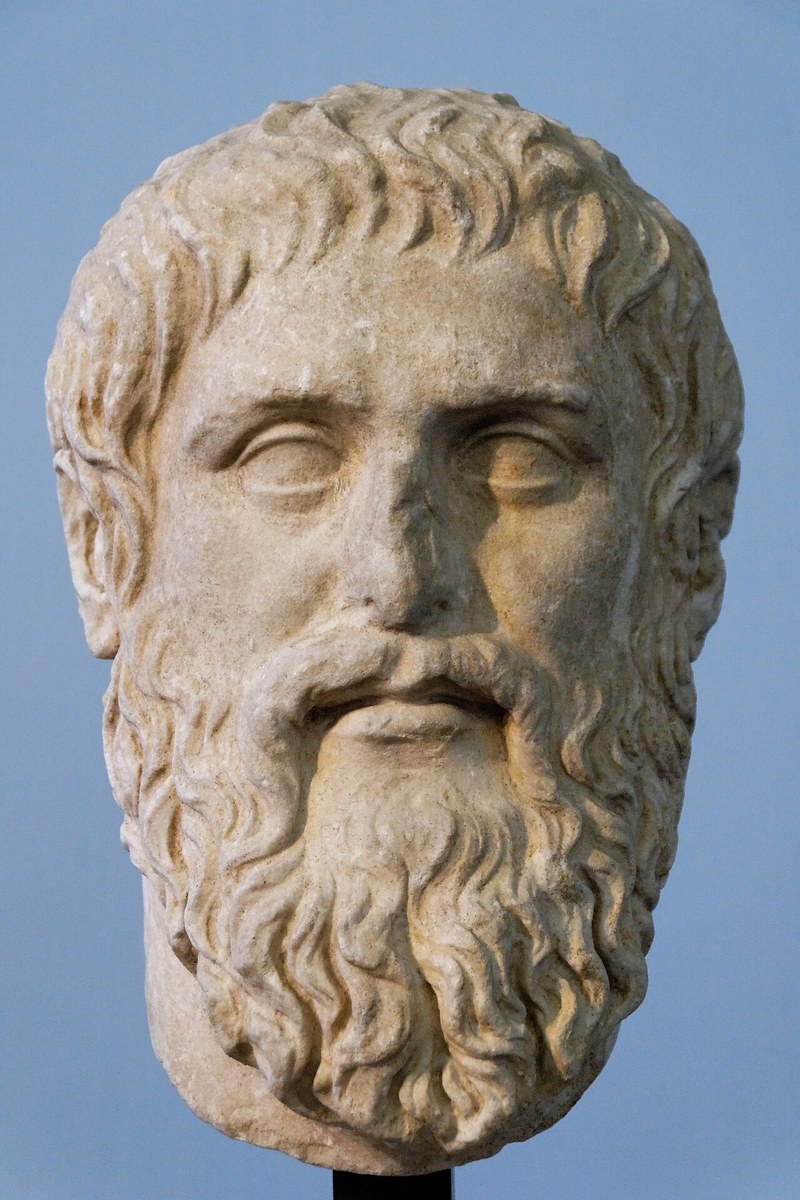
Photograph by Marie-Lan Nguyen (Wikimedia Commons user Jastrow), 2009, CC BY 2.5; Roman copy after Silanion, Capitoline Museums, Rome · Marble bust of Plato, a Roman copy (dated to the 1st century AD on the Commons page) of a portrait attributed to the sculptor Silanion (about 370 BCE, made for the Academy), Capitoline Museums, Rome (Centrale Montemartini), inventory MC 1377. Photograph by Marie-Lan Nguyen, 5 September 2009, her own work. The bust is an ancient sculptural portrait made about a century after the sitter's lifetime, so it is a later depiction and not a likeness. The file is the original 2400 x 3600 Commons photograph downscaled to 800 x 1200 with no upscaling. · CC BY 2.5 (photograph); the ancient sculpture itself is in the public domain
philosopher · Ancient
428 BCE–347 BCE
Not yet included in personality matching — the documented evidence doesn't yet cover enough of the personality model. Everything else on this page is fully available.
He wrote philosophical dialogues, among them the Republic, the Apology and the Phaedo, that are read as foundational texts of Western philosophy and set out his theory of Forms.
He founded the Academy, a school in a grove outside Athens, where he taught for the rest of his life and where Aristotle studied; the word 'academic' derives from its name.
His writing on the immortal soul, on love as a ladder of ascent and on art as imitation shaped later philosophy and Western culture.
Scholars reconstruct an Academy curriculum from the Republic in which arithmetic, geometry, astronomy and harmonics prepared students for dialectic, with Plato setting problems and criticising methods rather than directing research himself.
This is consistent with a teacher who treated mathematical training as a route to philosophical inquiry. Mastery Orientation
According to Allan, his late dialogues absorb scientific ideas, such as a physiology in the Timaeus and Eudoxus's astronomy in the Laws, and use them for moral and theological arguments.
This is consistent with a thinker whose philosophical work drew on several fields of inquiry. Cross-Domain Range
After Socrates was executed in 399 BCE he left Athens and travelled, and on his return around 387 or 380 BCE he founded the Academy, which remained his base for the rest of his life.
This is consistent with a shift from an apprentice of Socrates to the head of his own teaching institution. Mastery Orientation
People whose overall profiles resemble theirs.


Not a rival — a different profile shape worth a look.