Marie Curie
93% Profile Match
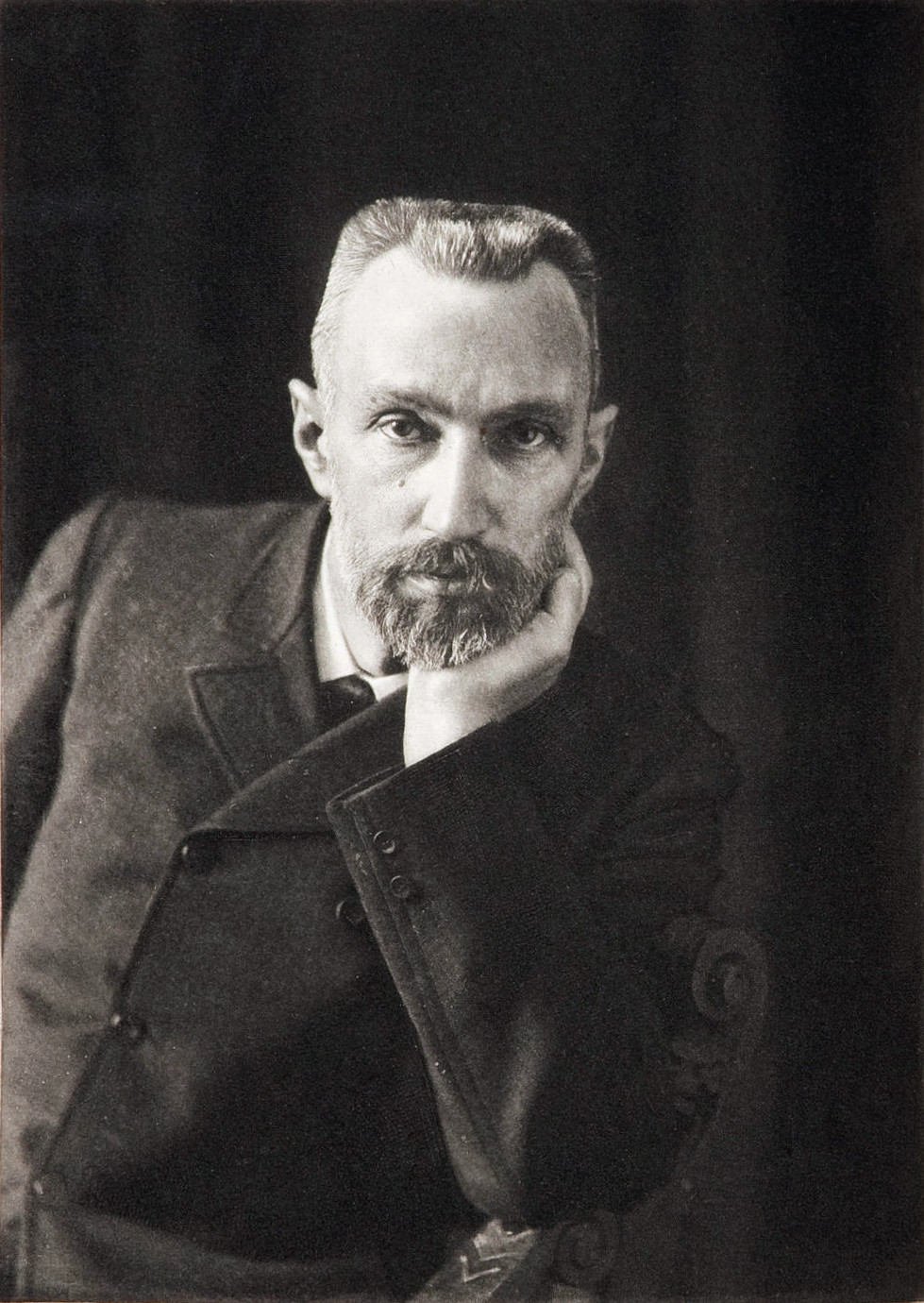
Unknown photographer, heliogravure by Dujardin, 'Pierre Curie in 1906'; published in Marie Curie, Traite de radioactivite (1910) and Pierre Curie (1923); public domain · Wikimedia Commons, 'Pierre Curie by Dujardin c1906.jpg' -- photographic portrait of Pierre Curie, dated 1906 in the frontispiece caption ('Pierre Curie in 1906', heliogravure by Dujardin, printed by Ch. Wittmann) of Marie Curie's 'Pierre Curie' (Macmillan, 1923; confirmed in the Internet Archive scan opened for the biography source), and also reproduced in her 'Traite de radioactivite' (Gauthier-Villars, 1910) per the Commons record; original Commons file 979 x 1380 pixels, saved unchanged (no scaling). The photographer is unknown; 'Dujardin' on Commons is the heliogravure printer. Rights basis: published in 1910 and 1923, before 1931 (public domain in the United States) with an unknown photographer and more than 70 years since publication (public domain in France and the EU); Commons tags it PD-old. An alternative Wellcome Collection scan (M0000112, credited to E. Pirou) was NOT used because Wellcome's own catalogue page labels the item 'In copyright' despite a CC BY digitisation licence, which is a conflicting institutional notice. · Public domain (published 1910 and 1923; unknown photographer)
physicist · 19th Century
1859–1906
Not yet included in personality matching — the documented evidence doesn't yet cover enough of the personality model. Everything else on this page is fully available.
With Marie Curie he announced the discovery of polonium and radium in 1898, and in 1903 the two shared half of the Nobel Prize in Physics with Henri Becquerel for their work on radioactivity.
In 1880, working with his brother Jacques, he discovered piezoelectricity, the appearance of electric charge on certain crystals under pressure, and the brothers built the quartz electrometer and balance to measure it.
He showed that the magnetic properties of a substance change at a certain temperature, now called the Curie point, found the law relating weak magnetization to temperature, and in 1894 set out his laws of symmetry in physical phenomena.
In 1880 he and Jacques tested quartz, topaz, Rochelle salt and other crystals with tinfoil, glue, wire and a jeweller's saw, and found that pressure produced electric charge.
This is consistent with a habit of building simple apparatus to test an idea directly. Resourcefulness
While studying magnetism he searched for strongly diamagnetic bodies and for conductors of magnetism, found none, and, according to his widow, never published these searches.
This is consistent with pursuing unforeseen possibilities for their own sake rather than for publication. Curiosity
In 1898 he set aside his own work on crystals to join Marie Curie's search for an unknown radioactive substance in pitchblende, which led to the discovery of polonium and radium.
This is consistent with a willingness to redirect his own research to work jointly on a promising problem. Collaboration
People whose overall profiles resemble theirs.