Marie Curie
92% Profile Match
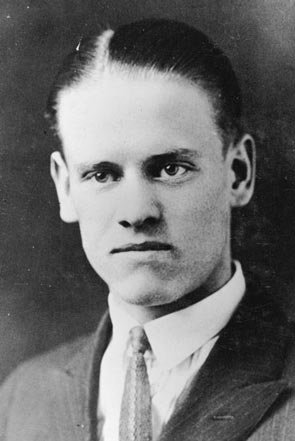
Philo Farnsworth, yearbook portrait, The Banyan (Provo: student body of Brigham Young University, 1924); photographer not credited (Commons: unknown author); public domain in the United States because published before 1931; downloaded from Wikimedia Commons and re-encoded, not resized · The Banyan (Brigham Young University yearbook, Provo, Utah), 1924 volume -- yearbook portrait in the 'Fourth Years' (high-school seniors) section, via Wikimedia Commons (cleaned crop of the same photograph, Commons source credit to the Utah State Historical Society 'I Love History' page) · Public domain (PD-US-expired)
In the summer of 1934 Farnsworth's laboratory staged public demonstrations of its electronic television system at the Franklin Institute in Philadelphia, televising performers and views from the roof and around the building for paying visitors. Sources give the length of the run as anywhere from ten days to about three weeks.
In 1939 Farnsworth's company and RCA concluded a patent-licence agreement under which RCA agreed to pay continuing royalties, which Gross describes as a break from RCA's usual policy. Everson, a company backer, writes that the talks ran from May to September 1939 and were conducted by the company's president and its patent chief while Farnsworth himself was in Maine.
According to Lemelson-MIT, nuclear fusion was Farnsworth's main research interest from the 1950s until his death. The Marriott Library finding aid says that at ITT he and his staff built a series of experimental fusion tubes he called fusors, in which the reaction lasted no more than about thirty seconds, and that in 1967 he moved the work to Brigham Young University.
In the summer of 1926 Farnsworth, not yet of age, presented his scheme to a group of San Francisco bankers at the Crocker First National Bank. According to Everson, who was present, he described a system with no moving parts, used a halftone newspaper picture to show how many separate picture elements would have to be sent each second, and answered the bankers' questions; an engineer had already reviewed his specifications for the group, and the bankers agreed to back the work.
Everson recalls Farnsworth arguing at this meeting that mechanical scanning could not reach the speed required, which is consistent with a habit of setting his approach explicitly against the prevailing method; the words were written down by a backer 23 years later. Independent Thinking
Gross dates a visit by the engineer Vladimir Zworykin, then associated with Westinghouse and RCA, to Farnsworth's San Francisco laboratory to 1930, after Farnsworth's investors had urged him to find a corporate partner. Everson writes that Zworykin spent several days there, that Farnsworth and his backers knew that showing him everything was a considerable risk and chose to do so, and that Zworykin asked to watch Cliff Gardner make a dissector tube.
The episode is consistent with a willingness to accept calculated exposure to a competitor in return for the chance of a partnership; the reasoning comes from Everson's account, not from Farnsworth's own words. Risk Tolerance
After about two years at Philco's Philadelphia plant, Farnsworth left in 1933 and set up his own company and laboratory in the Philadelphia area; Everson dates the new laboratory to 1934. Gross says the new company let him work on his dissector without outside interference, and Everson says Philco's production aims had come to differ from Farnsworth's aim of building a broad patent structure through advance research.
The break is consistent with a preference for keeping control over the direction of his research, although Philco's own aims and finances also shaped it. Need for Autonomy
People whose overall profiles resemble theirs.


Not a rival — a different profile shape worth a look.