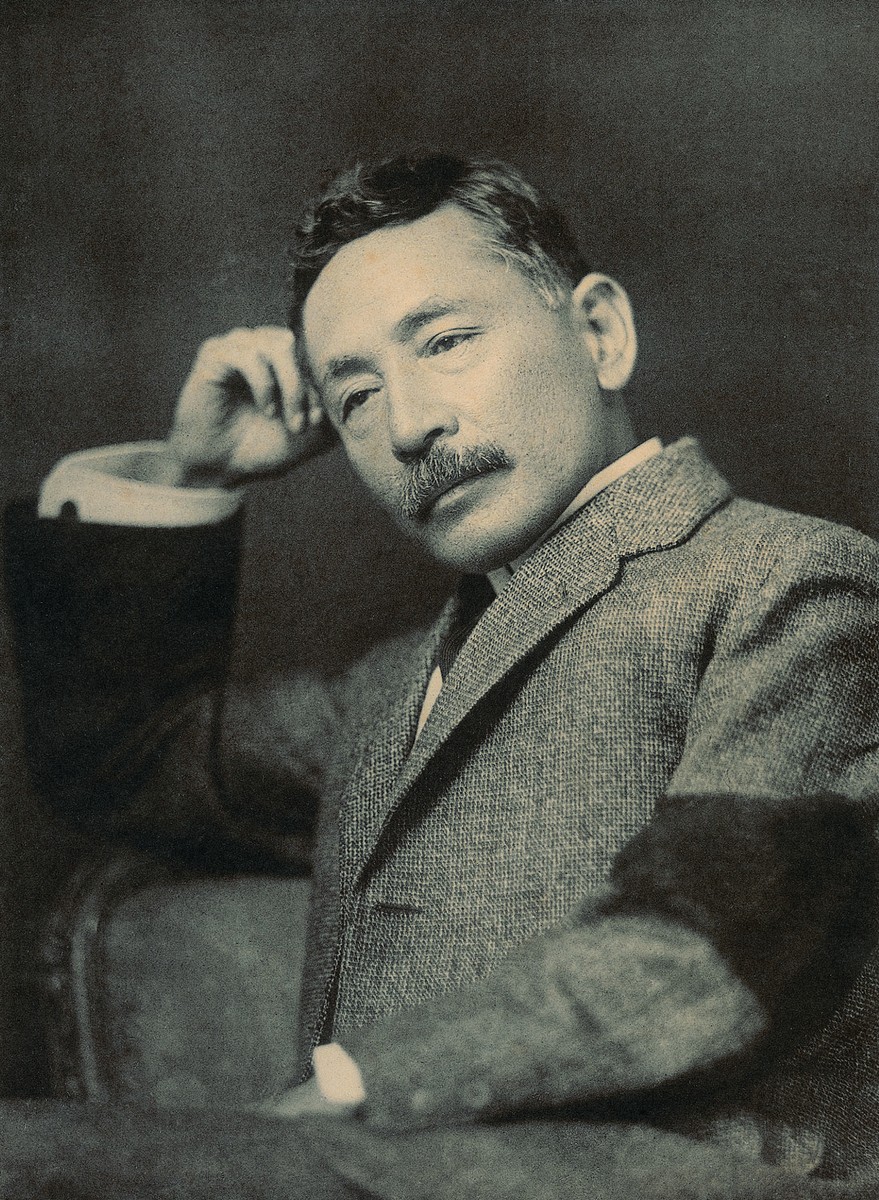
Photograph attributed to Ogawa Kazumasa, September 1912, via Wikimedia Commons (public domain) · Portrait photograph of Natsume Soseki at about 45 in a tweed jacket with a mourning armband, resting his head on his hand, attributed to the photographer Ogawa Kazumasa (1860-1929) and dated September 1912 on the Wikimedia Commons file page 'Natsume Soseki photo.jpg' (Commons gives Jiten.com and a Japan Times page as its sources; the uploader's date is not independently documented). Corroboration read: the Japanese art-magazine Bijutsu Techo's entry on Ogawa Kazumasa calls him the photographer of the portrait that was the original for the Soseki image on the 1,000-yen note, and Toyo Keizai Online says the note portrait is a photograph taken when Soseki was 45 to commemorate the Meiji Emperor's funeral, which matches the visible armband. Rights basis: the creator Ogawa Kazumasa died in 1929 (Wikidata record Q3133048 lists 1860-1929), so a photograph of 1912 had passed out of copyright in Japan long before the 1 January 1996 US restoration date and is in the public domain in the United States as well; Commons tags it as an old Japanese photograph in the public domain. No institutional notice conflicting with this was found: the image is a faithful scan of a 1912 photograph and no museum or publisher reproduction restriction was found for the scan used. Caveats: I could not open a first-publication record for the print, and the Commons file's source pages do not themselves document the authorship, so the photographer attribution rests on the Commons record plus the corroborating Japanese pages. Original 1378 x 1881 pixels, downscaled to 879 x 1200 (no cropping, never upscaled). · Public domain (photographer died 1929)
Trait Constellation
Key Achievements
One of the outstanding novelists of Meiji Japan, he is credited by Britannica as the first to ably depict the alienated modern Japanese intellectual and with helping root the modern realistic novel in Japan.
I Am a Cat (1905-06) and Botchan (1906) made his name, and his later serialized novels include Sanshiro, And Then, The Gate, Kokoro (1914) and the unfinished Light and Darkness (1916).
In 1907 he left a university post to write serialized novels for the Asahi Shimbun, a step reported as extraordinary at the time, and young writers, among them Akutagawa Ryunosuke, gathered at his Thursday meetings.
Moments That Reveal Them
In 1911 the Education Ministry offered him an honorary doctorate, which he declined, according to Nippon.com disliking the spirit of studying merely to acquire such recognition.
This is consistent with an independent stance toward official recognition, though the stated reason comes from a single popular biography. Independent Thinking
In his last year in Britain he reportedly spent every moment in study, an inquiry into the nature of literature that later bore fruit in his Theory of Literature.
This is consistent with a strong commitment to deep study of his subject. Mastery Orientation
Turning Points
In April 1907 he resigned from the Imperial University and his other teaching posts and in May joined the Asahi Shimbun to write novels full time.
This is consistent with choosing independence as a writer over the security of an academic career. Need for Autonomy
Similar People
People whose overall profiles resemble theirs.


Ada Lovelace

Carl Jung

Rabindranath Tagore

Yayoi Kusama

Frida Kahlo
Opposite Profile
Not a rival — a different profile shape worth a look.

Otto von Bismarck
Sources
- Natsume Sōseki (Q180903), verified live via the Wikidata API (2026-10-31): label 'Natsume Sōseki', description 'Japanese novelist', born 1867-02-09, died 1916-12-09, citizenship Japan, Korean label 나쓰메 소세키. Orientation only; not used as support for any row.
- Encyclopaedia Britannica, 'Natsume Sōseki' (full article read, about 600 words). CANONICAL SIGNIFICANCE SOURCE: an outstanding Japanese novelist of the Meiji period and the first to ably depict the plight of the alienated modern Japanese intellectual; degree in English from the University of Tokyo in 1893, provincial teaching, government scholarship to England in 1900, lecturer at Tokyo from 1903; fame from I Am a Cat and Botchan, then Kusamakura; after 1907 he gave up teaching to write, producing Mon, Kokoro, Michikusa; says the modern realistic novel took root in Japan through him.
- National Diet Library, Japan, 'NATSUME Soseki', Portraits of Modern Japanese Historical Figures (English biographical note, read in full). Library biography: English department of the Imperial University 1893, teaching, London from 1900, instructor at Tokyo University, debut with I Am a Cat 1905-06, contract storywriter for the Asahi Shimbun from 1907, later novels, an expression style that differed from the naturalists and was called Yoyu-ha, evaluated as one of the great storywriters of modern Japan, and students who became writers. The page hosts the library's portraits of him.
- Inoue Yusuke, 'Natsume Soseki: Japan's Foremost Modern Novelist', Nippon.com (Shapers of Japanese History series, 9 February 2017; read in full, about 2,300 words). Detailed popular biography from the Nippon Communications Foundation: studies in classical Chinese and English, the London year of intense study that bore fruit in Theory of Literature, the Thursday meetings with disciples including Akutagawa, the 1907 move from the university to the Asahi Shimbun described as extraordinary at the time, the 1911 refusal of an honorary doctorate, the two trilogies, and later assessments by the translator Damian Flanagan and the scholar Michael K. Bourdaghs (admiring). Passages on his health and mental state were read but are not used.
- 'Soseki Natsume', Encyclopedia of World Biography (Gale; read at Encyclopedia.com, about 1,500 words). Reference biography with a critical-literary framing: his command of English and the library of hundreds of English books with his marginal notes, the refusal of uncritical Westernisation, the 1907 decision to give up the security and prestige of a university post for the Asahi, a note that thereafter he spurned official honours, and a survey of the novels. Statements about his nervous condition and the personal interpretation of his late novels were read but are not used.
- 'Natsume Soseki Chronology (1867-1916)', a dated chronology posted on a university lecturer's personal site (Universitas Gadjah Mada staff blog) and credited there to Marvin Marcus, 'Reflections in a Glass Door' (University of Hawai'i Press, 2009), read in full (about 1,700 words). Used only for dated career facts (April 1907 resignation from the Imperial University and other posts; 3 May 1907 joined the Tokyo Asahi Shinbun as the highest-paid staff writer; the Thursday Society from October 1906; the February 1911 refusal of the Education Ministry's honorary doctorate; annual serialised novels 1907-1916; lectures in 1911 and 1914). The primary book was not opened; the chronology also lists health and family events, which are not used.
- Tohoku University Library, 'Natsume Soseki Library' and 'About Natsume Soseki' (two short pages, read in full). The university holds his personal book collection and some of his handwritten works; its biography lists the Asahi serials from 1907 on (Gubijinso through Light and Darkness) and gives his death in 1916.
- Marie Omata, 'Natsume Soseki and Arts' (exhibition notice), The Japan Times, 9 May 2013 (read in full, about 150 words). Short notice for an exhibition at the Tokyo University of the Arts museum: says he was a fan of and knowledgeable about Japanese and British art, often referred to painters in his works, and collected more than 200 works by 80 artists.
- Wikipedia, 'Natsume Sōseki' (read; orientation only, never counted as a source and not used as support for any row). It was read to check the commonly repeated career claims (Thursday Salon, 1907 move, 1911 honour refused); its extensive passages on his health, mental state and family were deliberately not used.