Benjamin Franklin
94% Profile Match
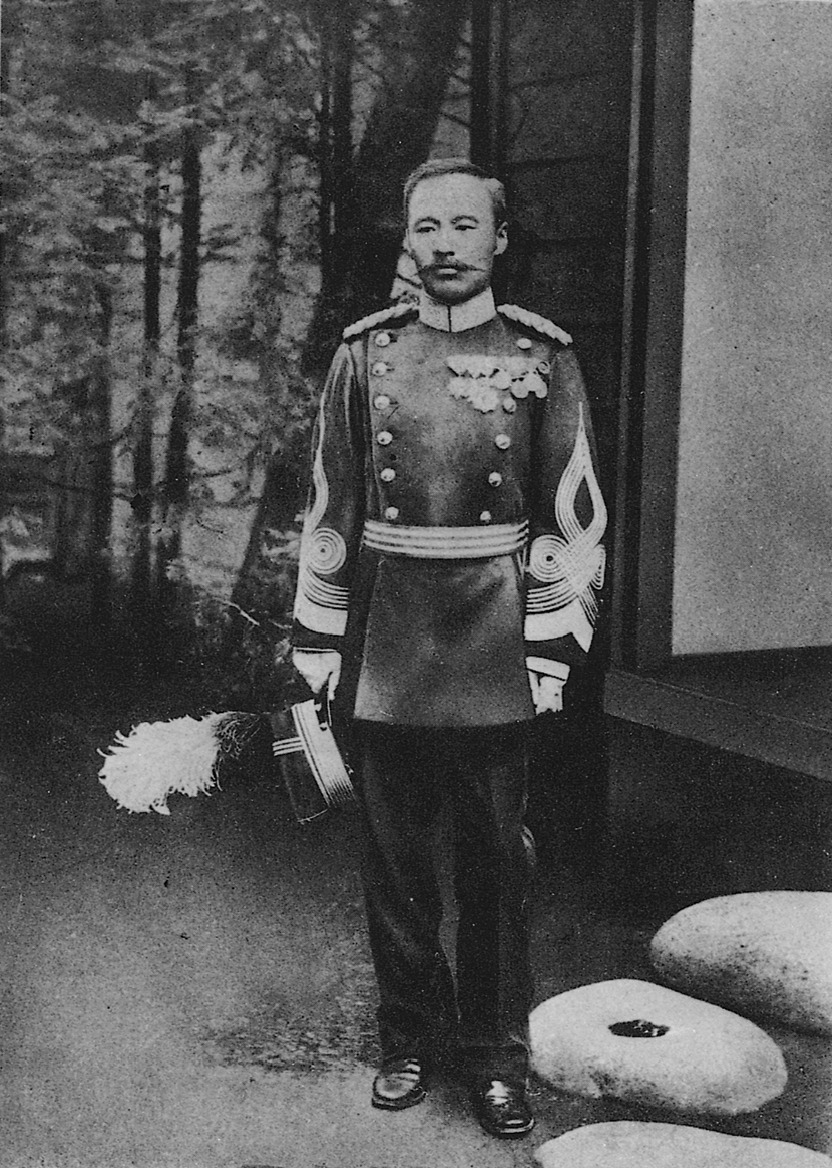
Ohashi Otowa, 1899, reproduced in Mori Junzaburo, 'Ogai Mori Rintaro' (1942); National Diet Library, Japan, Portraits of Modern Japanese Historical Figures · Full-length photograph of Mori Ōgai in army surgeon's uniform with plumed hat in hand, in the garden in front of the Kanchoro tea room, taken in June 1899 on the day before he left for Kokura, by Ohashi Otowa (1869-1901). The printed caption in the 1942 book 'Ogai Mori Rintaro' by Mori Junzaburo (Marui Shoten; National Diet Library Digital Collection record, access restriction Public Domain Mark) names the sitter, date, place and photographer; the same image is shown as the first of five portraits on the National Diet Library's exhibition page for MORI Ogai (file 0342_1.jpg). Rights basis: the photograph was taken in 1899 and the named photographer died in 1901 (Japanese Wikipedia, orientation only), so it is public domain by age in Japan, and as a Japanese work already out of copyright in 1996 it was not restored in the United States; the National Diet Library's exhibition states that all images in the exhibition are in the public domain and may be reused including commercially with source citation. The page does not carry a separate item-level statement for each photograph, so the rationale rests on photographer, date and age as well as that institutional statement. The file is the halftone reproduction as served by the library at 884 x 1281 pixels, cropped only to remove the printed caption and the border (832 x 1168 pixels); no scaling or upscaling. · Public domain (photograph of 1899 by Ohashi Otowa, died 1901; National Diet Library states all images in its exhibition are in the public domain)
writer · 20th Century
1862–1922
Not yet included in personality matching — the documented evidence doesn't yet cover enough of the personality model. Everything else on this page is fully available.
One of the creators of modern Japanese literature: his 1890 story Maihime (The Dancing Girl), closely based on his own time in Berlin, broke with the impersonal fiction of earlier generations and started a vogue for autobiographical writing, and his novel Gan (The Wild Goose, 1911-13) became his most popular work.
He brought European literature into Japanese through translation and criticism: the poetry collection Omokage (1889), Andersen's Improvisatoren (published 1892-1901), Goethe's Faust and Ibsen's John Gabriel Borkman (staged in his translation in 1909), and print debates with Tsubouchi Shoyo over the purpose of drama.
Alongside writing he was a physician-administrator: he studied hygiene in Germany (1884-88), co-wrote the 1897 hygiene textbook, rose in 1907 to head the army's medical division, and after 1912 turned to historical stories and critical biographies such as Shibue Chusai, later also directing the Imperial Household Museum.
In 1909 his story Vita Sexualis appeared in the magazine Subaru and the issue was banned; the Deputy Army Minister reprimanded him and afterwards asked him to publish fiction under a pseudonym.
This is consistent with a writer willing to publish provocative work despite pressure from his own superiors, though he also complied with the later request. Conflict Tolerance
From 1909 to 1914 he wrote the column Mukudori tsushin in the magazine Subaru, reporting concisely on cultural and scientific trends in Europe and North America, and for years after his German study he kept having new German books and periodicals sent to him.
This is consistent with a continuing, self-directed interest in developments abroad well beyond what his official posts required. Curiosity
Sent by the army to Germany in 1884 to study hygiene, he spent four years there also reading German literature and philosophy and visiting theatres and galleries, and returned in 1888 to start modernizing both Japanese medicine and Japanese literature, debuting with Omokage in 1889.
This is consistent with a person who used one professional assignment as an opening into a second field that he then pursued in parallel for the rest of his life. Cross-Domain Range
People whose overall profiles resemble theirs.



Not a rival — a different profile shape worth a look.