Louis Pasteur
90% Profile Match
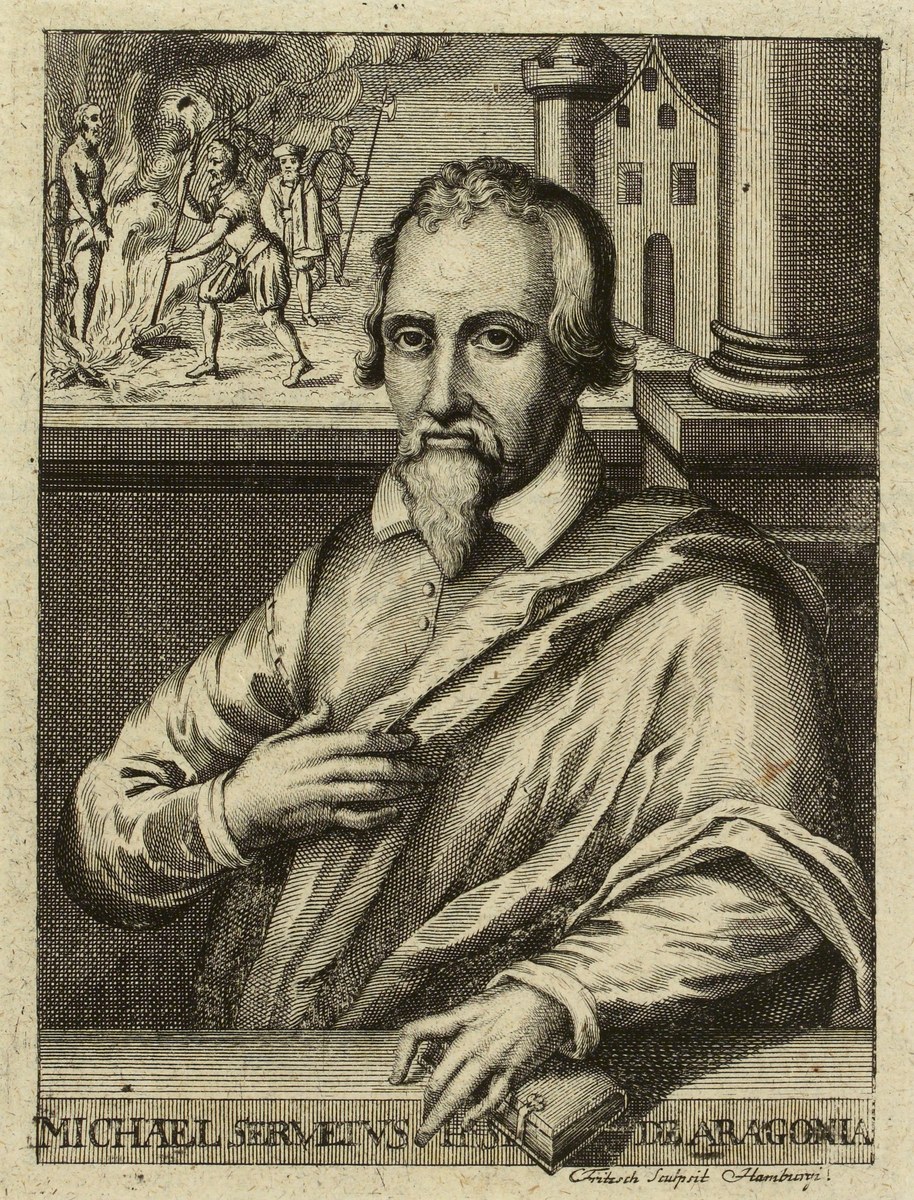
Christian-Friedrich Fritzsch, 18th century, Musee Carnavalet - Histoire de Paris / Paris Musees (G.19347), CC0 · Engraving 'Michael Servetus Hisp. de Aragonia', signed 'Fritzsch sculpsit Hamburgi' (Christian-Friedrich Fritzsch, active 1695-1769), 18th century, burin; Musee Carnavalet - Histoire de Paris, inventory G.19347. A later printed portrait made about two centuries after his death, not a portrait from life; the 1911 Britannica says no original likeness is known. Cropped to the plate from the museum image (2037 x 2673 pixels as published on Wikimedia Commons) and downscaled to 914 x 1200 (never enlarged). · CC0 1.0 (Paris Musees item-level mark on the museum's own page; the engraving is also public domain by age)
physician · Early Modern
1511–1553
Not yet included in personality matching — the documented evidence doesn't yet cover enough of the personality model. Everything else on this page is fully available.
Attacked the orthodox doctrine of the Trinity in De Trinitatis erroribus (1531) and again in Christianismi restitutio (1553), writings that Britannica says gave an important stimulus to the emergence of Unitarianism.
Trained in medicine at Paris and later a physician at Vienne, he almost incidentally made known his discovery of the pulmonary circulation of blood in Christianismi restitutio, describing blood passing from the right side of the heart through the lungs.
Condemned as a heretic by Catholic and Protestant authorities, he was burned at Champel near Geneva in 1553; the execution set off a Protestant controversy over the death penalty for heresy and influenced Laelius Socinus.
In 1546 he sent John Calvin the manuscript of his enlarged Christianismi restitutio and wrote repeatedly insisting on more radical views, and in 1553 he printed thirty of his letters to Calvin in the published book.
This is consistent with a willingness to press a dispute with the most prominent reformer of his day rather than avoid it, though he was far less open with the authorities who could punish him. Conflict Tolerance
Studying medicine at Paris in 1536-38 he assisted in anatomical dissection, and the Unitarian dictionary says he concluded that the blood was transformed in the lungs rather than in the heart, departing from Galen.
This is consistent with a readiness to depart from the accepted authority of his field on the strength of his own reasoning, as he did in theology. Independent Thinking
In 1530, after accompanying his patron Juan de Quintana to the coronation of Charles V at Bologna, he was distressed by papal ostentation, left his patron and went to Basel and Strasbourg to meet Reformation leaders, where he published his first book on the Trinity in 1531.
This is consistent with a decision to break from a secure patron and an established path in order to pursue his own theological views. Independent Thinking
People whose overall profiles resemble theirs.


Not a rival — a different profile shape worth a look.