Yayoi Kusama
94% Profile Match
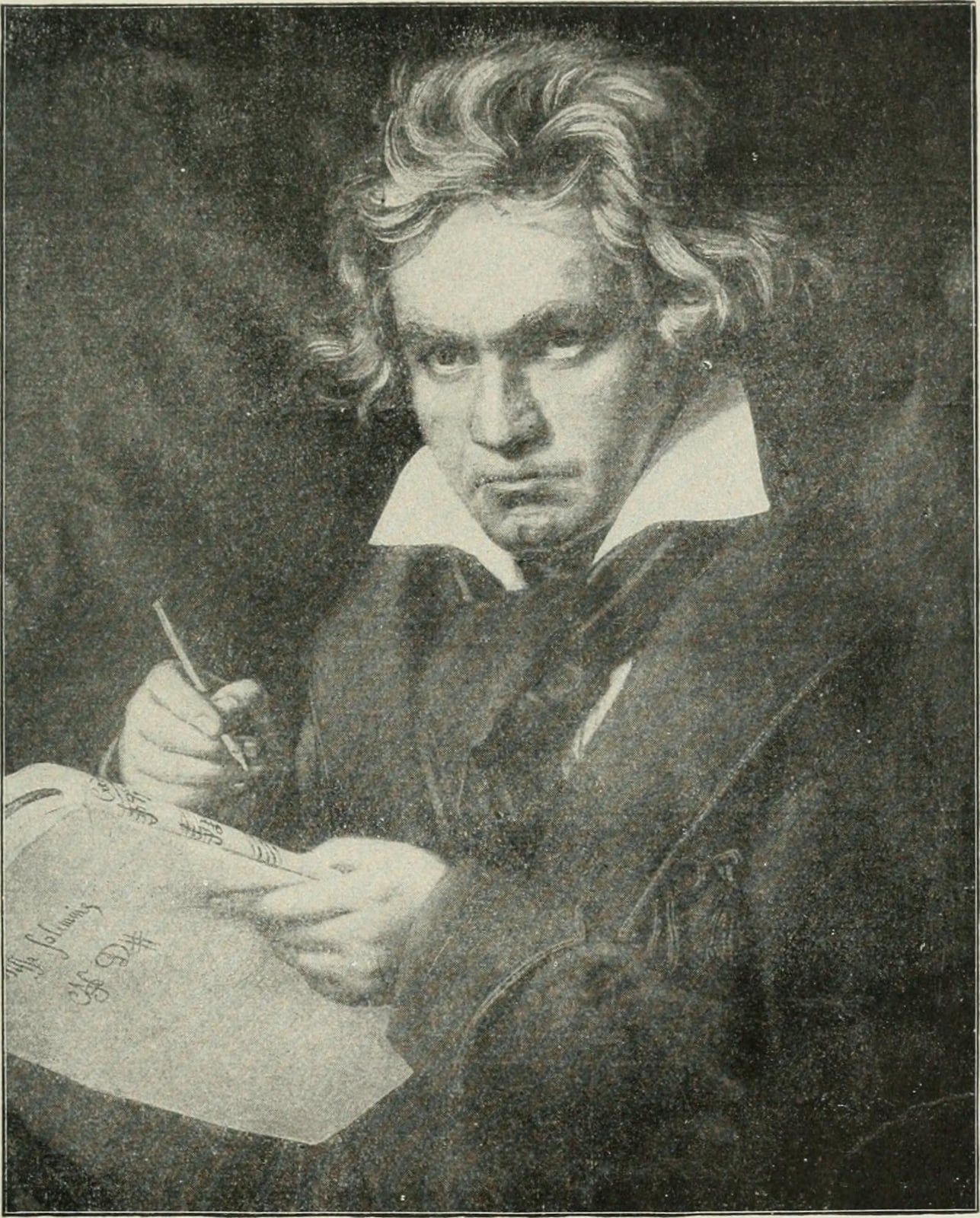
Painted from life by Joseph Karl Stieler, 1820, Beethoven-Haus, Bonn, Public Domain · Wikimedia Commons (hosted locally by this app as a resized/compressed derivative; see licenseUrl for the full-resolution original) · Public Domain
1770 — Born in Bonn.
1792 — Moved permanently to Vienna in November 1792, shortly before learning of his father's death.
1802 — Secluded himself at Heiligenstadt in 1802 and wrote the private letter later known as the Heiligenstadt Testament.
1803–1808 — Composed his middle-period "heroic" works, including the Third and Fifth Symphonies.
1809 — Negotiated an annual pension from three aristocratic patrons in 1809 to remain in Vienna.
1824–1827 — Completed and premiered his Ninth Symphony in 1824, after losing nearly all his hearing; died in Vienna in 1827.
Composed nine symphonies, thirty-two piano sonatas, and numerous chamber and choral works across roughly three creative periods, including the Third ("Eroica") and Fifth Symphonies and the late Ninth Symphony (1824) — the last completed and premiered after he had lost nearly all of his hearing — output regarded as a central pivot between the Classical and Romantic eras of Western music.
His middle-period "heroic" works — including the Third Symphony (1803–04), Fifth Symphony (1808), and the opera Fidelio (premiered 1805) — expanded the emotional scale and formal ambition of instrumental music beyond the conventions he had inherited from Haydn and Mozart, and became a starting point later composers drew on for Romantic-era orchestral writing.
On medical advice, secluded himself at Heiligenstadt, outside Vienna, from April to October 1802, where he composed a private letter to his brothers — never sent, discovered only after his death — recording his despair over his advancing deafness and thoughts of suicide, alongside his resolution to continue composing.
In 1809, facing a court appointment offer from Napoleon's brother Jérôme Bonaparte that would have taken him from Vienna, personally negotiated an annual pension of 4,000 florins from three aristocratic patrons — Archduke Rudolph, Prince Kinsky, and Prince Lobkowitz — to remain in the city. The arrangement proved unreliable in practice (Kinsky died in 1812, Lobkowitz went bankrupt in 1811), and Beethoven had to pursue legal action to recover part of what he was owed.
Beethoven's hearing loss, which he told a friend in 1815 had begun as early as 1798, progressed over roughly two decades until, by his own account, he could still distinguish only low tones and sudden loud sounds. He continued composing major works — completing and conducting the premiere of his Ninth Symphony in 1824 — through methods adapted to the loss, rather than by continuing to rely on hearing performances directly.
This is consistent with the profile's high resourcefulness score: a genuine constraint met by substituting his method of composing, not simply persistence despite adversity in the abstract. Resourcefulness
Beethoven's expansion of symphonic and chamber forms, sustained through the loss of the sense most central to his profession, is often cited as one of the most striking examples in Western art of work outlasting personal circumstance. His symphonies, sonatas, and quartets remain core orchestral and chamber repertoire two centuries later.
People whose overall profiles resemble theirs.