Sequoyah
94% Profile Match
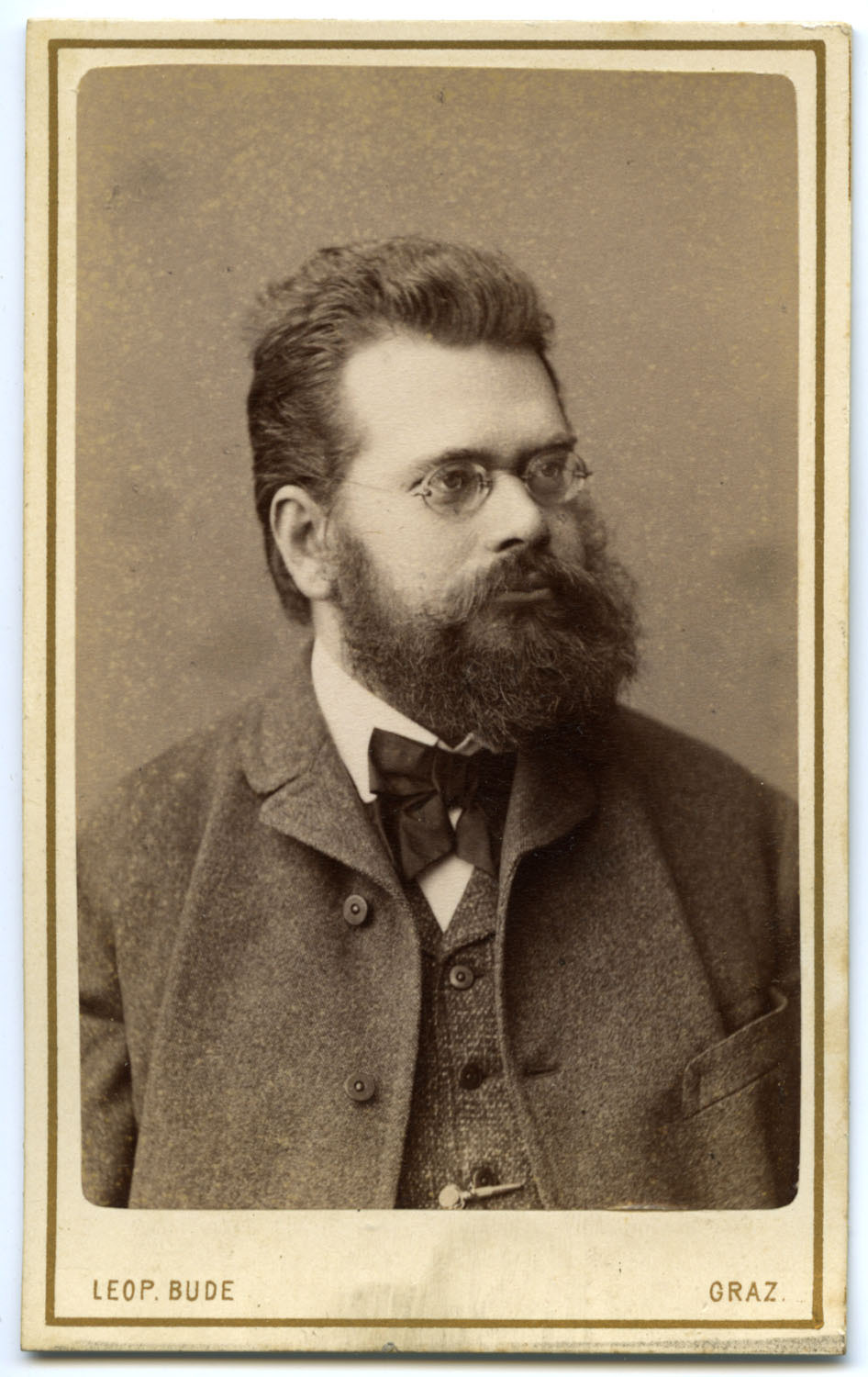
Photograph by the Atelier Leopold Bude, Graz, taken between 1870 and 1885; collection of the Kunstbibliothek, Staatliche Museen zu Berlin · Carte-de-visite photograph from the Atelier Leopold Bude, Graz, Staatliche Museen zu Berlin, Kunstbibliothek (object 1992,32/003a.066), catalogued with the title 'Ludwig Bolzmann' · Public domain (marked Public Domain Mark 1.0 by the holding museum; photographer's studio active in the 19th century)
physicist · 19th Century
1844–1906
Not yet included in personality matching — the documented evidence doesn't yet cover enough of the personality model. Everything else on this page is fully available.
In 1872 Boltzmann published 'Further studies on the thermal equilibrium of gas molecules' in the Vienna Academy proceedings. The paper contains the equation now named after him and the H-theorem, with which he described how a gas moves towards the velocity distribution Maxwell had postulated in 1860 and how its entropy increases. Uffink calls it one of his most important papers.
In 1877 he published 'On the relation between the second law of the mechanical theory of heat and the calculus of probabilities'. Equilibrium is there treated as the most probable macrostate, the one realised by the largest number of microstates, so that evolution towards equilibrium goes from less probable to more probable states. Planck later wrote the entropy relation as S = k log W; the Stanford Encyclopedia notes that Boltzmann never wrote it down in that form, and that scholars still disagree about how far the paper escapes the reversibility objection.
His two-volume Vorlesungen ueber Gastheorie (Lectures on Gas Theory), published in 1896 and 1898, grew out of lectures at Munich and Vienna. In the preface he says he set out chiefly to present the work of Clausius and Maxwell clearly, gave his own papers some space, and learned much from the discussions at the 1894 Oxford meeting of the British Association and the letters in Nature that followed. Uffink counts the book among the main events of his 1890s work on statistical physics.
In 1879 Josef Stefan had stated empirically that the energy radiated by a hot body rises with the fourth power of its temperature; in 1884 Boltzmann showed that the law follows from thermodynamics, which is why it bears both names. Earlier, in Graz in 1873-74, he had carried out seven delicate experiments on dielectrics, mostly in an unheated top-floor room, to test predictions of Maxwell's electromagnetic theory, and Ernst Mach judged him an experimenter hardly to be surpassed.
At the 1895 meeting of German scientists in Luebeck, Wilhelm Ostwald argued that the irreversibility of natural processes shows that they cannot be described by mechanical equations. Boltzmann had written to Ostwald the previous June that he meant to provoke a debate in the manner of the British Association; Felix Klein supported him. Arnold Sommerfeld, who was present, compared the exchange to a bull against a supple bullfighter in which the bull won, and wrote that the young mathematicians were on Boltzmann's side.
Setting out to provoke an open public debate with a leading opponent is consistent with comfort in confrontation. The same sources report that Mach and others found his polemics too sharp, so the stance cut both ways. Conflict Tolerance
Hoeflechner reports that when Boltzmann went to Heidelberg in 1870 and to Berlin in 1871, although already a full professor, to continue his studies with Kirchhoff and Helmholtz, he pointed out mistakes in their work at the first meeting, which caused a stir among the local audience. The account is a historian's summary without a quoted letter.
Telling two of the leading physicists of the day about errors in their work at a first meeting is consistent with intellectual independence from authority, as reported by one historian. Independent Thinking
In 1876 his former teacher and friend Josef Loschmidt objected that a purely mechanical theorem could never yield a one-way, time-asymmetric result such as the H-theorem claimed to give for the second law. According to Uffink, Boltzmann rethought the basis of his approach and in 1877 produced a conceptually different, probability-based analysis; whether it avoids the objection is still disputed. In the following years he returned to ensembles and the ergodic hypothesis, and in 1895 he stated that his theorem and the second law were only statements of probability.
Rebuilding the argument after a colleague's objection, instead of only defending it, is consistent with a willingness to revise a position under criticism, even though his later replies to critics such as Zermelo were described as sarcastic. Belief Updating
People whose overall profiles resemble theirs.



Not a rival — a different profile shape worth a look.