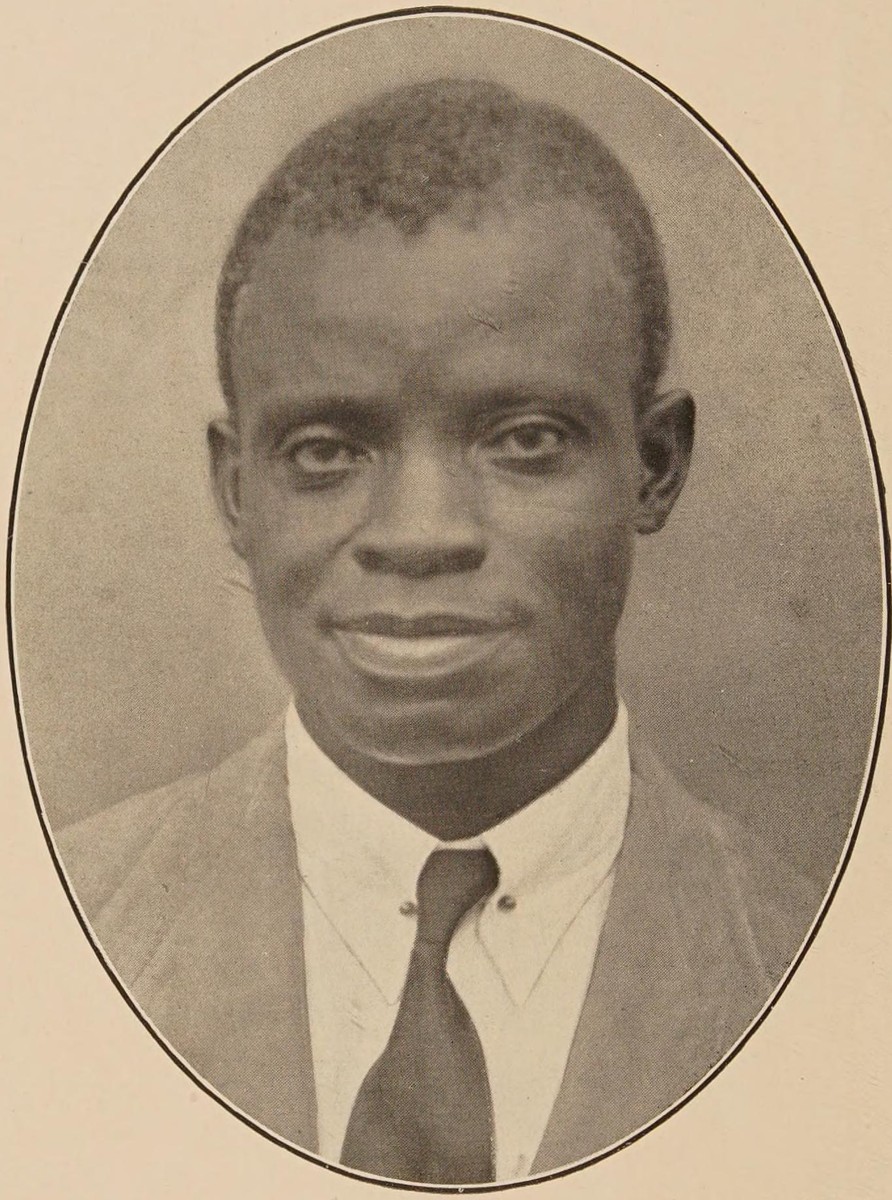

Photograph credited to Albert Dennis, reproduced as the frontispiece of Edwin W. Smith, Aggrey of Africa (1929); scan via the Internet Archive · Photograph of James Emman Kwegyir Aggrey printed as the frontispiece of Edwin W. Smith, Aggrey of Africa: A Study in Black and White (Doubleday, Doran and Company, New York, first published May 1929), with the printed credit 'Photo by Albert Dennis' and a facsimile of his signature; taken from the Internet Archive page scan of that book (original page image 1774 x 2926 pixels), cropped to the oval photograph and downscaled to 892 x 1200 pixels, no upscaling. Basis: the photograph was published in 1929, so under United States law it is in the public domain (95 years from publication ended on 31 December 2024); rights outside the United States, the photographer's dates and the photograph's date of sitting were not established. The Commons file suggested by the lead (a Columbia finding-aid picture of unknown author, dated by an uploader's guess to 1917) was not used. · Public domain in the United States (published 1929)
teacher · 20th Century
James Emman Kwegyir Aggrey
1875–1927
Known For
Not yet included in personality matching — the documented evidence doesn't yet cover enough of the personality model. Everything else on this page is fully available.
Trait Constellation
Key Achievements
A Gold Coast-born educator, he was the only African member of the Phelps-Stokes commissions that toured Africa to study education (1920 and 1924), and in late 1924 he joined the staff of Achimota College on the Gold Coast, becoming its assistant vice-principal.
After graduating B.A. from Livingstone College in North Carolina in 1902 he stayed on its faculty as registrar and teacher of English, sociology and economics, while working toward a doctorate at Columbia University.
He endorsed A. G. Fraser as Achimota's principal, and in 1925 went to London to confer with the Colonial Office advisory committee on extending the college to include girls.
Moments That Reveal Them
At Livingstone College he called the roll himself at eight o'clock each morning and was known as a stickler for punctuality; students who tried to catch him late never succeeded.
This is consistent with a regular, self-imposed routine in his teaching, as one admiring biography describes it. Discipline
At a Student Christian Movement conference in England in 1925, his Sunday address to some six or seven hundred students was followed by so many questions that, an observer says, it barely finished by midnight.
This is consistent with an ability to hold and engage a large student audience, as reported by admiring witnesses. Persuasiveness
Turning Points
In early 1924, with offers on the table from Achimota, Fort Hare and the Nigerian government, he told J. H. Oldham his heart was in the Gold Coast and endorsed Fraser as principal, and in late 1924 he returned to the Gold Coast as senior staff of Achimota.
This is consistent with choosing to commit to a shared institution-building effort in his home country. Collaboration
Similar People
People whose overall profiles resemble theirs.


Maimonides

Confucius

Warren Buffett

Mahatma Gandhi

Charles Darwin
Opposite Profile
Not a rival — a different profile shape worth a look.
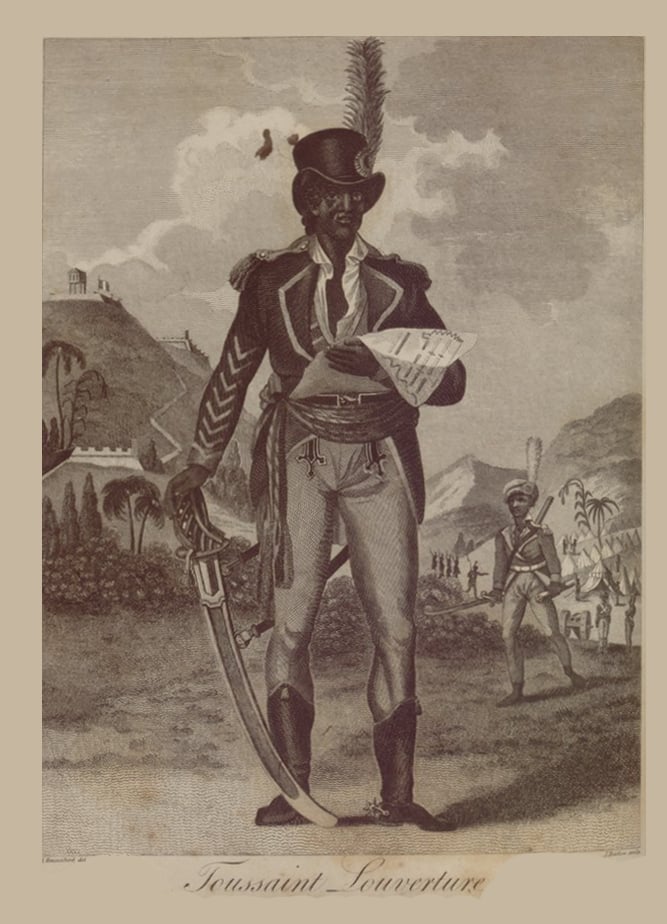
Toussaint Louverture
Sources
- James Emman Kwegyir Aggrey (Q1679925), verified live via the Wikidata API (2026-10-31): English description 'Gold Coast-born intellectual, missionary, and teacher (1875-1927)', born 1875-10-18, died 1927-07-30, no Korean label. Orientation only; not used as support for any row.
- Mark R. Lipschutz and R. Kent Rasmussen, 'Aggrey, James Emman Kwegyir (1875-1927)', Dictionary of African Historical Biography, 2nd edition (University of California Press, 1986), reproduced with permission by the Dictionary of African Christian Biography at Boston University, read in full: Wesleyan schooling and teaching in mission schools before 1898, B.A. at Livingstone College in 1902, teaching on its faculty, doctoral work at Columbia, membership of the Phelps-Stokes education commissions (tours of 1920 and 1924, the only African member), senior staff of Achimota College from late 1924, sudden death in July 1927. CANONICAL SIGNIFICANCE SOURCE (Britannica returned HTTP 403). An independent scholarly dictionary entry; it notes that his long absence from Ghana caused difficulties and offers no other critical assessment.
- Edwin W. Smith, 'Aggrey of Africa: A Study in Black and White' (Doubleday, Doran and Company, New York, 1929; Internet Archive scan, full text read in part), a biography written for the Phelps-Stokes trustees from his letters, his widow and colleagues: his schooling, his student years and professorship at Livingstone College (registrar, classes in English, sociology and economics), the two commissions, and the genesis of Achimota, including his recommendation of A. G. Fraser as principal and his appointment as assistant vice-principal. The author says he tried not to paint an idealised picture, but the book is admiring and much of its testimony comes from friends; it also records the 'running fire of black criticism' he met from radical Africans at one meeting.
- Karen Sotiropoulos, 'James and Rose Aggrey and the Black Atlantic Gestations of African Nationalism', International Journal of African Historical Studies 53(2), 2020, pp. 239-264, abstract read on the Cleveland State University repository page (full text not opened): calls him the father of African education and the 'Booker T. Washington of Africa', says he influenced later nationalists, and reads his vision of cooperation on the Phelps-Stokes tour through his letters to his wife. A modern scholarly, nuancing account; abstract only, so used for context and for the political reading that is not scored.
- South African History Online, 'James Emmanuel Kwegyir Aggrey' (first published 17 February 2011, updated 20 June 2018), read: born in Anamabu on 18 October 1875, spent three months in South Africa in 1921 as a member of the Phelps-Stokes Commission, a prime mover in founding the Johannesburg Joint Council of Europeans and Africans, and with a race-relations outlook of compromise and cooperation that reinforced the tendency of African National Congress leaders to join interracial councils. An independent history archive; its race-relations material is political context and is not scored.