Yayoi Kusama
92% Profile Match
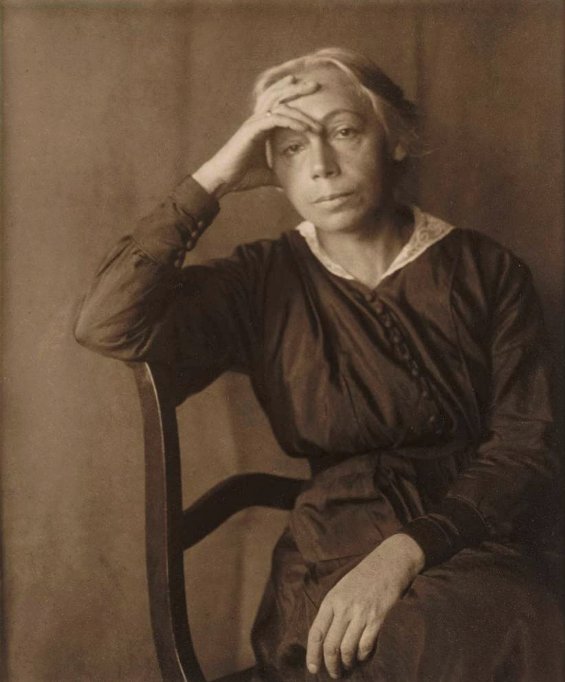
Hugo Erfurth, 1917; Kupferstich-Kabinett, Staatliche Kunstsammlungen Dresden (via Deutsche Digitale Bibliothek / Wikimedia Commons) · Hugo Erfurth, "Bildnis Käthe Kollwitz", 1917, photograph 29.4 x 24.3 cm, Kupferstich-Kabinett, Staatliche Kunstsammlungen Dresden, via Deutsche Digitale Bibliothek and Wikimedia Commons file "1917 Foto Käthe Kollwitz.png" (original 565 x 682 px; converted PNG to JPEG at the same size, not upscaled) · Public domain (Hugo Erfurth died 1948; published before 1 January 1931, so public domain in the United States, and the author term has expired in the country of origin; Commons template PD-old-auto-expired|1948)
artist · 20th Century
1867–1945
Not yet included in personality matching — the documented evidence doesn't yet cover enough of the personality model. Everything else on this page is fully available.
Kollwitz made A Weavers' Revolt, six prints (three lithographs and three etchings) begun in 1893 after she saw the premiere of Gerhart Hauptmann's play The Weavers and finished in 1897. Shown at the Great Berlin Art Exhibition in 1898, the cycle brought her breakthrough; the jury proposed a medal for it and Kaiser Wilhelm II rejected the proposal. ARTinWORDS notes that the cycle depicts a fictional revolt set in the present, not the historical 1844 uprising or the play's plot.
Peasants' War, a cycle of seven etchings made between 1902 and 1908, was inspired by Wilhelm Zimmermann's history of the 1524-25 Peasants' War. The Kollwitz Museum Köln records that she first designed it as colour lithographs, and that it was funded by the Association for Historical Art in Dresden after she applied in 1904. She received the Villa Romana Prize in 1907. Art in America calls the cycle arguably her greatest in any medium.
In the early 1920s Kollwitz made War, a cycle of seven woodcuts, after taking up the woodcut medium under the influence of Ernst Barlach's prints. The Kollwitz Museum Köln describes it as her treatment of what she had experienced and understood during the First World War. Five of the seven prints, Art in America notes, concern bereaved parents.
The Grieving Parents is a pair of kneeling granite figures, a mother and a father, installed in 1932 at the war cemetery at Roggevelde near Diksmuide, Belgium, where her son Peter was buried; the cemetery was later merged into Vladslo, taking the figures with it. She had planned a memorial since 1914, dropped the first design in 1919 and drew up a new one in 1924. The granite figures were carved by August Rhades and Fritz Diederich from her plaster models.
In 1937-38 Kollwitz made the small sculpture Pietà (Mother with her Dead Son). The Käthe-Kollwitz-Museum Berlin records that an enlarged replica made by the sculptor Harald Haacke stands in the Neue Wache in Berlin; the original is a late work among her three small sculptures of those years.
In September 1909, when she began her first multi-figure sculpture, a mother with a dead child, Kollwitz showed the first result to the sculptor Alexander Oppler, whom she knew from Munich. ARTinWORDS reports that he pointed out the poor construction of the work and that this spurred her ambition. In 1904 she had already spent two months in the sculpture class of the Académie Julian in Paris and visited Rodin's studios.
Going to a critical colleague with unfinished work, and learning the craft in a class years earlier, is consistent with a strong drive to master a new medium. Mastery Orientation
Alfred Kuhn, a contemporary critic, records that the first plate of the Peasants' War, the ploughmen, existed in earlier versions in which a woman guided the plough. In the 1906 state she had been removed and only two men straining into the harness remain. The Art in America critic adds that she reworked another plate, Black Anna, many times and replaced an earlier flying nude figure with an earthbound one.
Cutting a figure and redrawing others across successive states is consistent with a perfectionist approach to composition; the sources describe the changes but not her stated reasons. Perfectionism
Around 1920, impressed by Ernst Barlach's woodcuts, Kollwitz made one of her first woodcuts, a memorial print of 1920, after more than two decades working mainly in etching and lithography. Art in America says the medium better suited her need for directness, and that she had always found etching slow and technical. The woodcut became the medium of her cycle War.
Changing the main medium after two decades, because another artist's work showed what it could do, is consistent with a willingness to experiment with technique. Experimentation
People whose overall profiles resemble theirs.
Not a rival — a different profile shape worth a look.