Rosalind Franklin
89% Profile Match
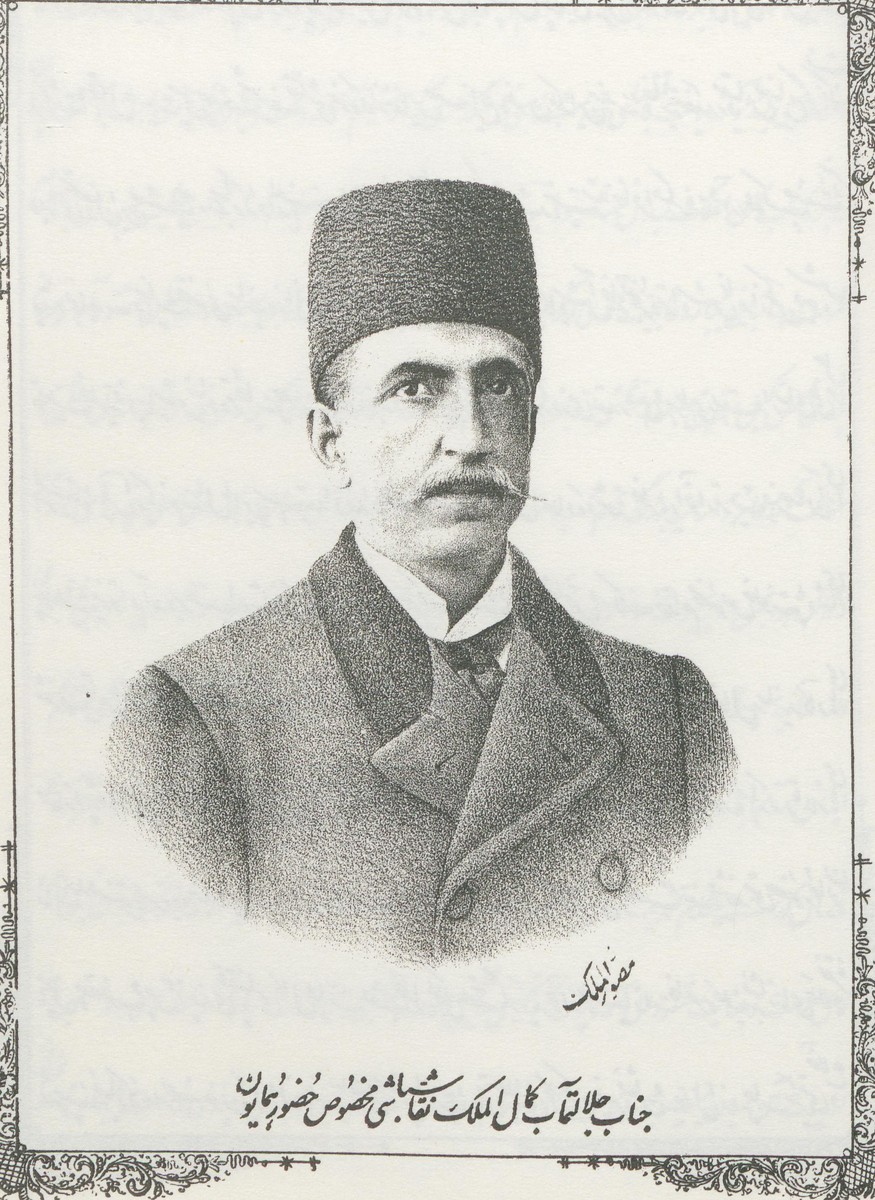
Portrait lithograph by Mehdi Mossavar al-Molk, Sharafat no. 60 (1902), digitised by the Universitats- und Landesbibliothek Bonn, Public Domain Mark 1.0, via Wikimedia Commons · Portrait lithograph of Kamal-ol-Molk, signed by Mehdi Mossavar al-Molk, printed as the full-page frontispiece of the Tehran periodical Sharafat (Sherafat) no. 60, Ramadan 1319 AH (about December 1901 to January 1902), with the printed caption naming 'Kamal-ol-Molk, naqqashbashi (chief painter) to His Majesty's presence'; Encyclopaedia Iranica independently records that Sharafat no. 60 (1902) carried his portrait drawn by Mossavar al-Molk. A depiction made in his lifetime by another artist, not a documented sitting or photograph, so recorded as a historical depiction. Rights basis: the holder of the digitised periodical, the Universitats- und Landesbibliothek Bonn (record 7070386, Translatio project), states in its METS metadata that the work is under Public Domain Mark 1.0; independent of that, the print was published in Tehran in 1902, i.e. before 1931, so it is in the public domain in the United States by age (as far as I could establish Iran was not a Berne or UCC partner, so no URAA restoration is expected), and nothing in the record claims a conflicting copyright. Caveats: the Commons file (File:Sharafat, Issue 60, p. 01.png, 4096 x 5120 pixels, originally a scan of a bound volume that may be a later reprint of the 1900s original) carries a PD-Iran tag and the library's PD mark; I could not open the library's live viewer (it served a browser-verification page), so the rights statement was read from the library's OAI-PMH METS record instead; the creator Mossavar al-Molk's death date was not established. The image used here is a crop of the framed portrait and its caption from that page (the surrounding book margins and the facing page removed), downscaled from a 2100 x 2880 crop to 875 x 1200 pixels, never upscaled. · Public domain (published 1902; Public Domain Mark 1.0 by the digitising library)
painter · 19th Century
1848–1940
Not yet included in personality matching — the documented evidence doesn't yet cover enough of the personality model. Everything else on this page is fully available.
Court painter to the Qajar shahs, granted the title Kamal-al-Molk in 1894, he became the leading Iranian exponent of European academic naturalism, and his Hall of Mirrors painting of the 1880s-90s is his best-known work.
In 1911 he founded the Academy of Fine Arts (Madrasa-ye Sanaye Mostazrafa) in Tehran, directed it for about a decade, and trained a generation of painters who formed the school named after him.
After studying the old masters in Florence and Paris (1898-1901) he turned toward urban scenes and ordinary people's lives, and his naturalism dominated Iranian painting for a generation, while modernist critics later said it discouraged a more authentic Persian modern art.
Offered his choice of reward for a royal commission in 1898, he asked to go to Europe to improve his technical mastery, and spent about three years in Florence and Paris copying works such as Rembrandt's Saint Matthew and Titian's Entombment.
This is consistent with a priority on technical mastery over court rewards. Mastery Orientation
The Hall of Mirrors painting commissioned by Naser al-Din Shah occupied him for almost five years, and it is noted for the exactness of its architecture, reflections, carpet and furnishings.
This is consistent with sustained, exacting attention to detail, though the exactness is read from the finished work. Detail Orientation
In 1911, with the education minister's help, he gained a state site and budget for the Academy of Fine Arts, moved into a room by its gate, shared lunches with students and paid stipends to needy ones from his own salary.
This is consistent with a motive to build an institution and train others, though the personal details come from friends' accounts. Impact Motivation
People whose overall profiles resemble theirs.