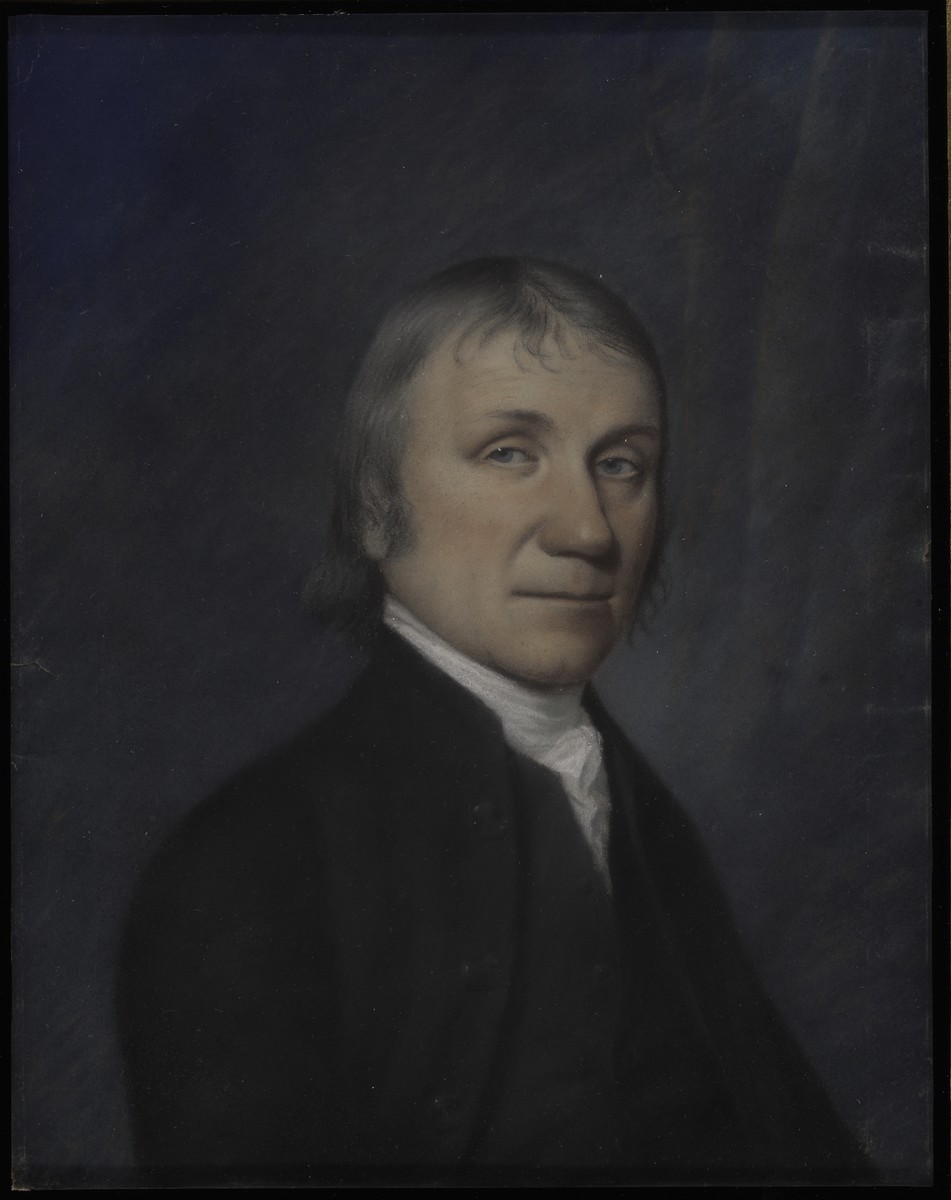
James Sharples, Joseph Priestley, 1797, pastel on paper, National Portrait Gallery, Smithsonian Institution, NPG.77.160 (CC0) · Wikimedia Commons, 'Joseph Priestley by James Sharples, 1797, pastel on paper, from the National Portrait Gallery - NPG-NPG 77 160.jpg' -- pastel on paper by James Sharples (c. 1751-1811), 1797, drawn from life in America, National Portrait Gallery, Smithsonian Institution (NPG.77.160); the museum's digital image is released under CC0 (Smithsonian Open Access). Original Commons file 5563 x 6385 pixels includes the museum frame and mat; cropped to the pastel itself (2710 x 3420 pixels) and downscaled once to 951 x 1200 (never upscaled). · CC0 1.0 (Smithsonian Open Access); work in the public domain
chemist · Early Modern
Joseph Priestley
1733–1804
Known For
Not yet included in personality matching — the documented evidence doesn't yet cover enough of the personality model. Everything else on this page is fully available.
Trait Constellation
Key Achievements
His History and Present State of Electricity (1767) surveyed the field and added his own experiments, and it led to his election to the Royal Society.
He identified at least eight new gases, devised a way to make carbonated water, and set out hundreds of experiments in the six-volume Experiments and Observations on Different Kinds of Air (1774-1786).
In 1774 he isolated the gas now called oxygen, which he named dephlogisticated air, and showed it to Lavoisier, who built the new chemistry on it.
Moments That Reveal Them
After finding that a candle burned strongly in the new air from heated mercuric oxide, he put mice in it and then breathed it himself, noting that only two mice and he had so far had the privilege.
This is consistent with a researcher who followed an unexpected result with further tests on whatever he could try, including himself. Curiosity
In 1797, when the scientific community had dismissed phlogiston, he published The Doctrine of Phlogiston Established, and he still held the view when he died.
This is consistent with holding a framework against the weight of contemporary evidence, a stance historians read as both tenacious and costly. Belief Updating
Turning Points
After Lavoisier's Traite of 1789, the Hexagon article says, Priestley's science turned from new discoveries to rearguard actions defending phlogiston.
This is consistent with a researcher whose output shifted from exploring new phenomena to defending an established position once the field moved against him. Belief Updating
Similar People
People whose overall profiles resemble theirs.

Louis Pasteur

Louis Armstrong

Leonardo da Vinci

Abraham Lincoln

Galileo Galilei
Sources
- Joseph Priestley (Q159636) -- verified live via the Wikidata API (2026-10-10): English label 'Joseph Priestley', description 'English chemist, theologian, educator, and political theorist (1733-1804)', born 13 March 1733 (a second 24 March value reflects the calendar change), died 6 February 1804, Korean label present. Orientation only; not used as support for any row.
- Science History Institute, 'Joseph Priestley', Scientific Biographies (updated 2026 by John Powers) -- INDEPENDENT institutional history-of-science biography. Covers the history of electricity (1767), the identification of at least eight new airs, the nitrous air test, early experiments on plants refreshing air, the six-volume Experiments and Observations on Different Kinds of Air, the 1774 isolation of oxygen shown to Lavoisier, and his long defence of phlogiston against the new chemistry. Read in full; its sections on religion, dissent and the Birmingham riot were not used as personality evidence.
- James L. Marshall and Virginia R. Marshall, 'Joseph Priestley', The Hexagon of Alpha Chi Sigma (University of North Texas chemists), Summer 2005, pp. 28-33 -- secondary biographical article drawing on Schofield, Partington, Thomson and Davis; used for the electricity book, brewery-prompted gas studies, new gases found at Bowood, the oxygen visit to Lavoisier, the plant and blood experiments, and, most usefully, the scholarly assessments of why he clung to phlogiston (Partington's critical reading, Schofield's balanced one, Davis's view that his logic was self-consistent). Some of its general statements about his manner and reactions are the authors' impressions and were not used. Read in full.
- 'A Breath of Immoral Air: Joseph Priestley and the Discovery of Oxygen', Chapter 1 of a Wiley popular-science book on scientific breakthroughs (sample chapter PDF, John Wiley and Sons; author not shown on the pages read) -- popular narrative that quotes Priestley's own accounts of the 1774 experiment, the mice and the tasting of the new air, the soda-water work, the trough, and the later phlogiston pamphlet of 1797; also gives the Lavoisier and Scheele background. Popular-science level and partly dependent on Priestley's own words; used for dated experimental episodes cross-checked with the Institute and Hexagon articles. Read in full.
- Joseph Priestley, 'Experiments and Observations on Different Kinds of Air', volume I (1774; Project Gutenberg text of the London first edition) -- SELF source used only as work evidence: the Preface (immediate publication of results, openly stating his real views and mistakes, doubts multiplying with discoveries), the finding that vegetation restores air spoiled by burning candles, and the failed ice-and-fixed-air experiment. The volume containing the oxygen experiments (volume II) was not opened. Never used as sole support for a behavioural claim.
- NEH 'Humanities' magazine (Spring 2024, vol. 45 no. 2), 'Joseph Priestley Created Revolutionary Maps of Time' -- journalistic essay quoting Rosenberg and Grafton and Priestley's biographer Robert Schofield on his 1765 Chart of Biography, his output of roughly 150-200 publications, and Schofield's judgement that contemporaries were more profound and analytic but that Priestley made systematic and operational what had been fragmentary. Read in full; the passages on the digital-humanities project and on politics were not used.
- Linda Hall Library, 'Scientist of the Day: Joseph Priestley', 14 July 2015 (William B. Ashworth Jr., University of Missouri-Kansas City) -- short historian's entry noting his books on electricity, optics and gases and recording Georges Cuvier's eulogy line that he was a father of modern chemistry who refused to acknowledge his daughter; also mentions the Rembrandt Peale portrait. Read in full (very short). The Birmingham riot context was not used.
- National Portrait Gallery, Smithsonian Institution, object NPG.77.160, 'Joseph Priestley' by James Sharples, 1797, pastel on paper, sight size 23 x 17.8 cm (record read through the Smithsonian Open Access API, which marks the image CC0; the museum's web page returned a server error and a 403) -- used only to check the portrait's rights. Not used for scoring.