Jane Goodall
93% Profile Match
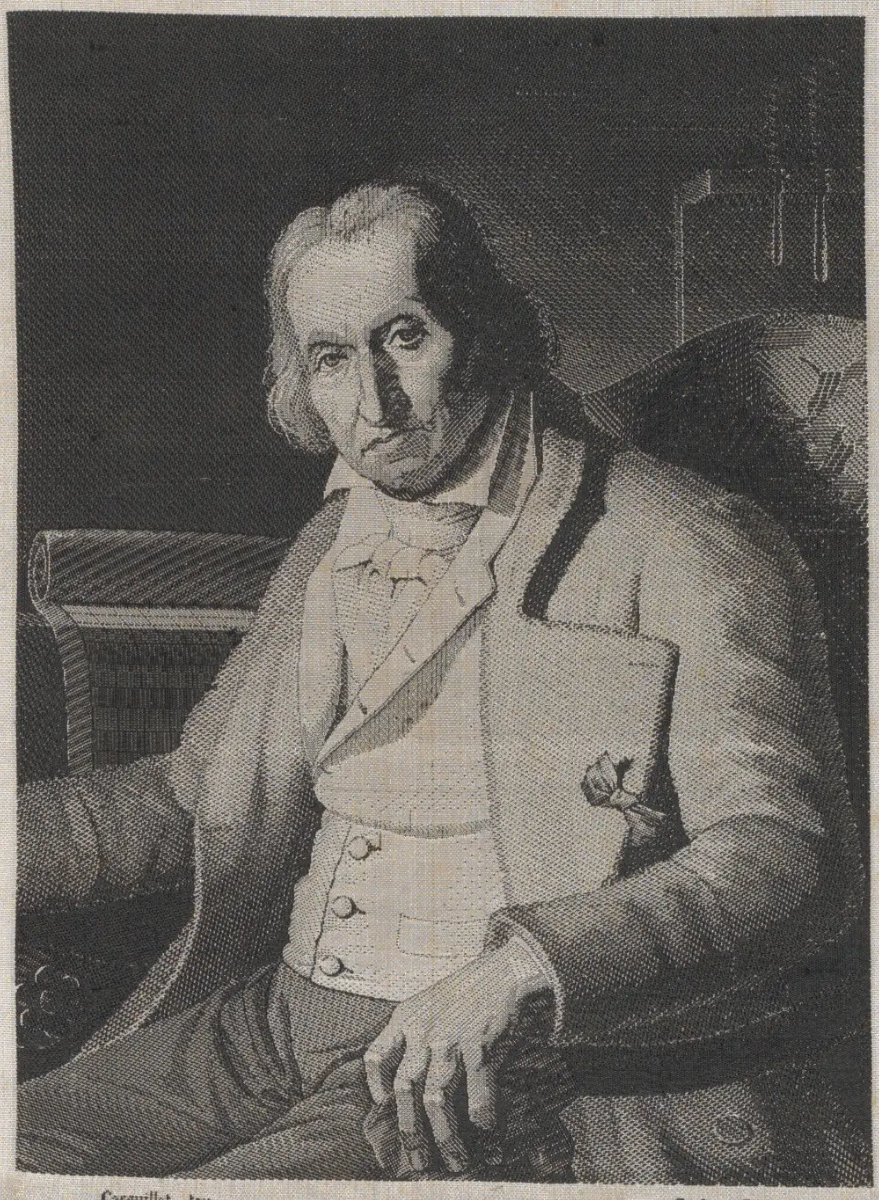
Francois Carquillat for Didier Petit et Cie, after Jean Claude Bonnefond, c. 1870-1880, Rijksmuseum, Amsterdam (RP-F-2013-22-61), public domain · Woven silk portrait 'A la memoire de J.M. Jacquard', woven by Francois Carquillat for Didier Petit et Cie after a print by Jean Claude Bonnefond (whose painted portrait was made for the city of Lyon in 1831), mounted in a nineteenth-century photograph album and catalogued by the Rijksmuseum, Amsterdam, as object RP-F-2013-22-61, dated c. 1870-c. 1880; the museum titles it 'Woven portrait of the weaver and merchant J.M. Jacquard'. A posthumous woven copy, not a portrait from life. Digital master 3420 x 4106 pixels; this copy is cropped to the woven picture and downscaled to 879 x 1200 (never enlarged). · Public Domain Mark 1.0 (Rijksmuseum item-level statement; the woven portrait and its sources are also public domain by age)
inventor · 19th Century
1752–1834
Not yet included in personality matching — the documented evidence doesn't yet cover enough of the personality model. Everything else on this page is fully available.
In 1804-05 he introduced the Jacquard mechanism, which uses interchangeable punched cards to control a loom's warp threads so that any desired pattern can be woven automatically.
He built on Vaucanson's earlier punched-card loom and an 1801 loom he patented and showed in Paris, and despite Lyon weavers burning machines and attacking him, 11,000 of his looms were in use in France by 1812.
Charles Babbage adopted its punched cards as the input and output medium for his proposed Analytical Engine, and Herman Hollerith later used punched cards for census data.
In 1801 he exhibited an automatic loom at the Paris industrial exhibition and took out a French patent for it on 23 December of that year.
This is consistent with testing his machine in public and securing it before further development. Experimentation
Lyon silk weavers who feared for their jobs burned machines and attacked Jacquard, yet the loom came into general use and 11,000 were running in France by 1812.
This is consistent with sticking with an invention despite open hostility, though the sources say little about his own response. Persistence
In Paris he was attached to the Conservatoire des Arts et Metiers, where he studied Vaucanson's earlier loom and in 1804-05 perfected the punched-card mechanism that bears his name, although History of Information notes the account of the Vaucanson study is unchecked.
This is consistent with refining a machine step by step by studying earlier designs. Experimentation
People whose overall profiles resemble theirs.