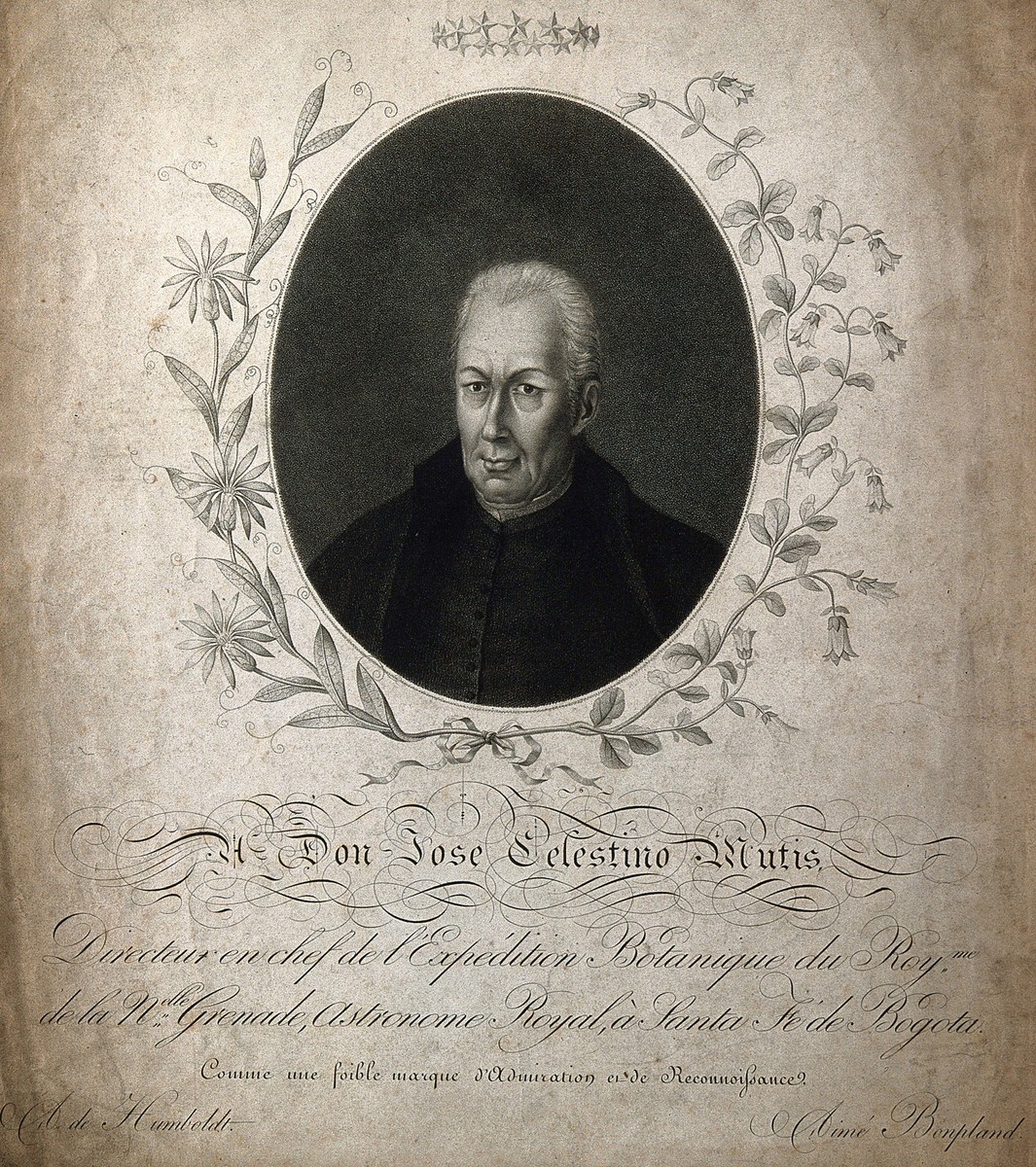
Dedication portrait of José Celestino Mutis from A. von Humboldt and A. Bonpland, stipple engraving, engraver and date not recorded, Wellcome Collection, public domain · Stipple engraving of José Celestino Mutis in an oval with flowers, lettered with the dedication 'A Don Jose Celestino Mutis, Directeur en chef de l'Expedition Botanique du Roy.me de la N.lle Grenade, Astronome Royal, à Santa Fé de Bogota. Comme une foible marque d'Admiration et de Reconnoissance.' and signed 'A. de Humboldt' and 'Aimé Bonpland'; Wellcome Collection (reference 7116i), whose catalogue lists the dedicators as Humboldt and Bonpland, gives no engraver or date, and rates the digital image Public Domain Mark. The print is the dedication plate that Humboldt and Bonpland made for Mutis, who died in 1808, so it is an early nineteenth-century print made by others, not a documented sitting. The file used is the holder's 2,363 x 3,063 pixel image, cropped once to the plate and downscaled to 1,065 x 1,200 pixels; nothing was upscaled. · Public domain (Wellcome Collection Public Domain Mark; early nineteenth-century print)
naturalist · Early Modern
José Celestino Mutis
1732–1808
Known For
Not yet included in personality matching — the documented evidence doesn't yet cover enough of the personality model. Everything else on this page is fully available.
Trait Constellation
Key Achievements
He directed the Royal Botanical Expedition to the New Kingdom of Granada from 1783 until his death in 1808, training its collectors and painters; the expedition produced drawings of about 2,700 plants.
He studied the cinchona (quina) trees of New Granada, distinguishing four officinal species with twenty-four varieties, work that the Catholic Encyclopedia says gives his research lasting importance.
In 1762 he opened the mathematics chair at the Colegio del Rosario, where students read Newton and Copernicus, and through his efforts Bogota's astronomical observatory was built in 1802-03.
Moments That Reveal Them
When he opened the mathematics chair in 1762 he had students read Newton's Principia and Copernicus, and was denounced by Dominicans to the Inquisition commissioner, but the tribunals ruled that Copernicus could not be condemned.
This is consistent with teaching new ideas against local opposition, though the viceroy and Crown backed him. Independent Thinking
On his first arrival in Cartagena in 1760 he recorded in his diary four sharks following the ship and two barracudas whose genus he could not deduce.
This is consistent with an early habit of noting unfamiliar animals and the limits of his own identification. Curiosity
Turning Points
In 1783 Charles III appointed him to lead the botanical expedition, after he had spent years planning a survey of the country's flora, and he settled in Mariquita to direct it.
This is consistent with a long-nurtured plan finally turning into an organised enterprise. Proactive Agency
Similar People
People whose overall profiles resemble theirs.

Gertrude Bell

Ada Lovelace

Carl Jung

Franz Kafka

Benjamin Franklin
Sources
- José Celestino Mutis y Bosio (Q731937), verified live via the Wikidata API (2026-11-06): label 'José Celestino Mutis y Bosio', description 'Spanish mathematician and botanist (1732-1808)', born 6 April 1732, died 11 September 1808, citizen of Spain, many occupations recorded, Korean label 호세 셀레스티노 무티스. Orientation only; not used as support for any row.
- Josef Rompel, 'José Celestino Mutis', The Catholic Encyclopedia (1911; entry read in full on New Advent). CANONICAL SIGNIFICANCE SOURCE: physician to the viceroy of New Granada from 1760, taught mathematics, founded and directed the Bogotá observatory near the end of his life, devoted his energy to the natural history of New Granada, appointed in 1783 leader of the state-founded botanical expedition, trained collectors, painters and engravers and taught Zea, Caldas and Restrepo, studied the cinchona trees (four officinal species and twenty-four varieties), corresponded with Linnaeus, hosted Humboldt and Bonpland in 1801. Critical voice: says he 'never ended his researches' and published almost nothing in his lifetime, and that his manuscripts lay unnoticed in Madrid; also defends him against critics who treat him as an unimportant amateur. A century-old reference article by a Catholic scholar.
- Henry Darío Agudelo-Zamora, 'José Celestino Mutis and the gestation of ichthyology in the Viceroyalty of New Granada', Caldasia 44(3), 2022 (article read in the introduction and the first section, about a third of the text). A peer-reviewed paper that lists his roles (physician, miner, botanist, naturalist, astronomer, cleric, mathematics professor), quotes his 1760 diary notes on sharks and barracudas on arrival, records that he always had at least two paintings made of each important specimen (one for Spain, one kept in Santafé as a backup), that the only study he did at Linnaeus's request was on ants, and, citing a 1905 biography, that his patience, calm nature and perfectionism were admirable but kept him from publishing most of his findings. The ichthyology sections that follow were not read.
- Alfredo D. Bateman, 'José Celestino Mutis: la influencia de Mutis en la cultura nacional', lecture to the Academia Colombiana de Ciencias, 28 October 1960 (printed text read for about the first two thirds). A celebratory institutional lecture, with many quotations from earlier biographers: his arrival in 1760, the opening of the mathematics chair at the Colegio del Rosario on 13 March 1762, the Dominican denunciation to the Inquisition over Copernican teaching and the viceroy's protection, the 1772-73 cinchona finds near Bogotá, the mining reports of the 1770s, the 1783 foundation of the expedition, and his own letter saying that in the face of local beliefs he preferred silence to unbearable contradictions. Admiring and patriotic; used with caution.
- Museo Nacional de Colombia, travelling exhibition panel 'José Celestino Mutis 1732-1808: Las matemáticas y la astronomía' (curated by Ángela Santamaría Delgado, 2008; panel read in full). States that in 1762 he opened the mathematics chair at the Colegio Mayor del Rosario to spread the mathematical and physical sciences, that students read Newton's Principia and Copernicus there, that he was ordained on 19 December 1772, and that through his efforts and the viceroy's support the Bogotá astronomical observatory was built in 1802-03 under Francisco José de Caldas. A short institutional text.
- Patrick Gibson, 'The Expedition Continues, Colombia', Botany One (page read in full). Review of a 2023 book from three botanical institutions: Mutis arrived in 1760, directed the Royal Botanical Expedition from 1783 until his death in 1808, the expedition's artists made drawings of 2,696 plants, the painters received plants in different seasonal stages, and the work reached Madrid in 1816-17 and returned to Colombia in 2023. Used only to corroborate the expedition's scale.
- Universidad del Rosario, 'Correspondencia de Mutis a Linneo' (page read in full): Latin transcription, with a Spanish translation noted, of Mutis's letter to Linnaeus from Santafé in 1764, held by the Linnean Society of London. Primary, self-authored: lists his earlier letters to Linnaeus since 1761, mentions an ants study and a plan for an American journey sent to the King in May 1763 with the viceroy's testimony, his medical practice, and an inaugural oration for Newtonian philosophy against the Peripatetics that he had not yet finished, and says he kept copies of his letters. Treated as self-report.
- José Ramón Marcaida and Juan Pimentel, 'Green treasures and paper floras: The business of Mutis in New Granada (1783-1808)', History of Science 52(3), 2014 (abstract only; the full article is behind a paywall and was not read). Abstract says the paper examines his work as naturalist and entrepreneur, his promotion of quina, cinnamon and tea, and the expedition's artistic workshop that produced the Flora de Bogotá. Orientation on the commercial side only; no row depends on it.
- Wellcome Collection, 'José Celestino Mutis. Stipple engraving.' (catalogue record and IIIF image read live; Public Domain Mark; note 'Dedicated to Mutis by A. Humboldt and A. Bonpland'). Used for the portrait only, not for any trait row.