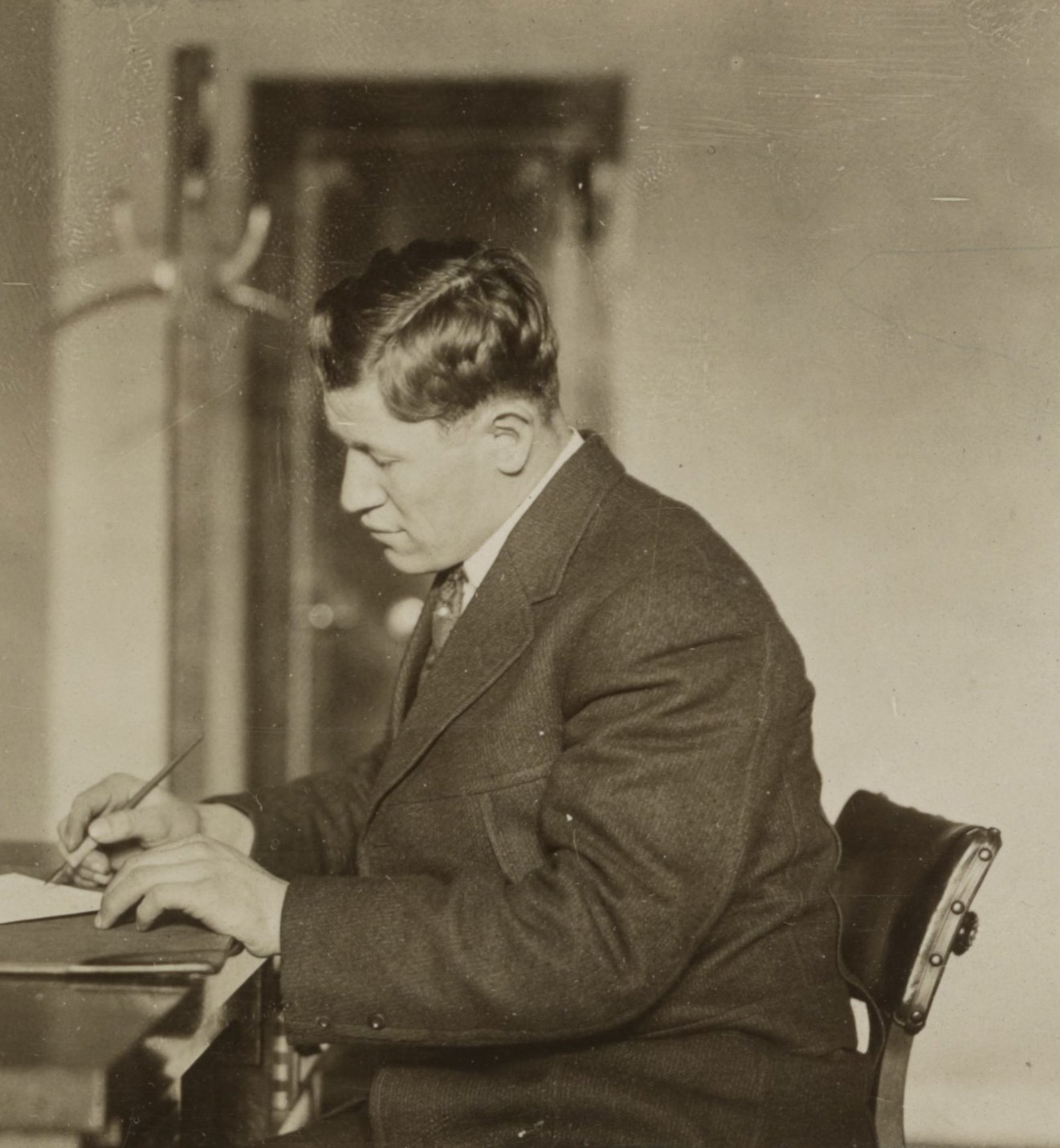

Underwood & Underwood, 'Jim Thorpe, the olympic hero', gelatin silver print, 1913 (item notes: 'Copyright 1913, by Underwood & Underwood', U.S. Copyright Office J179594); Library of Congress; cropped to the subject · Library of Congress Prints and Photographs Division (ppmsca.31944, LCCN 2011649818) via Wikimedia Commons · Public domain
athlete · 20th Century
Jim Thorpe
1888–1953
Known For
Not yet included in personality matching — the documented evidence doesn't yet cover enough of the personality model. Everything else on this page is fully available.
Trait Constellation
Key Achievements
At the 1912 Stockholm Olympics Thorpe won the pentathlon and the decathlon. In 1913 the Amateur Athletic Union ruled that summer minor-league baseball had made him a professional, and his results were struck out; the IOC named him co-champion in 1982 and, in July 2022, the sole winner of both events.
Canton Bulldogs manager Jack Cusack signed Thorpe in 1915 for $250 a game, and he went on to play for and coach the team. According to the Pro Football Hall of Fame, the charter members of the league formed in 1920, the forerunner of the NFL, named him its president.
Thorpe played six seasons of major-league baseball between 1913 and 1919 with the New York Giants, Cincinnati Reds and Boston Braves, appearing in 289 games in all, according to the SABR Biography Project.
Moments That Reveal Them
In his memoir, Canton manager Jack Cusack describes a 1917 game against Massillon as a personal duel between Thorpe and Stan Cofall, who kicked two field goals for a 6-0 Massillon win. Cusack writes that Thorpe lost his temper at rough play he thought uncalled for, was hurt in the second quarter but played on, and carried the ball more than anyone else.
The account is consistent with the profile's competitiveness score, though it comes from one insider who was also Thorpe's friend. Competitiveness
On the voyage to Stockholm in 1912, Sally Jenkins reports, a reporter found Thorpe resting in a deck chair and Thorpe said he was practising the long jump in his head. A photograph published by the National Museum of the American Indian shows him training on the ship's deck, which its historian cites against the story that he refused to train.
Read alongside coach Pop Warner's remark that Thorpe was always looking for a new motion that would help him, the episode offers one example of the deliberate technique work behind the profile's mastery-orientation score; other contemporaries described him as averse to training. Mastery Orientation
Turning Points
When the AAU charges became national news in late January 1913, Thorpe signed a letter admitting that he had played summer baseball for pay; a friend later told a congressional investigator that the letter had been drafted by coach Pop Warner and the school superintendent. Within weeks he signed a three-year contract with the New York Giants, and from 1915 he also played professional football with Canton.
The loss of his amateur status was decided by others, but what he did next, working in two professional sports at once, sits alongside the profile's cross-domain-range score. Cross-Domain Range
Similar People
People whose overall profiles resemble theirs.

Franz Kafka

Michelangelo

Aristotle

Leonardo da Vinci

Rachel Carson
Opposite Profile
Not a rival — a different profile shape worth a look.
Wangari Maathai
Sources
- Jim Thorpe (Q221482) -- identity verified live via the wbgetentities API (2026-09-26): label 'Jim Thorpe', description 'American track and field athlete and baseball player (1888-1953)', P569 28 May 1888 (plus an unknown-value statement), P570 28 Mar 1953, citizenship United States (Q30), instance of human, en aliases 'Bright Path', 'James Francis Thorpe', 'Wa-Tho-Huk', ko label '짐 소프', kowiki sitelink '짐 소프', P18 'Jim Thorpe 1910s2.jpg' and 'Jim Thorpe1912 Olympics.jpg'. Orientation only; not used as support for any row.
- Don Jensen, 'Jim Thorpe', SABR Baseball Biography Project (posted 4 Jan 2012) -- baseball historian's biography (non-self, secondary), drawing on the player's file at the National Baseball Hall of Fame Library, Cook (2011), Wheeler (1981) and contemporary papers; carries the FIRSTHAND recollections of room-mate Chief Meyers and team-mate Edd Roush and quotes Thorpe (self). Used: the 1909 withdrawal from Carlisle and 1910-11 summer baseball, the 1911 return, the Jan 1913 letter (self, quoted), the 1913 Giants signing, 1913-19 baseball career incl. the 1919 complaint about playing time and trade, the 1915 football start, film work 1931-50 and merchant marine 1945. Fetched with curl and read in full. NOTE: it says he 'founded' the Canton Bulldogs in 1915, which the Pro Football Hall of Fame and Cusack contradict (Cusack signed him); that claim is not used. Its drinking, marriage and late-life poverty passages are not used.
- James Ring Adams (senior historian, National Museum of the American Indian), 'The Jim Thorpe Backlash: The Olympic Medals Debacle And the Demise of Carlisle', American Indian Magazine (Smithsonian NMAI), 2012 -- historian's account (non-self, scholar) of the Jan 1913 AAU charges, the letter Thorpe signed (quoted; Gus Welch later told a congressional investigator it was drafted by Warner and superintendent Friedman), the AAU's own misgivings, Warner shipping the medals back, the 1914 investigations of Carlisle, Thorpe's later visits to the campus, the 1982 IOC decision and Florence Ridlon's discovery of the 1912 30-day rule; photo captions on his mismatched shoes and on training on the deck of the Finland (photo attributed to Avery Brundage). Fetched with curl and read in full; the passages on his burial dispute are not used.
- Jack Cusack, 'Pioneer in Pro Football' (memoir, first published 1963; reprinted with editorial notes in PFRA Annual No. 8, 1987) -- FIRSTHAND insider account (non-self) by the Canton Bulldogs manager who signed Thorpe in 1915 and was his business manager in 1921 (a friend, so an interested party). Used: the 1915 signing at $250 a game via Bill Gardner; the PFRA editor's note that after the first 1915 Massillon game Thorpe criticised his team-mates' lack of team play and replaced Hazlett as coach; Thorpe as captain being hesitant to substitute and the agreement that Cusack could substitute; the 1917 Massillon game (lost his temper at Cofall's rough play, injured in the second quarter but played on); the shoulder pads made at Thorpe's suggestion and the abandoned plan to market them; Cusack holding Thorpe's earnings at his own request; the 1921 request that Cusack look after his financial affairs at Cleveland. Full PDF fetched with curl, converted with pdftotext and the Thorpe passages read in full (the 1906 scandal and team rosters were skimmed).
- Sally Jenkins, 'Why Are Jim Thorpe's Olympic Records Still Not Recognized?' (print title 'The All-American'), Smithsonian Magazine, July 2012 -- journalist's feature (non-self; Jenkins is also the author of a Carlisle football history) drawing on Kate Buford's biography and Olympic historian Bill Mallon; carries recollections of Carlisle teachers Marianne Moore and Verna Whistler and of coach Pop Warner ('always watching for a new motion which will benefit him'), reporter Francis Albertanti's shipboard exchange with Thorpe, the 1912 Eastern trials javelin throw, the Stockholm events, and Thorpe's own sayings (self). Fetched with curl and read in full. Its 'greatest athlete' judgements (Mallon) and the passages on his marriage motive, family, finances and illness are NOT used.
- Pro Football Hall of Fame, 'Jim Thorpe' player page (profootballhof.com, read 2026-09-26) -- institutional biography (non-self): Cusack signed him for the end of the 1915 season at $250 a game; star and coach of the Bulldogs (unofficial titles 1916, 1917, 1919); named president by the charter members in 1920; halftime kicking demonstrations; notes his exploits 'tend to be exaggerated'. Fetched with curl and read in full. Used for career facts and corroboration of Cusack only.
- Bob Gill, 'A Legend Comes to Life: Jim Thorpe in the Days Before the NFL', The Coffin Corner vol. 12 no. 2 (PFRA, 1990) -- researcher's game-by-game reconstruction (non-self) of Thorpe's 1915-19 Canton games from Canton Repository play-by-play; a deliberately sceptical check on the legend. PDF fetched and read in full with pdftotext. Statistics and results only; not used to support any row (results are not behaviour), read to check the Cusack chronology.
- Carlisle Indian School Digital Resource Center (Dickinson College), 'Jim Thorpe Student File' and 'Thorpe, Jim' person page (NARA RG 75, Entry 1327, box 37, folder 1783) -- archival catalogue description (non-self): entered 6 Feb 1904, left 14 Jun 1909, re-enrolled 8 Sep 1911, departed 1 Feb 1913. The catalogue text was read; the 97-page scanned file itself has no text layer and was NOT read (only a thumbnail sheet was viewed). Used for dates only.
- 'Jim Thorpe's 1912 Olympic Gold Medals Are Finally Reinstated', Smithsonian Magazine (Smart News), July 2022 -- news report (non-self) of the July 2022 IOC decision listing Thorpe as sole winner of the 1912 pentathlon and decathlon after the Bright Path Strong petition, the 1982 co-champion status, and the statement of Hugo Wieslander's family that he had regarded Thorpe as the sole legitimate champion. Fetched with curl and read in full. Event facts for the editorial only; not used for any row. Native News Online's report of the same announcement was also read and is not counted separately.