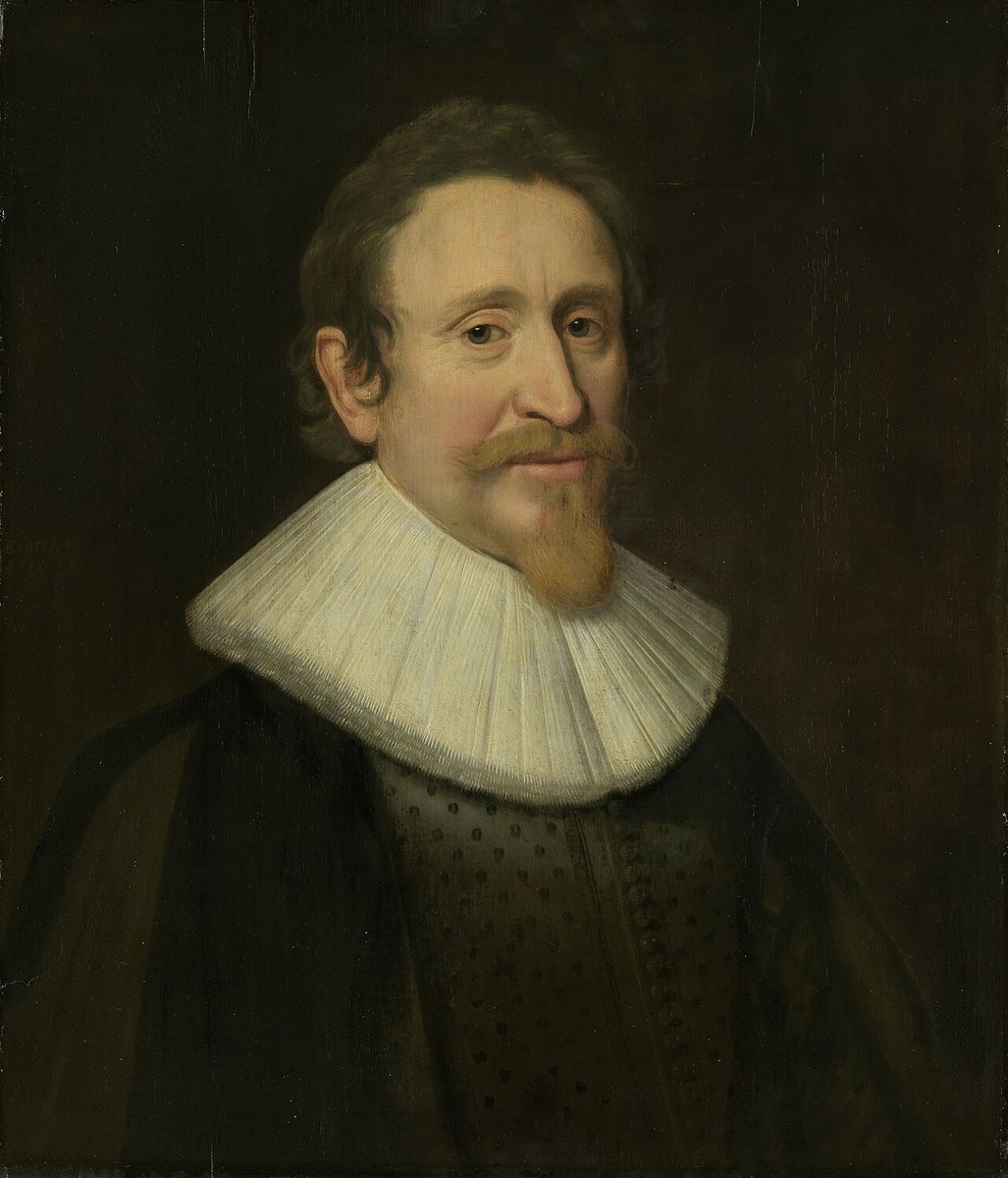
Workshop of Michiel Jansz van Mierevelt, 1631; Rijksmuseum, Amsterdam (public domain) · Rijksmuseum, Amsterdam, object SK-A-581, 'Portrait of Hugo de Groot (1583-1645)', oil on panel, workshop of Michiel Jansz van Mierevelt, inscribed with his age 48 and the year 1631. The museum's own page says he posed for Van Miereveld during a short return to the Republic and that this panel is one of the many copies of that portrait, so it is a workshop copy of a portrait made from a sitting, not the original sitting itself and is recorded as a historical depiction. The painter died in 1641, so the panel is public domain by age; the Rijksmuseum page has an empty copyright field and Wikimedia Commons records the museum's statement that its images are public domain or CC0 (Commons file 'Portret van Hugo de Groot (1583-1645) Rijksmuseum SK-A-581.jpeg', original 4862 x 5680). The saved file was produced by downscaling a 1280 x 1495 Commons rendering of that original to 1027 x 1200; nothing was upscaled. · Public domain
jurist · Early Modern
Hugo Grotius
1583–1645
Known For
Not yet included in personality matching — the documented evidence doesn't yet cover enough of the personality model. Everything else on this page is fully available.
Trait Constellation
Key Achievements
Published De iure belli ac pacis (On the Law of War and Peace) in Paris in 1625, building a general theory of law among nations on natural law; Britannica calls it one of the greatest contributions to international law.
Argued that the sea is open to all nations in Mare Liberum (1609), published from a chapter of his commissioned work on prize and booty; the English jurist John Selden published a critical reply.
Wrote across fields: critical editions of Aratus and Martianus Capella, the play Adamus Exul admired by Milton, a history of the Dutch revolt, and theological works including a widely read defence of Christianity.
Moments That Reveal Them
In De iure belli ac pacis he argued that natural law would hold even if there were no God, so that it could bind people of any belief, though he then added religious and utility arguments for rulers who would not heed secular ones.
This is consistent with grounding law outside confessional authority, though scholars dispute how original the move was. Independent Thinking
Asked by the Dutch East India Company to defend the seizure of a Portuguese ship, he wrote a long treatise on prize and booty; one chapter, Mare Liberum, was published and widely reprinted, while the Stanford Encyclopedia notes its partly propagandistic aim.
This is consistent with skilled legal advocacy for a client, with the purpose of the work questioned by critics. Persuasiveness
Turning Points
After leaving the Netherlands in 1621 he settled in Paris, where he wrote and in 1625 published De iure belli ac pacis, the work on which most of his reputation rests.
This is consistent with continued scholarly output after a major change in circumstances. Persistence
Similar People
People whose overall profiles resemble theirs.


Maimonides

Louis Pasteur

Warren Buffett

Confucius

Malala Yousafzai
Opposite Profile
Not a rival — a different profile shape worth a look.

Otto von Bismarck
Sources
- Hugo Grotius (Q154959) -- verified live via the Wikidata API (2026-10-26): English label 'Hugo Grotius', description 'Dutch jurist and scholar (1583-1645)', born 1583-04-10, died 1645-08-28, Korean label present, P18 image the Rijksmuseum portrait SK-A-581. Orientation only; not used as support for any row.
- Encyclopaedia Britannica, 'Hugo Grotius', written by Yasuaki Onuma (Professor Emeritus of International Law, University of Tokyo), updated September 2026, read in full: precocious childhood (Latin elegies at eight, Leiden at eleven, pupil of Scaliger), his editions of Martianus Capella and Aratus, the play Adamus Exul admired by Milton, the Annals of the Low Countries (published 1657), the 1604-1609 work for the Dutch East India Company that became Mare Liberum, his offices, the 1618 sentence and 1621 escape (context), De Jure Belli ac Pacis (1625) built on natural law independent of religion, with a layered structure of secular, religious and utility arguments, and its description as one of the greatest contributions to international law. CANONICAL SIGNIFICANCE SOURCE. Reference article by a specialist; admiring in tone, and it treats the political struggle as context only.
- Jon Miller, 'Hugo Grotius', Stanford Encyclopedia of Philosophy (plato.stanford.edu, 2021 revision), the life, works and originality sections read in full: his early learning, his legal practice and offices, imprisonment and escape (context), the output of some five dozen book-length works, De iure praedae commissioned around 1603 by the Dutch East India Company with an acknowledged propagandistic aim and its Chapter Twelve published as Mare Liberum, answered critically by John Selden, the 1625 De iure belli ac pacis and its later editions that added references, the scholarly dispute over his originality (Irwin: 'no pioneer' in ethics; Schneewind and d'Entreves crediting method; Kingsbury and Roberts on systematic reassembling of practice), his lasting influence, and the apocryphal last words. Scholarly encyclopaedia entry that cites critical literature (Tuck, van Ittersum), though those works were not opened.
- Rijksmuseum, object page and catalogue entry SK-A-581, 'Portrait of Hugo de Groot (1583-1645)', workshop of Michiel Jansz van Mierevelt, 1631, oil on panel 63 x 55 cm, inscribed 'Aetatis 48 / Ao 1631', read in full: the museum summarises his Mare liberum (1607) and De iure belli ac pacis and states that during a short return to the Republic he posed for Van Miereveld and that this is one of many copies of that portrait; the 'Copyright' field is empty. Used for the portrait basis and a brief orientation; not used for scoring.
- Peace Palace Library (The Hague), review note on Henk Nellen, 'Hugo Grotius: A Lifelong Struggle for Peace in Church and State, 1583-1645' (Rens Steenhard, 3 September 2020), read in full, and the library's Grotius collection history page on the IALL website (opening sections read): describes him as the most famous humanist scholar of the Dutch Golden Age with influential works on the laws of war and peace, Dutch history and church unification, notes that Mare liberum gave the Dutch East India Company a ready justification for a trading empire, that his letters form the basis of Nellen's biography (Nellen co-edited the last five volumes of the correspondence), and that the library holds the largest Grotius collection with about 150 editions of De iure belli ac pacis. Institutional library notes; Nellen's biography itself was not opened.