
Alan Turing
94% Profile Match
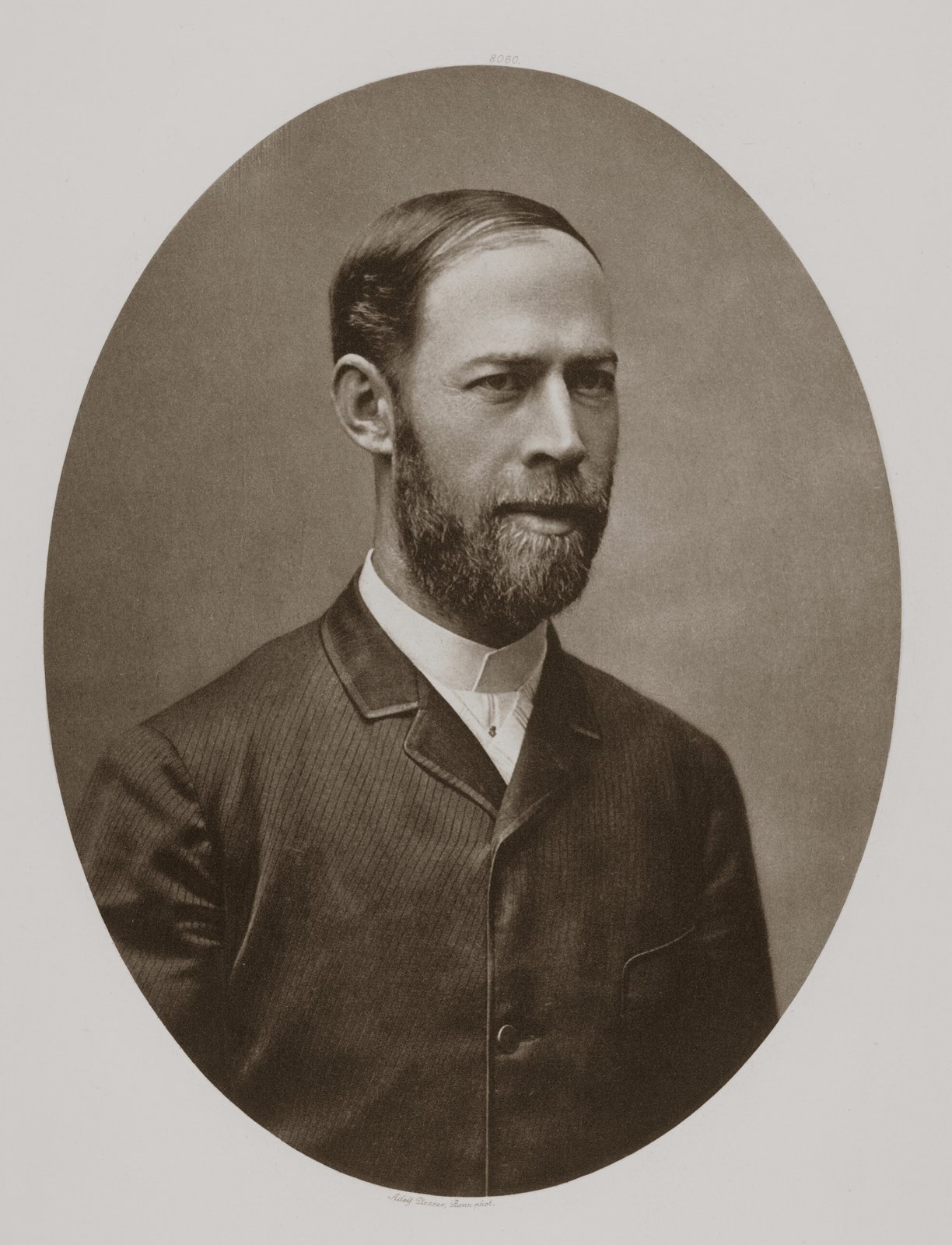
Robert Krewaldt, Kaiserplatz 16, Bonn, c. 1890 (cabinet photograph); reproduction via Wikimedia Commons · Wikimedia Commons, File:HEINRICH HERTZ.JPG (cabinet photograph by Robert Krewaldt, Bonn, c. 1890; reproduction credit Guenter Josef Radig); same portrait published in Die Gartenlaube 1894 · Public domain (photograph published in 1894 or earlier; Commons tag PD-old)
physicist · 19th Century
1857–1894
Not yet included in personality matching — the documented evidence doesn't yet cover enough of the personality model. Everything else on this page is fully available.
At the Technical High School in Karlsruhe, Hertz produced rapid electric oscillations with a spark gap, detected them with a resonant receiver, and showed that electric action travels through air at a finite speed. He made standing waves by reflection from a wall, measured their wavelength and velocity, and showed that the waves are reflected, refracted and polarised like light. Helmholtz wrote that Faraday and Maxwell had proposed this view as probable but unverified, and that Hertz supplied the demonstration; he reported the first results to the Berlin Academy on 10 November 1887 and gathered the papers in Electric Waves (1892). The unit of frequency, the hertz, is named after him.
While preparing these experiments Hertz noticed that the spark of one oscillator influenced the spark of a second one nearby. Glass plates cut off the effect and quartz did not, and he concluded that it came from ultraviolet light from the primary spark. He published it as 'On an Effect of Ultra-Violet Light upon the Electric Discharge' and then put it aside to return to the main line of research. Righi, Hallwachs, Elster and Geitel later made the phenomenon more precise.
In January 1881, at the Physical Society of Berlin, Hertz presented a theory of the contact of elastic solids pressed together. It determines the deformation and stress in both bodies; the contact surface is an ellipse whose size grows as the cube root of the force. In 1882 he extended it into a definition of hardness for a technical journal. Lenard reports that the work was received with interest, including from the Berlin geodetic base-line measurements, where elastic contact had introduced an uncertainty.
Hertz's last work, The Principles of Mechanics Presented in a New Form, was written over his last three years and published after his death in 1894, with a preface by Helmholtz. It sets out a mechanics without force as a fundamental concept, derived from a single law. Helmholtz admired its logical rigour but said he himself preferred another method. Nordmann describes it as a first geometrization of mechanics; Hertz's approach did not win wide acceptance among physicists but was taken up by philosophers of science, among them Ludwig Wittgenstein.
In the months after November 1887 Hertz tried to show that waves in air and waves along a wire interfere in the same phase at every distance. The phase differed with distance, which pointed to an infinite speed in air, the opposite of what he expected, and he gave up for some weeks. He then reasoned that finding that Maxwell was wrong would matter as much as confirming him, repeated the experiment with care, and published the result, which he explained by a lower speed along the wire. In 1892 he wrote that this conclusion could 'scarcely be regarded as correct' and that a calculation error in the paper had been pointed out by Poincare.
Repeating an unwelcome result, publishing it, and later marking his own conclusion as probably wrong is consistent with belief updating; the account is Hertz's own, and Planck independently records the same correction. Belief Updating
On 24 February 1883 Hertz wrote to his parents from Berlin that for a week he had been absorbed in the equilibrium of a floating ice sheet with a man standing on it. The sheet should sink under the man, rise in a ring around him, and sink again, with ever smaller waves. He added that he knew the problem was not very important, that he ought to be writing the paper for his Kiel appointment, and that his thoughts kept returning to it. The solution was published from Kiel a year later.
Staying with a problem he called unimportant, against his own schedule, is consistent with deep focus; the evidence is his own letter, as selected by Lenard. Deep Focus
In October 1877 Hertz went to Munich to continue his engineering studies. On 1 November he wrote to his parents that he wanted to return to natural science: he would rather be a second-rate engineer than a second-rate investigator, though engineering was the surer livelihood, and he asked his father for a decision rather than advice. His father agreed. Hertz spent the winter on mathematics and mechanics, reading Laplace and Lagrange in the original, and went to Berlin in October 1878 to study under Helmholtz and Kirchhoff.
Choosing the less secure path after weighing it, and then spending the winter on original treatises, is consistent with a mastery orientation. Mastery Orientation
People whose overall profiles resemble theirs.

Not a rival — a different profile shape worth a look.
