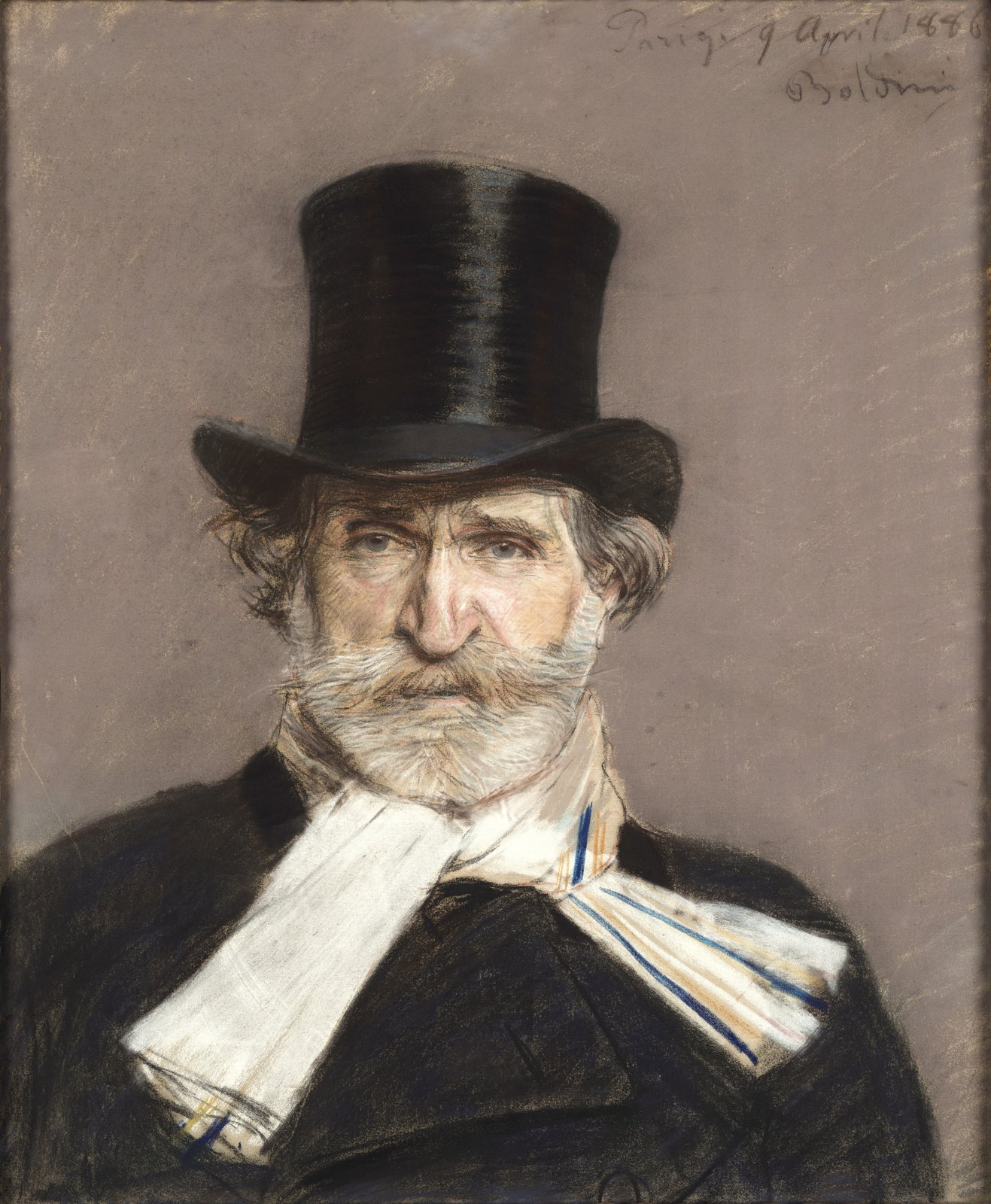

Giovanni Boldini, Portrait of Giuseppe Verdi, 1886, Galleria Nazionale d'Arte Moderna, Rome; faithful reproduction (Google Arts & Culture) of a public-domain work; downscaled · Giovanni Boldini, Portrait of Giuseppe Verdi (Ritratto di Giuseppe Verdi), pastel on paper, 65 x 54 cm, inscribed 'Parigi 9 April 1886', Galleria Nazionale d'Arte Moderna e Contemporanea, Rome (inv. 464; Wikidata Q20091566); reproduction from Google Arts & Culture via Wikimedia Commons · Public domain
Trait Constellation
Key Achievements
Between March 1851 and March 1853 Verdi premiered three operas that have stayed in the international repertory ever since: Rigoletto (Venice), Il trovatore (Rome) and La traviata (Venice). His Aida opened at the Cairo opera house on 24 December 1871, followed by its European premiere at La Scala in February 1872.
Late in life Verdi wrote two Shakespeare operas to librettos by Arrigo Boito. Otello opened at La Scala on 5 February 1887 after about seven years of work, and the comedy Falstaff followed there on 9 February 1893, when Verdi was seventy-nine.
In the 1890s Verdi paid for and closely supervised the building of the Casa di Riposo per Musicisti in Milan, a residence for elderly musicians without means, and created its foundation in December 1899. At his request it opened only after his death, receiving its first residents in October 1902, and he left it the royalties from his operas.
Moments That Reveal Them
For the first Macbeth (Florence, 1847), the soprano Marianna Barbieri-Nini later recalled more than a hundred piano and orchestra rehearsals, three months of work on the sleepwalking scene, and a duet rehearsed over 150 times. In her account, printed by the critic Gino Monaldi in 1899, Verdi called the two singers away to rehearse it once more just before the dress rehearsal, with the audience already in the theatre.
The episode is consistent with this profile's high perfectionism score, though the figures come from one performer's recollection decades later. The same account records the cost: the cast resented what she called his exaggerated demands. Perfectionism
In early 1858 the Naples censors withdrew permission for Verdi's new opera about the murder of a king. According to press reports of the time, quoted by his biographer Arthur Pougin, Verdi refused to fit his music to a substitute libretto despite a formal protest and a claim for damages, and the opera was withdrawn. It reached the stage in Rome in February 1859 as Un ballo in maschera, with the action moved to colonial Boston.
His refusal in Naples offers one example of the conflict tolerance scored in this profile. The Rome version sits alongside it as a reminder that he also accepted compromises when a production was otherwise impossible. Conflict Tolerance
Turning Points
According to the scholar Fabrizio Della Seta, from Ernani (1844) onward Verdi's contracts reserved him the right to approve the singers. After Nabucco he never set a libretto that someone else had already written: he chose the subjects and planned the scenes himself, and the libretto stage often took longer than the music.
This shift in working terms fits the high need for autonomy recorded in this profile. Della Seta also places it within a wider change in the standing of Italian composers, so it reflects the theatre business of the time as well as Verdi himself. Need for Autonomy
Similar People
People whose overall profiles resemble theirs.

Rosalind Franklin

Frida Kahlo

James Joyce

Sigmund Freud
Coco Chanel
Sources
- Giuseppe Verdi (English Wikipedia) -- orientation only; not used as support for any scored row. Korean Wikipedia title '주세페 베르디' confirmed via the Wikidata kowiki sitelink.
- Giuseppe Verdi (Q7317) -- verified live via wbgetentities (2026-10-02): en label 'Giuseppe Verdi', description 'Italian opera composer (1813–1901)', ko label '주세페 베르디', P569 values 1813-10-09 / 1813-10-10 (plus an apparently erroneous 1813-04-10), died 1901-01-27, citizenship Q165040 and Q172579 (Kingdom of Italy), P18 three images incl. the Boldini 1886 portrait, kowiki '주세페 베르디'. Orientation only.
- Fabrizio Della Seta, 'VERDI, Giuseppe Fortunino Francesco', Dizionario Biografico degli Italiani, vol. 98 (Rome: Istituto dell'Enciclopedia Italiana / Treccani, 2020; online text updated), read in full in Italian 2026-10-02 (c. 50,000 characters, extracted from the page's embedded data) -- MODERN SCHOLARLY perspective, independent of the period memoirs; Della Seta is a Verdi scholar (author of the MGG Verdi article). Used for: his warning that early-life material depends on later recollections and is 'circonfusa da un'aura di leggenda'; the 1832 Conservatory refusal and private study with Lavigna; from Ernani (1844) reserving by contract the right to approve the performers; the 'composer-dramatist' role -- after Nabucco never setting a pre-existing libretto, planning situations by acts, scenes and numbers, libretto drafting often taking longer than the music; the exceptional effort in the composition and staging of Macbeth (1847); his reading (Shakespeare, Schlegel, de Stael recommended to Piave in 1845, Manzoni) and contacts with painters and sculptors; Re Lear libretto drafts 1849-56 never realised; the Naples 1858 'lungo braccio di ferro' over Una vendetta in domino / Un ballo in maschera; the break with La Scala 1845-69 'perche insoddisfatto della qualita delle esecuzioni'; Aida staged by him in person in several cities 1872-80; the 1871 Florimo letter and its context; the 1879-86 Otello process 'with a slowness and care he had never given any other opera', interrupted for the Boccanegra (1881) and Don Carlo (1884/1886) revisions; Falstaff (1893) and its later retouches; the Villanova hospital (1888), the Casa di riposo per musicisti (built 1889-99, opened 1902) and his will. Political career (1861 deputy, 1874 senator) and Risorgimento reception were read but are not scored.
- Arthur Pougin, Verdi: An Anecdotic History of His Life and Works, trans. with notes by James E. Matthew (London: H. Grevel, 1887; French original 1886), archive.org OCR full text (Cornell copy cu31924022318830) -- CONTEMPORARY JOURNALIST/CRITIC perspective: Pougin was a Paris music critic who did not claim personal intimacy with Verdi; he compiles press reports (Gazette Musicale etc.), printed letters and the recollections of Verdi's librettists, and is admiring and explicitly anecdotal. Read: contents; ch. VIII pp. 132-157 (Rigoletto and the Venice censorship 1850-51 -- 'Le Roi s'amuse or nothing', the score written and orchestrated in forty days; Verdi's practice of choosing subjects and sketching the libretti; the 'La donna e mobile' secrecy anecdote; the Traviata failure of 6 March 1853 with his note to Muzio, the singers' disconcertion at the music's novel character, its revision and 1854 recovery; the Gazette Musicale's 1857 change of view on his 'effort of transformation'); ch. IX pp. 179-186 (Un ballo in maschera: the Naples 1858 standoff as reported by the Gazette Musicale of 4 April 1858 and a fuller press account, the Rome compromise and first night 17 Feb. 1859, his complaint about the female singers); ch. XI pp. 196-215 (Don Carlos rehearsals 1866-67 incl. the Gazette Musicale report that 'Verdi himself went through his part with each of the interpreters'; Aida -- Camille du Locle's letter of 28 March 1880 on the genesis of the libretto, written 'under the eye of the maestro, who took a large share in the work'); ch. XIV pp. 267-277 (Sant'Agata: a long quotation from the Aida librettist Antonio Ghislanzoni's Reminiscenze artistiche describing his 1868 visit -- routine, farm management, reading -- and Pougin's own account of the daily timetable and charities); ch. XV pp. 278-291 (letters printed in full: to Pedrotti 1 Jan. 1875 and to the Padua theatre commission 6 June 1884 declining to appear in public; to Florimo, Jan. 1871, declining the Naples Conservatory; on the diapason, 10 Feb. 1884; to Cencetti, July 1873, on stage direction; to Filippi, 1865; the Times note of Oct. 1886 that the Otello singers were to study their parts at Sant'Agata under his supervision). The ch. V account of the 1840 bereavements and the 'near-abandonment then Nabucco' story was read and deliberately NOT used.
- Blanche Roosevelt, Verdi: Milan and 'Othello' (London: Ward and Downey, 1887), archive.org OCR full text (verdimilanothell00roos) -- JOURNALIST EYEWITNESS perspective: Roosevelt (an American singer turned writer) met Verdi in Paris in 1875 and wrote these letters from Milan in Jan.-Feb. 1887 during the Otello rehearsals and premiere; admiring of the music but openly critical of the man in places ('Theatrical directors in Italy and elsewhere have complained a great deal about Verdi's hardness'), and partly gossip-based. Read: pp. 82-93 (her 1875 Paris call on Verdi -- his remark that Paris was too noisy for work while Sant'Agata's solitude helped him; her description, partly from hearsay, of Sant'Agata, his farming, daily routine, punctual fulfilment of contracts, support of the librettist Piave, the 1887 condition that La Scala also give Aida if it wanted Otello, and a planned charitable foundation); pp. 112-115 (Otello rehearsals closed to outside critics; his reported doubts, relayed second-hand from a Ricordi); pp. 177-179 (the costume designer Edel's workroom: 'Verdi's orders are peremptory'); pp. 229-230 (Boito's report of the dress rehearsal); pp. 247-249 (his wish to return to Sant'Agata after the premiere); p. 203 (his music 'required being sung as it was written'). Hearsay passages are marked as such where used.
- Gino Monaldi, Verdi 1839-1898 (Turin: Fratelli Bocca, 1899), archive.org OCR full text (verdi1839189800mona_0), read in Italian -- CONTEMPORARY CRITIC/IMPRESARIO perspective: Monaldi (1847-1932) was an Italian music critic and theatre manager who corresponded with Verdi and met him at Montecatini; admiring. Read: the index/chapter summaries; ch. VIII pp. 79-82 (the Florence Macbeth of 1847, including the long first-person recollection of the soprano Marianna Barbieri-Nini, the first Lady Macbeth: more than a hundred piano and orchestra rehearsals, three months on the sleepwalking scene, the duet rehearsed 'more than 150 times' and a 151st time just before the dress rehearsal, and the cast's resentment of his 'esagerate esigenze' -- an INSIDER PERFORMER account, retrospective by decades and not independently dated, so its numbers are treated as approximate); ch. XXVIII pp. 262-266 (Verdi's letters to Monaldi of 3 Dec. 1890 and 18 Jan. 1892 on Falstaff, and Monaldi's own conversation with him at Montecatini in July 1891, where he said he was working two hours a day on the orchestration).
- Verdi's OWN letters -- SELF perspective, one perspective, never sole support for a row. Main edition read: I copialettere di Giuseppe Verdi, ed. Gaetano Cesari and Alessandro Luzio (Milan, 1913), archive.org OCR (icopialettere00verd), read in Italian by line ranges: to Salvadore Cammarano, Paris, Nov. 1848 (pp. 60-63: requests for added scenes and verses in La battaglia di Legnano; his objections to Eugenia Tadolini as Lady Macbeth for Naples and detailed staging and orchestration instructions); to Colini, Nov. 1848 (p. 63); to the Turin competition committee, 5 Dec. 1880, and to Arrigo Boito, 11 Dec. 1880, on revising Simon Boccanegra (pp. 315-316); to Domenico Morelli, 24 Sept. 1881, on Otello costumes (p. 316); to Giulio Ricordi, 25 Dec. 1882 (footnote p. 328), and to the mayor of Villanova and to Frignani, 16 Feb. 1885 (pp. 328-329), on the Villanova hospital; to Boriani, president of the Villanova hospital, 22 April 1891 (pp. 367-368); to the mayor of Parma, 29 April 1891; to Hans von Bulow, 14 April 1892; to Giulio Ricordi on the Falstaff production terms, 1892 (pp. 377-378; date line illegible in the OCR, placed between April and Sept. 1892) and 18 Sept. 1892 (pp. 379-382); to the architect 'Camillo' [Boito; surname garbled in the OCR] on the Casa di riposo, 3 April 1893 (pp. 398-399); to Giulio Ricordi, 8 and 10 May 1896 (pp. 407-408). Also letters printed in Pougin 1887 ch. XV (Florimo 1871, Pedrotti 1875, Cencetti 1873, Padua 1884, diapason 1884) and in Monaldi 1899 (3 Dec. 1890, 18 Jan. 1892). The Werfel and Stefan English selection (1942) was not available as text and was not read.
- Casa di Riposo per Musicisti - Fondazione Giuseppe Verdi, Milan (casaverdi.it) -- INSTITUTIONAL perspective (the foundation Verdi created; interested in his memory, but documentary in content). Pages read in full 2026-10-02: 'Istituzione' (foundation deed of 16 Dec. 1899; the house opened, at his explicit request, only after his death; first nine guests on 10 Oct. 1902; his will assigning capital and royalties) and 'La costruzione e le origini' (his letter to Giulio Ricordi of Oct. 1889 on buying the land 'senza idea fissa'; that he was reluctant to give small subsidies and loans but wanted to programme help 'con precisione assoluta', being informed of his income 'fino all'ultimo centesimo'; the 1895 meeting with the architect Camillo Boito and the building contract of 16 April 1895; his insistence on 'riposo' and 'Ospiti' rather than 'ricovero'; costs exceeding the estimate).