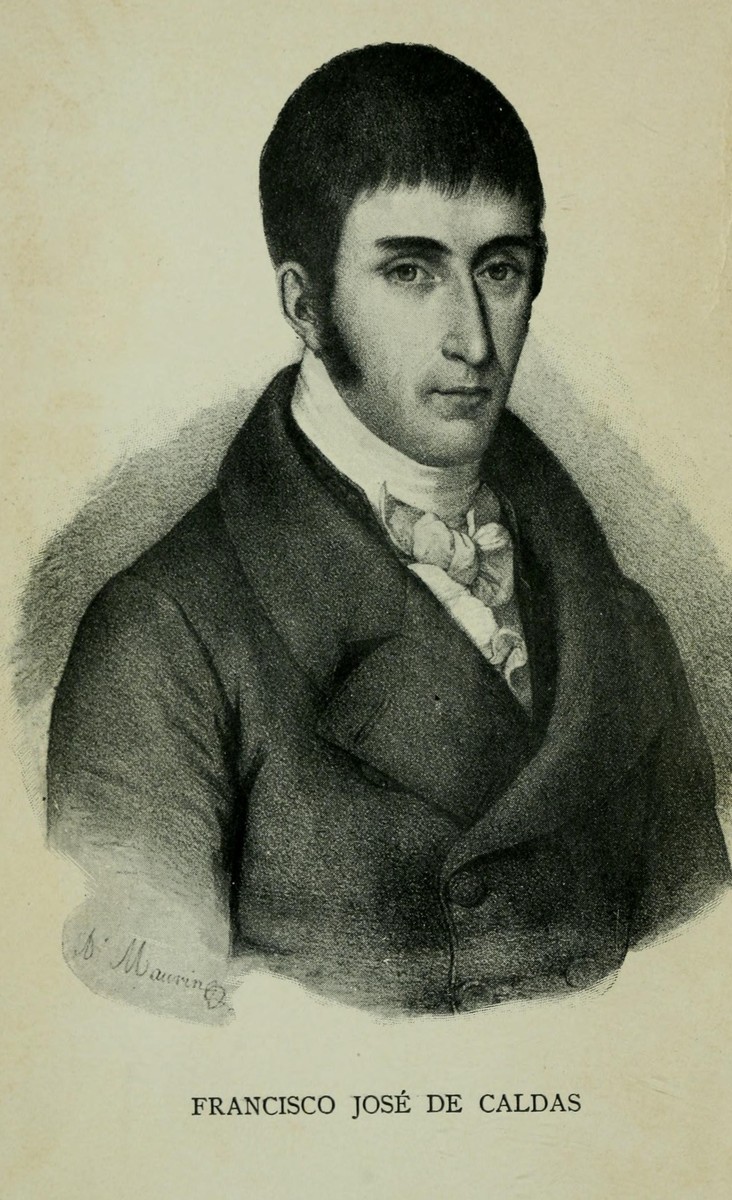
Lithograph signed A. Maurin, reproduced in Diego Mendoza, Expedición botánica de José Celestino Mutis al Nuevo Reino de Granada y Memorias inéditas de Francisco José de Caldas (Madrid, 1909), scan from the Internet Archive, public domain · Lithograph portrait of Francisco José de Caldas, captioned 'FRANCISCO JOSÉ DE CALDAS' and signed 'A. Maurin' at lower left, printed as a plate in Diego Mendoza's 'Expedición botánica de José Celestino Mutis al Nuevo Reino de Granada y Memorias inéditas de Francisco José de Caldas' (Madrid: Librería General de Victoriano Suárez, 1909; imprint 'Imp. de Fortanet'), from the Internet Archive's scan. The book's title page gives 1909 and Madrid, so the plate was published before 1931; Caldas died in 1816, so the lithograph is a later depiction made after his death, not a documented sitting, and it is older than the 1909 book. The Internet Archive record carries no separate rights statement, so the basis rests on the documented 1909 publication and the plate's older origin; no museum or holder claims rights. The file used is the Internet Archive's 1,895 x 2,991 pixel page image, cropped to the plate and downscaled to 732 x 1,200 pixels; nothing was upscaled. The earlier c. 1836 oil by José María Espinosa was not used because its holder was not opened. · Public domain (1909 Madrid publication of an older lithograph; no rights statement on the Internet Archive record)
astronomer · 19th Century
Francisco José de Caldas
1768–1816
Known For
Not yet included in personality matching — the documented evidence doesn't yet cover enough of the personality model. Everything else on this page is fully available.
Trait Constellation
Key Achievements
He worked out and applied a method of measuring altitude from the boiling point of water, using it on Andean mountains and publishing it in articles between 1801 and 1809.
From 1805 he directed the new astronomical observatory in Bogota, fixing its coordinates and height and keeping the meteorological observations that he published in 1808.
He collected cinchona for Mutis's botanical expedition, studied plant distribution by altitude with Humboldt, and from 1808 published the Semanario del Nuevo Reino de Granada, which ran until 1811.
Moments That Reveal Them
After breaking a thermometer near the Puracé volcano, he repaired and recalibrated it with snow and boiling water, and the mismatch led him to link the boiling point to atmospheric pressure.
This is consistent with improvising a repair and then following up an unexpected discrepancy. Resourcefulness
In October 1801, before he had met Humboldt, he wrote from Quito thanking friends in Santa Fe for copying Humboldt's barometric profile and papers, which he called a treasure and then annotated.
This is consistent with seeking out better methods on his own initiative before a meeting. Proactive Agency
Turning Points
In 1802 he met Humboldt and Bonpland at Quito and spent six months with them, learning much of what he needed to work as an astronomer, geodesist, geographer and botanist.
This is consistent with a self-taught observer widening into several fields after meeting trained travellers. Cross-Domain Range
Similar People
People whose overall profiles resemble theirs.


Aristotle

Ada Lovelace

Averroes

Bertrand Russell

Ibn Sina
Sources
- Francisco José de Caldas (Q1442069), verified live via the Wikidata API (2026-11-06): label 'Francisco José de Caldas', description 'Neogranadine lawyer and scientist (1768-1816)', born 4 October 1768, died 30 October 1816 (sources differ between 28 and 30 October), citizen of Colombia, no Korean label. Orientation only; not used as support for any row.
- Complete Dictionary of Scientific Biography, 'Caldas, Francisco José De' (entry read in full via Encyclopedia.com). CANONICAL SIGNIFICANCE SOURCE: self-taught in mathematics and astronomy despite a law education; met Humboldt and Bonpland at Quito in 1802 and learned from them; commissioned by Mutis to collect plants, mainly cinchona, in the south of New Granada; took over the new Bogotá astronomical observatory in December 1805; began the Semanario del Nuevo Reino in January 1808; names as his greatest scientific achievements the method of measuring altitude by the boiling point of water, his discovery of many cinchona species and varieties, and his collaboration with Humboldt on plant distribution by altitude. The entry also covers his role in the 1810 revolt and his execution, which are not scored. A short reference entry.
- Blog of the Institute of Mathematics, University of Seville, 'Hypsometry in New Granada' (page read in full). Tells how he broke a thermometer near the Puracé volcano, repaired and recalibrated it with snow and boiling water, reasoned that the discrepancy came from atmospheric pressure at the boiling point, worried that a European had already found it, and published four articles on the method between 1801 and 1809; notes that Fahrenheit (1724) and Deluc (1762) had earlier proposed the principle, which he did not know. Relays a nineteenth-century biographer for the thermometer episode and is sympathetic.
- José Ignacio Ruiz, 'Caldas, primer geógrafo de Colombia', Boletín de la Sociedad Geográfica de Colombia no. 91-92 (1966; article read in full). An admiring tribute by a geography dean: his 1800 volcano trip and first plant-geography observations, hypsometry, geometry teaching at the Colegio del Rosario, the observatory's coordinates, meteorological observations, Humboldt's remark that Caldas reached delicate astronomical observations alone with instruments made by his own hands, and his essay on the influence of climate; says that unlike the reserved Mutis he liked to share what he knew. Patriotic and uncritical; used with caution.
- Jorge Álvarez Lleras, 'Reseña histórica del Observatorio Astronómico y Meteorológico de Bogotá', Boletín de la Sociedad Geográfica de Colombia vol. 4 no. 1 (1937; first part read, about the first fifth of the paper). Records that the observatory was completed on 20 August 1803 at Mutis's request, that Caldas worked there from the start, that he lacked a mural circle so his work was sun transits for local time, barometric height of the building and meteorological observations, that he observed through 1807 and published the first six months of 1808, and quotes Caldas's own account of discussing the boiling-point method with Humboldt. Written by a later observatory director; frank about the instrument limits.
- Luis Carlos Arboleda, 'Las mediciones barométricas de Humboldt y Caldas en la Nueva Granada' (Universidad del Valle and Colombian Academy of Sciences; abstract and first sections read, remaining sections skimmed by keyword). A scholarly paper built on Caldas's letters: in October 1801 he thanked friends in Santa Fe for copying Humboldt's work 'as much as they could', even 'sucking him like a leech', called Humboldt's barometric profile 'a treasure for me', studied and annotated its formulas, learned the formulas from Humboldt in 1802 and later applied the Laplace formula to the observatory's height in 1809; quotes his caution that a mean barometer height needs many readings under dry, wet, hot and windy conditions. Historian of mathematics; mostly sympathetic but describes Humboldt's irritation at copyists.
- Alberto Gómez Gutiérrez, 'Alexander von Humboldt y la cooperación transcontinental en la Geografía de las plantas: una nueva apreciación de la obra fitogeográfica de Francisco José de Caldas', HiN 17(33), 2016 (abstract only; the full article was not read). The abstract compares Humboldt's 1803 manuscript on plant geography with Caldas's contemporary work, after the two lived together in Quito in the first half of 1802. Orientation on the priority debate only; no row depends on it.
- Diego Mendoza, 'Expedición botánica de José Celestino Mutis al Nuevo Reino de Granada y Memorias inéditas de Francisco José de Caldas' (Madrid: Librería General de Victoriano Suárez, 1909), copy digitised by the Internet Archive; the lithograph plate captioned 'Francisco José de Caldas' was inspected on the scanned page. Used for the portrait only, not for any trait row.