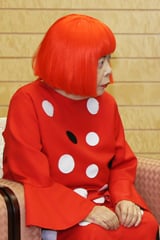
Yayoi Kusama
94% Profile Match
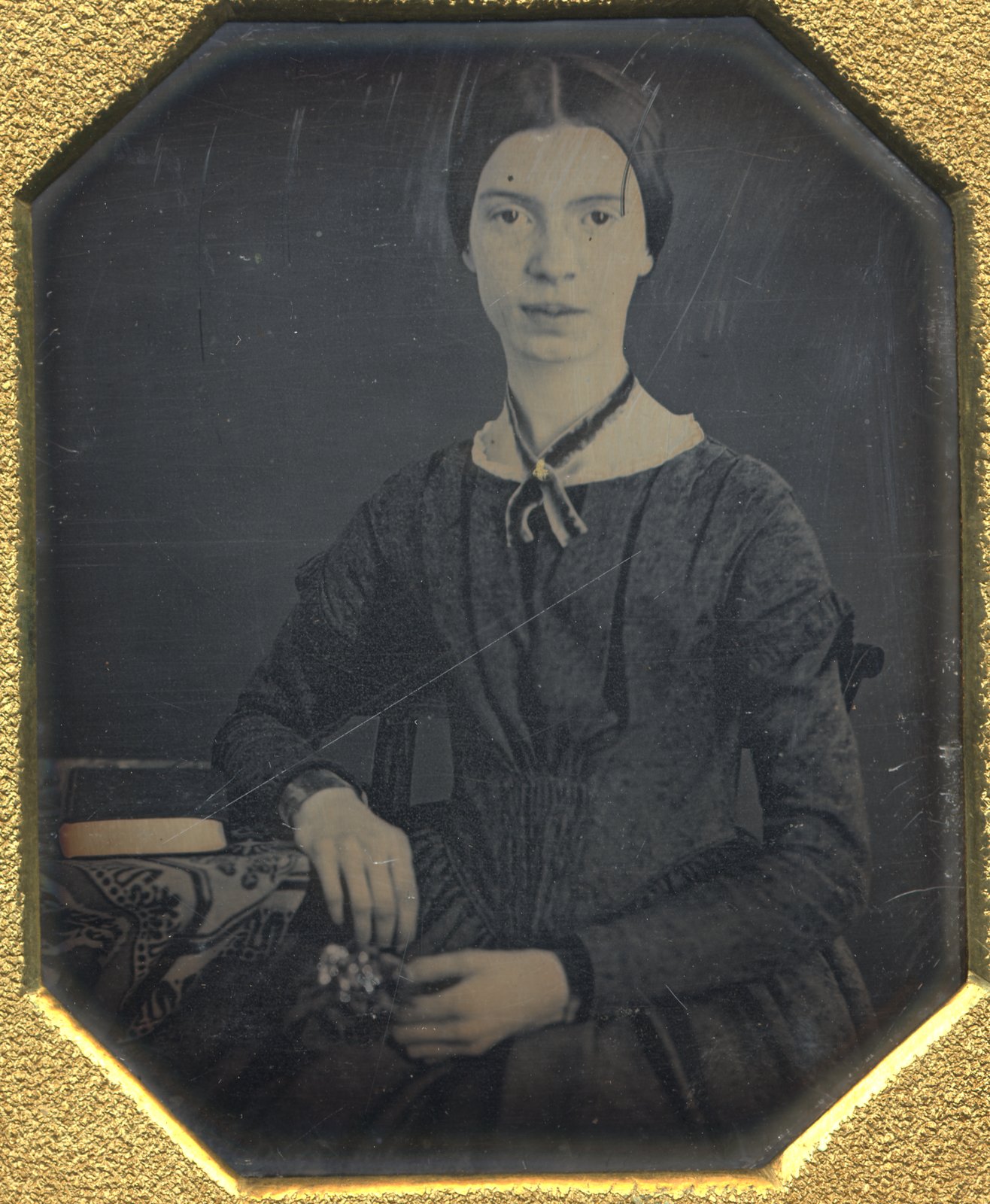
Emily Dickinson, daguerreotype, c. 1846-47; original in Amherst College Archives & Special Collections (credit requested by the holder); cropped and downscaled · Daguerreotype of Emily Dickinson, unknown photographer, probably Amherst, Mass., between 10 Dec. 1846 and late March 1847 (Amherst College Archives & Special Collections, Emily Dickinson Collection; Millicent Todd Bingham gift, 1956) -- Amherst College's own 720 dpi colour scan of the cased daguerreotype ('ED-dag-case-720dpi'), uploaded to Wikimedia Commons as File:ED-dag-cropped-720dpi.tif (original 4788 x 2797 px TIFF); cropped to the plate and gold mat (case lid and velvet removed) and downscaled to 1600 px long edge · Public domain
Dickinson wrote nearly 1,800 poems. Her manuscripts were untitled, numbered only in an approximate chronological sequence, strewn with dashes and irregularly capitalized, and often extremely elliptical in their language; she often used perfect rhyme but also made frequent use of slant rhyme.
Between about 1858 and 1864 Dickinson copied more than 800 of her poems into forty small booklets she made herself, folding sheets of paper and tying them with string. The booklets, now called fascicles, were found by her sister after her death in 1886. About 2,500 poem manuscripts in her hand survive in all.
Only ten of her poems and one letter are known to have been printed in her lifetime, the poems all without her name; scholars doubt that she authorised most or all of these printings. The first collection, Poems (1890), was edited by Thomas Wentworth Higginson and Mabel Loomis Todd, who regularised her punctuation and changed some words. Editions based on the manuscripts came later, from Thomas H. Johnson in 1955 and R. W. Franklin in 1998.
In the summer of 1861 Dickinson sent her sister-in-law Susan Dickinson the poem 'Safe in their Alabaster Chambers', then a completely different second stanza. Susan wrote back that she was 'not suited' with the new stanza, and Dickinson sent a third version, asking 'Is this frostier?'. The notes and manuscripts survive at Harvard and are printed in the 1958 scholarly edition of her letters.
Answering a reader's criticism with fresh alternatives, not by defending the first version, is consistent with the profile's experimentation score. Her later manuscripts often keep several possible words side by side. Experimentation
In June 1862 Higginson suggested she delay publishing. She replied that publishing was 'foreign to my thought'. In 1876 the writer Helen Hunt Jackson pressed her to contribute to an anonymous poetry series. Dickinson asked Higginson for a note saying he disapproved, so that Jackson would accept her refusal. In 1884 Jackson was still urging her to 'give them light'.
Keeping control over whether her poems went into print, despite repeated requests, sits alongside the profile's high score for need for autonomy. Scholars still disagree about whether she wanted to publish, so this reading describes what she did, not why. Need for Autonomy
In April 1862, after reading Higginson's advice to young writers in the Atlantic Monthly, Dickinson wrote to him, a stranger, asking whether her verse was 'alive', and enclosed four poems. In a private letter to the magazine's editor he described verse received that week as 'fortunately not to be forwarded for publication'. In his 1891 account he says he tried to steer her toward rules and traditions, but she would not change a word order just to gain a rhyme, and he soon gave up trying to guide her.
Seeking out an established critic and then keeping her own forms offers one example of the profile's independent thinking. Higginson's account was written decades later by an admirer and co-editor, which is one reason that score is kept below the top band. Independent Thinking
People whose overall profiles resemble theirs.