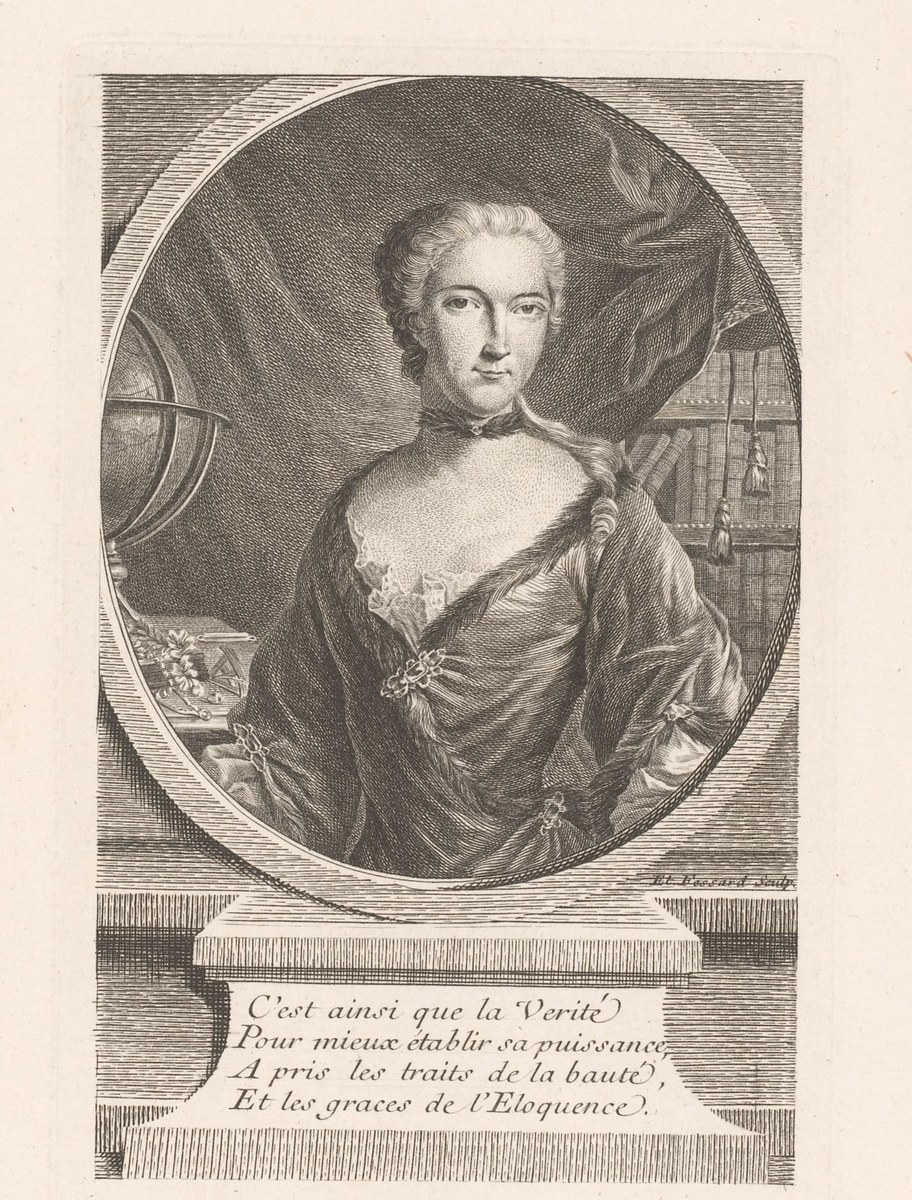
Étienne Fessard after Jean-Marc Nattier, Portrait of Émilie du Châtelet, print, Rijksmuseum, Amsterdam (RP-P-1910-5050), public domain · Engraved portrait of Émilie du Châtelet by Étienne Fessard (named on the print) after a design by Jean-Marc Nattier, plate 147 x 97 mm, dated 1724-1777 by the museum; Rijksmuseum, Amsterdam, object RP-P-1910-5050, titled by the museum as a portrait of Émilie du Châtelet. The museum's record marks the image Public Domain. It is a later print after another artist's design and not a documented sitting, so it is a historical depiction. The file is a crop of the plate from the museum's 4364 x 5884 scan of the print and its mount, downscaled to 912 x 1200 with no upscaling. · Public domain (Rijksmuseum Public Domain Mark; engraver Étienne Fessard died 1777)
physicist · Early Modern
Émilie du Châtelet
1706–1749
Known For
Not yet included in personality matching — the documented evidence doesn't yet cover enough of the personality model. Everything else on this page is fully available.
Trait Constellation
Key Achievements
She translated Newton's Principia into French in the 1740s and added her own commentary with algebraic and calculus explanations; her version, published in 1759 after her death, is still the leading French translation.
In her 1740 Institutions de physique she gave Newtonian physics a Leibnizian metaphysical grounding, a textbook that helped make Leibniz's philosophy known in France.
She entered the Académie des sciences' 1737 prize competition on the nature of fire; her dissertation, which argued against fire being a material substance, was published by the Académie in 1744 alongside the winning entries.
Moments That Reveal Them
On a 1739 trip to Brussels she took many books and the mathematician Samuel König to teach her algebra, so that the journey would not interrupt her studies.
This is consistent with a student who organised her life around continuing to learn mathematics. Mastery Orientation
She defended Leibniz's idea of living force (vis viva) against the Académie's secretary Mairan and printed her exchange with him in the second edition of her Institutions.
This is consistent with a thinker willing to argue a contested position against a senior academician. Independent Thinking
Turning Points
In the mid-1740s she turned from writing her own textbook of physics to translating and commenting on Newton's Principia, work she carried on until her death in 1749.
This is consistent with a shift from presenting her own synthesis to a long commitment to making Newton's mathematics accessible in French. Persistence
Similar People
People whose overall profiles resemble theirs.


Ada Lovelace

Alan Turing

Leonardo da Vinci

Carl Jung

Rosalind Franklin
Opposite Profile
Not a rival — a different profile shape worth a look.

Martin Luther King Jr.
Sources
- Émilie du Châtelet (Q7286), verified live via the Wikidata API (2026-11-01): label 'Émilie du Châtelet', birth 1706-12-23 and death 1749-09-10 (day precision), Korean label 에밀리 뒤 샤틀레, image statements include a Nationalmuseum (Sweden) painting and a second file. The English description field currently reads 'Era chiná physicist, and author (1706-1749)', which looks like a garbled edit and was ignored. Orientation only; not used as support for any row.
- Stanford Encyclopedia of Philosophy, 'Émilie du Châtelet', read through a fetched summary of the entry (not line by line). CANONICAL SIGNIFICANCE SOURCE: her 1740 Institutions de physique is called her magnum opus and supplies a Leibnizian and Wolffian metaphysics for Newtonian physics; her translation and commentary on Newton's Principia, written in the early 1740s and unpublished until 1759, is 'still the leading French translation'; she entered the 1737 Académie des sciences prize competition on fire, with her essay published alongside the winners (Euler won), and repeatedly revised it; she sought tutors in mathematics (Maupertuis, then Samuel König from 1739); her first principles were contradiction and sufficient reason, she was unusually open to hypotheses but set limits on them and dissented from Keill's extension of attraction; she defended Leibniz's vis viva against the Académie secretary Mairan; König accused her of plagiarism (the entry judges the charge misplaced), and Barber (1967) called her thought 'essentially derivative' while Wade (1947) argued for independence, the later view having become dominant. Scholarly reference.
- MacTutor History of Mathematics (University of St Andrews), 'Émilie du Châtelet', read in full: Latin and languages as a girl; later tuition from Maupertuis and Clairaut, discussing some topics 'in the spirit of a collaborator'; the 1737 fire essay, which she entered without telling Voltaire until the winners were announced, published by the Académie in 1744; on a 1739 trip to Brussels she took many books and the mathematician König to teach her algebra so that her studies would not be interrupted; the Institutions de physique (1740) and the dispute with König; she began the Principia translation in 1745, a part was published in 1756 under Clairaut, and the whole in 1759; Voltaire's preface says the algebraic commentary was based on Clairaut's ideas, that she worked out the calculations and Clairaut checked each chapter; also quotes critics (a jealous cousin's description) and Voltaire's admiring Éloge. Independent institutional biography that leans on Voltaire's admiring testimony for her working habits.
- Matthew Wills, 'Émilie Du Châtelet: Heroine of the Enlightenment', JSTOR Daily (22 July 2016), read in full: summarises Judith Zinsser's work on the Principia translation, which Wills says is still considered the standard French translation; she added a commentary with three ways into Newton's celestial mechanics, supplemented later discoveries, and was barred from all but the public sessions of the Académie des sciences because of her gender; a contemporary review said she 'offers us Newton made accessible to everyone'. Popular-scholarly summary of one scholar's research.
- Sarah Hutton, review of 'Émilie Du Châtelet: Rewriting Enlightenment Philosophy and Science' (Eighteenth-Century Fiction 19:3, 2007, Project MUSE), read in full: calls the Principia translation a 'remarkable achievement', says her Institutions de physique helped make Leibniz's philosophy known in France, lists her poetry, plays, treatise on happiness, Bible commentary and translation of Mandeville, notes Diderot's acknowledgment of her in the Encyclopédie and German and Italian translations of the Institutions, and says her writings were later 'depreciated as mere translations, or presumed to be the work of the men of her circle', with Madame de Graffigny's unflattering remarks having tarnished her image. Independent scholarly review with the posthumous-reputation counter-voice.
- Voltaire Foundation (University of Oxford), publication page for 'Émilie Du Châtelet: Rewriting Enlightenment Philosophy and Science' (SVEC 2006:01, eds Judith P. Zinsser and Julie Candler Hayes), read in full: until recently she was 'more remembered as the companion of Voltaire than as an intellectual in her own right'; the volume treats her free translation of Mandeville's Fable of the Bees, the 1738 prize dissertation on fire, the 1740 Institutions de physique and the exchange with Mairan, her two-volume exegesis of the Bible, the Principia translation and commentary, and the Discours sur le bonheur. Publisher's description by scholars of the field.
- Elizabeth H. Blackburn, 'Émilie du Châtelet', She Thought It biography page, read for the first 7,500 characters: the fire essay studied with Voltaire at her Cirey laboratory; the 1740 anonymous first edition of the Institutions as a textbook for her son and its 1742 second edition under her name with her vis viva exchange with Mairan; the plagiarism charge by König; the Principia translation completed by spring 1747 with Clairaut's help and her added appendices and algebraic commentary (the start and completion dates differ from MacTutor's); Cirey as library, laboratory and meeting place for young mathematicians and writers. Secondary biographical summary with footnoted scholarship.