
Sequoyah
88% Profile Match
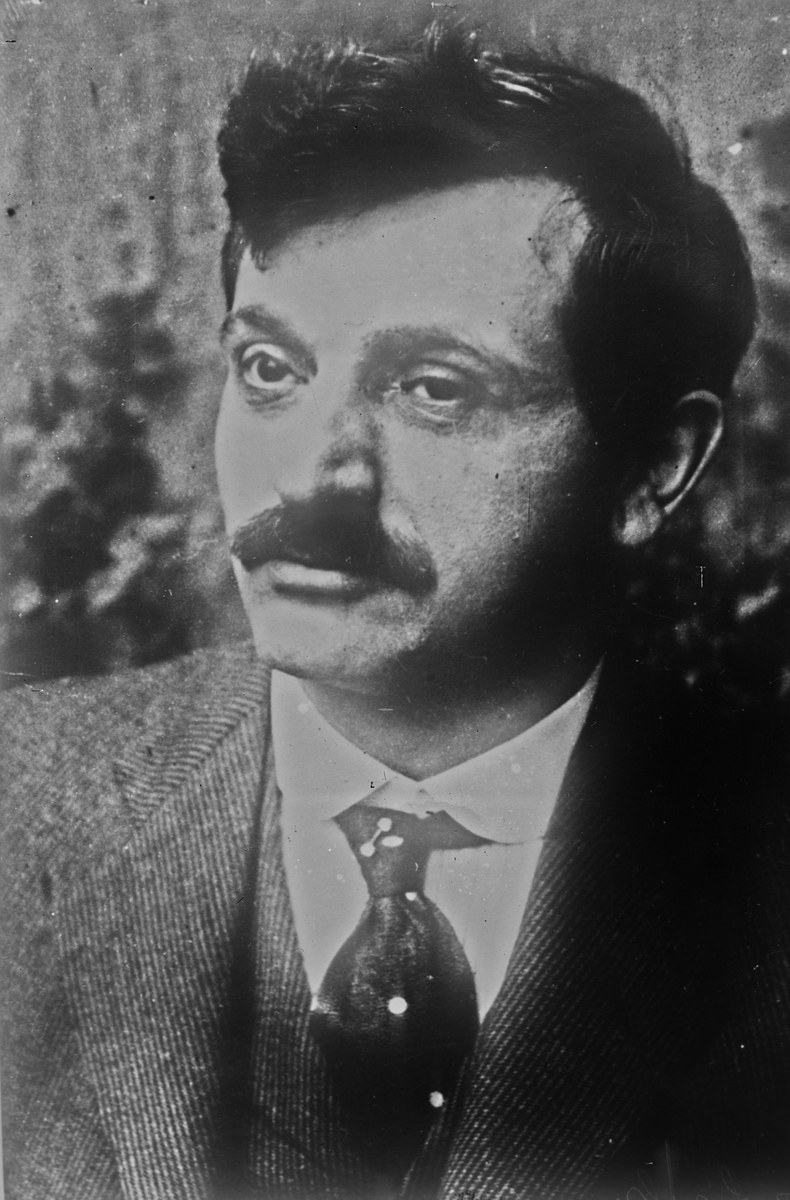
Agence Rol, Dr Emanuel Lasker, January 1921, Bibliotheque nationale de France (Gallica), public domain · Press photograph 'Dr [Emanuel] Lasker (echecs)' by the Paris press-photo agency Agence Rol (the individual photographer is not named), January 1921, reference Rol 63114, glass negative 18 x 13 cm, Bibliotheque nationale de France (Estampes et photographie, EI-13 (755)), digitised on Gallica. The BnF's own catalogue record for this item (read through its OAI service) gives the date as January 1921, identifies the subject as Lasker and states the rights as 'domaine public' / 'public domain'. The scan was 6105 x 8511 pixels; this project cropped away the negative's frame and edge labels (to 5060 x 7690) and reduced it to 790 x 1200 pixels, never enlarging it · Public domain (item-level statement by the Bibliotheque nationale de France; 1921 press photograph by Agence Rol)
athlete · 20th Century
1868–1941
Not yet included in personality matching — the documented evidence doesn't yet cover enough of the personality model. Everything else on this page is fully available.
Won the world chess championship from Wilhelm Steinitz in 1894 and held it for 27 years, defending it against Marshall, Tarrasch, Janowski and Schlechter until he lost it to Capablanca in 1921.
As a mathematician, introduced the notion of a primary ideal in 1905 and proved the primary decomposition theorem for ideals of polynomial rings, a result Emmy Noether generalised in 1921.
Wrote Common Sense in Chess (1896) and Lasker's Manual of Chess, and philosophical works including Das Begreifen der Welt (1913), and held a doctorate in philosophy and mathematics.
After returning to competition at Zurich in 1934, he took third place at the second Moscow International in 1935 at age 66, without losing a game.
This is consistent with sustained competitive effort late in a long career. Persistence
In December 1926, after he was left off the invitation list for the 1927 New York tournament, he issued a long public statement against the organiser that set off fierce exchanges in the press.
This is consistent with a willingness to take a dispute over conditions into public view. Conflict Tolerance
Reaching ten wins against Steinitz in Montreal on 26 May 1894, at age 25, made him world champion, a title he then kept for 27 years.
This is consistent with a competitor who converted early promise into a lasting championship. Competitiveness
People whose overall profiles resemble theirs.

Not a rival — a different profile shape worth a look.
