Carl Jung
90% Profile Match
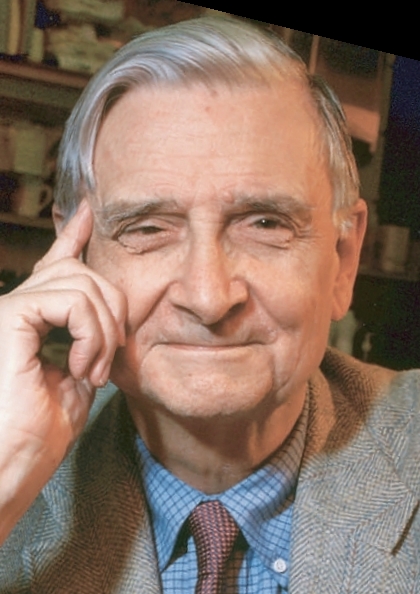
Photo: Jim Harrison / PLoS, CC BY 2.5 · Wikimedia Commons 'File:Edward O. Wilson, 2003 (cropped).jpg' (Wikidata P18), extracted from 'Plos wilson.jpg', source credited as the PLoS download plos_wilson.pdf; author Jim Harrison, dated 2003-02, licence tag cc-by-2.5, category Media from PLOS journals / Open Access File of the Day. Commons record: 420 x 594 (downloaded file confirmed 420 x 594). A wider uncropped original 'Plos wilson.jpg' exists at 1240 x 1054 but was not used (different framing, not checked further; no upscaling anywhere). The PLoS institutional page was not opened; PLoS journals publish under CC BY, consistent with the tag, and no conflicting notice was observed. · CC BY 2.5
biologist · Contemporary
1929–2021
Not yet included in personality matching — the documented evidence doesn't yet cover enough of the personality model. Everything else on this page is fully available.
Wilson earned his Harvard doctorate in 1955 on the ant genus Lasius and became the leading authority on ants; according to National Geographic and Nature he catalogued hundreds of new species and, from fieldwork in Melanesia and the Caribbean, proposed the taxon cycle of range expansion and restriction.
With Robert MacArthur he published The Theory of Island Biogeography (1967), linking an island's size to the number of species it supports; National Geographic says the idea was later applied to mainland reserves and became a cornerstone of conservation biology.
His 1975 book Sociobiology: The New Synthesis set out to study the evolution of social behavior across species and drew sharp criticism for its final chapter on humans; Nature credits later books including Biophilia and the Pulitzer-winning The Ants (1990) with bringing biodiversity into the mainstream.
After the 1975 letter from Gould, Lewontin and others linked Sociobiology to biological determinism, Wilson answered with the more provocative On Human Nature (1978) rather than retreating, according to Nature and to critical historians in the New York Review of Books.
This episode is consistent with a willingness to hold a contested position under sustained public opposition, which his critics read as hardening and his collaborator as intellectual courage. Independent Thinking
In 2010, working with mathematicians, Wilson disavowed a central tenet of his earlier work on how genetic relatedness drives insect societies; the Harvard Gazette says this sparked a debate in Nature, and his co-author Bert Holldobler says he himself disagreed with the change.
This is consistent with a readiness to revise a theory he had helped establish, though colleagues who knew his work disputed the revision itself. Belief Updating
The 1975 publication of Sociobiology: The New Synthesis moved Wilson from ant specialist to a public figure at the center of a debate over biology and human behavior, and his later books reached general readers.
The shift is consistent with a drive to extend detailed specialist knowledge into a unifying account for wider audiences. Systems Thinking
People whose overall profiles resemble theirs.


Not a rival — a different profile shape worth a look.
