
Alan Turing
93% Profile Match
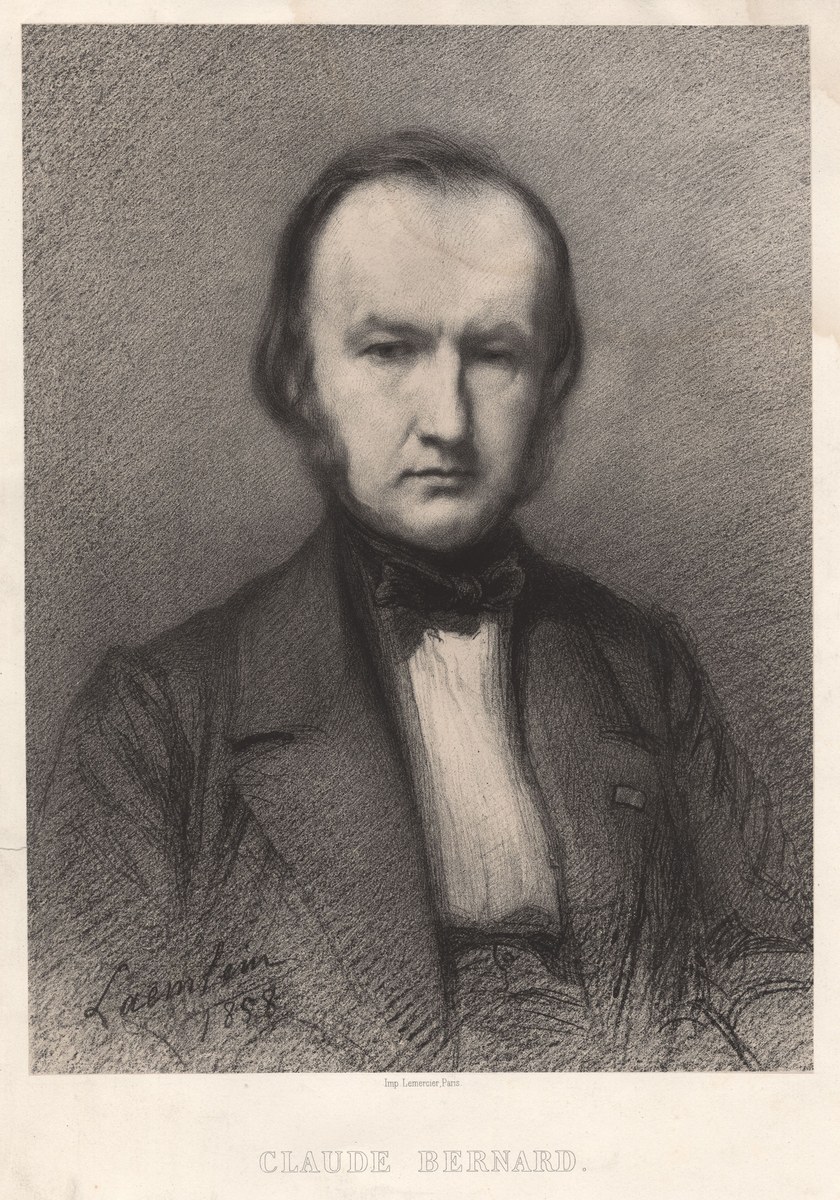
Alexandre Laemlein, 1858, BIU Sante, Universite Paris Cite (CIPC0168), Licence ouverte · Lithograph portrait 'Claude Bernard', signed 'Laemlein 1858', printed by Lemercier, Paris; Bibliotheque interuniversitaire de sante (BIU Sante), Universite Paris Cite, record CIPC0168 (stamp of R. Blanchard). A contemporary printed portrait made when he was 45; the holder record does not document a sitting. Digital master 2645 x 3779 pixels; this copy downscaled to 840 x 1200 (never enlarged). · Licence ouverte (Etalab) stated on the BIU Sante record; the lithograph is also public domain by age (Laemlein died 1871)
scientist · 19th Century
1813–1878
Not yet included in personality matching — the documented evidence doesn't yet cover enough of the personality model. Everything else on this page is fully available.
Played a major part in establishing the principles of experimentation in the life sciences, becoming one of the founders of experimental medicine; his 1865 Introduction to the Study of Experimental Medicine remains a widely read classic.
Discovered the role of pancreatic juice in digesting fats, the liver's glycogenic function and the vasomotor nerves that regulate blood supply, and showed how curare and carbon monoxide act on the body.
Developed the concept of the internal environment, the idea that the constancy of the body's internal milieu is the condition for independent life, which Britannica says led to the present understanding of homeostasis.
Puzzled by the chance observation that some rabbits passed clear rather than cloudy urine, he inferred that they had not been fed and were living on their own tissues, confirmed it by feeding them meat, and an autopsy then led him to the role of the pancreas in digestion.
This is consistent with a habit of following up an unexpected observation with a testable hypothesis and a confirming experiment. Curiosity
After washing the sugar out of a freshly removed dog's liver he found that the liver was again rich in sugar a day later, and inferred that it must contain a sugar-forming substance; in 1857 he isolated pure glycogen from it.
This is consistent with an experimental style that tests a physiological idea directly on the organ and draws the next inference from the result. Experimentation
Forced to rest by illness from 1860, he used his convalescence of 1862-63 to draft the Introduction to the Study of Experimental Medicine, moving his emphasis from the pursuit of concrete facts to the methods and principles of biological science.
This is consistent with a shift from collecting results toward generalising them into a framework for the field. Systems Thinking
People whose overall profiles resemble theirs.


Not a rival — a different profile shape worth a look.
