Maya Angelou
93% Profile Match
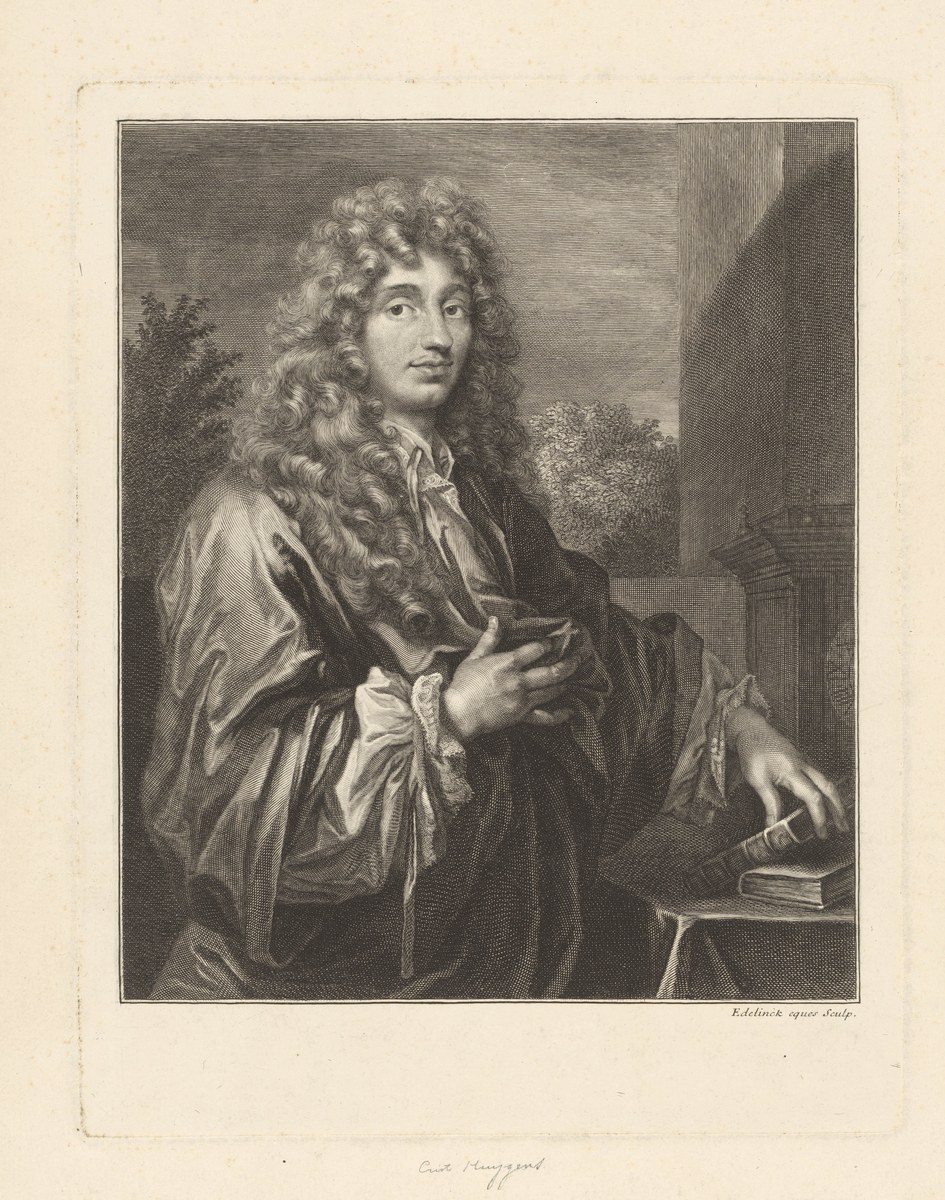
Gerard Edelinck, after a drawing by Jacques-Antoine Friquet de Vauroze, Portrait of Christiaan Huygens, engraving, 1687-1688, Rijksmuseum, Amsterdam, RP-P-BI-7524, Public Domain · Engraving of Christiaan Huygens by Gerard Edelinck after a drawing by Jacques-Antoine Friquet de Vauroze, made about 1687-1688, Rijksmuseum, Amsterdam, object RP-P-BI-7524 (the portrait that was later printed facing the title page of Huygens's Treatise on Light, 1690, according to the museum). The museum record carries a Public Domain mark. This is a printed portrait made during his lifetime from another artist's drawing; there is no documented sitting, so it is classed as a later depiction rather than a likeness. The file is the museum's 5090 x 6464 pixel image downscaled to 945 x 1200 with no upscaling. · Public domain (engraver Gerard Edelinck d. 1707; Rijksmuseum Public Domain Mark)
He proposed a wave theory of light in his Treatise on Light (written 1678, published 1690), whose principle of secondary wave fronts bears his name, and with telescopes he built with his brother he discovered Saturn's moon Titan and the true shape of its rings.
He built a pendulum clock in 1656, a large gain in the accuracy of timekeeping, and worked out the mathematics of the pendulum in the Horologium Oscillatorium (1673); his marine clocks, tested at sea for decades, did not solve the longitude problem.
He worked out the laws of collision of elastic bodies, showing Descartes's rules wrong, wrote a 1657 treatise on probability, and from 1666 was a leading member of the new Academie Royale des Sciences in Paris.
He kept working on a clock to find longitude at sea for decades: clocks were tested at sea in the 1660s, and with a clockmaker and Dutch East India Company funding a new one was tested in 1685, 1686 and 1690, but the trials were judged unsatisfactory because the clock was too sensitive to the ship's motion.
This is consistent with sustained effort on one practical problem across repeated disappointing trials. Persistence
In his first publication in 1651 he refuted Gregory of St Vincent's claimed squaring of the circle, and in the preface to his Treatise on Light he wrote that its demonstrations do not give the certainty of geometry but reach a high probability when predicted phenomena are confirmed by experiment.
This is consistent with a careful distinction between rigorous proof and probable inference. Analytical Rigour
After several years of mainly mathematical work, in 1655 he and his brother began grinding lenses, and within about a year he had discovered Saturn's satellite and recognised its ring; this led him to precise timekeeping and the pendulum clock in 1656.
This is consistent with a mathematician who turned to building instruments to answer observational questions. Experimentation
People whose overall profiles resemble theirs.

Not a rival — a different profile shape worth a look.