Rachel Carson
85% Profile Match
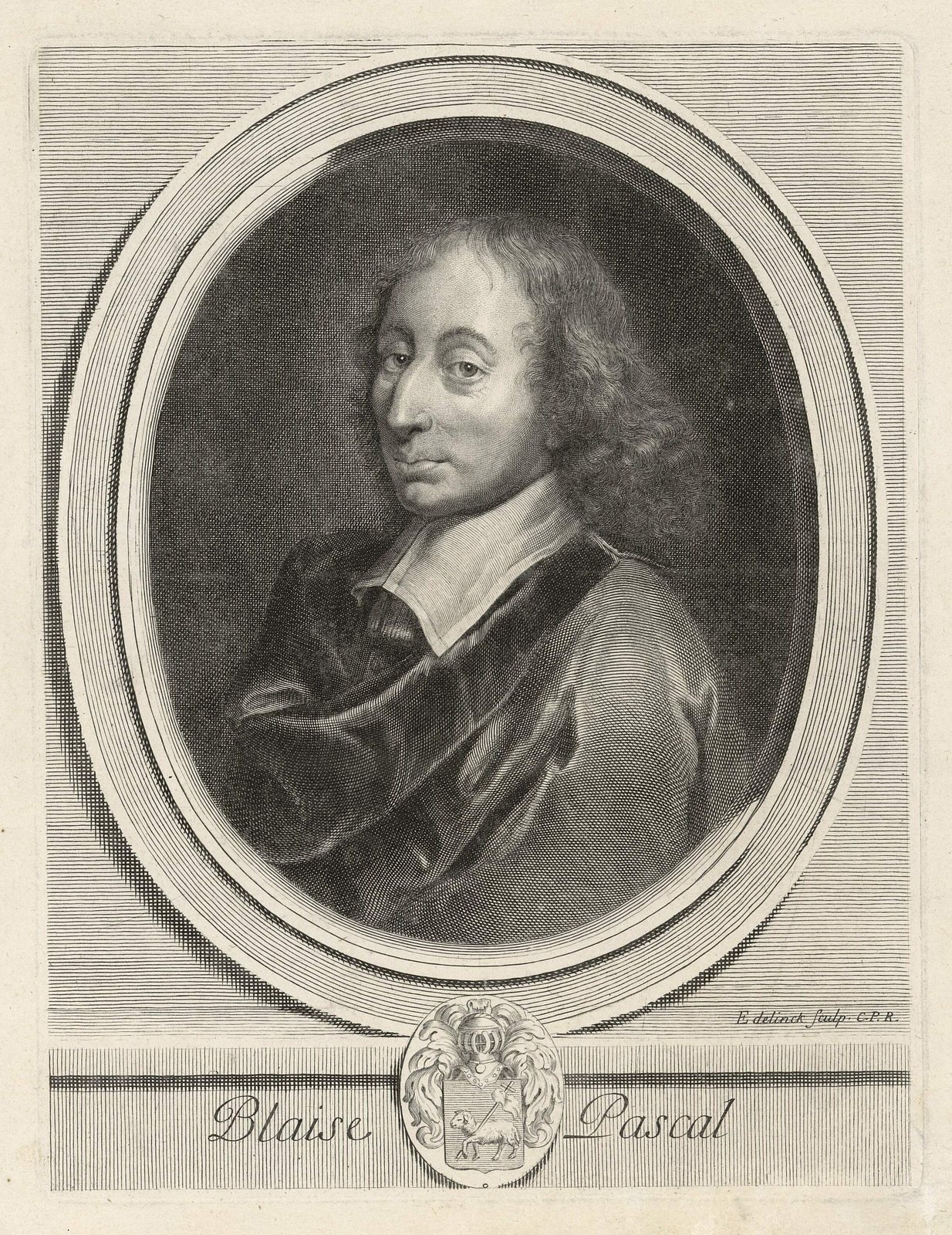
Gérard Edelinck, portrait of Blaise Pascal after François II Quesnel, engraving, c.1691; Clermont Auvergne Métropole, Bibliothèque du patrimoine (GRA 6025); reproduction CC BY-SA 4.0; cropped and downscaled · Gérard Edelinck, copper engraving after François II Quesnel, c.1689-1692 (probably 1691), Bibliothèque du Patrimoine de Clermont Auvergne Métropole (GRA 6025), via Wikimedia Commons (cropped scan) · Public domain (17th-century engraving); library reproduction released under CC BY-SA 4.0
In the summer of 1654 Pascal and Pierre de Fermat exchanged letters on how to divide the stakes of a gambling game interrupted before its end, solving the problem by different methods; mathematicians date the beginning of probability theory to this correspondence. The same year Pascal wrote his Treatise on the Arithmetical Triangle, a systematic study of the table of binomial coefficients that now bears his name, using a form of proof by induction. It was published only after his death, and the triangle itself, known in earlier traditions, was not his invention.
In 1646-47 Pascal took up Torricelli's mercury-barometer experiment and published his New Experiments Concerning the Vacuum; in November 1647 he asked his brother-in-law Florin Périer to test on the Puy de Dôme whether the effects blamed on nature's horror of a vacuum came instead from the weight of the air, and on 19 September 1648 Périer found the mercury about three inches lower at the summit than at the base. His Treatise on the Equilibrium of Liquids, written in the early 1650s and published after his death, sets out the principle of fluid pressure now called Pascal's law, and the SI unit of pressure bears his name. Descartes and others accepted the readings but disputed that the space above the mercury was a true vacuum.
From 1642 Pascal worked on an arithmetical machine, now called the Pascaline, a brass-and-ebony adding and subtracting machine with automatic carry. His own letter and the royal privilege of 1649 say he built more than fifty different models before settling on one, and about eight of the original machines survive. It was not the first calculating machine, since Wilhelm Schickard built one in 1624, and Pascal's sold poorly and went out of production around 1652.
Between January 1656 and March 1657 Pascal published eighteen anonymous open letters, the Provincial Letters, defending the theologian Antoine Arnauld against censure by the Sorbonne and then attacking the moral teaching of the Jesuits, in lively French meant for general readers rather than scholars' Latin. They circulated widely, were condemned in Rome in 1657, and later critics, even one who faulted his method, called them a masterpiece of French prose. His unfinished notes for a defence of Christianity, the Pensées, were published after his death in 1670 and include the argument known as Pascal's wager.
In the 1645 dedication of his arithmetical machine to Chancellor Séguier, Pascal wrote that artisans could not build what he had designed, and that after a Rouen clockmaker made a useless imitation he dismissed all his workmen and resolved to abandon the project. At the Chancellor's urging he resumed work on the machine.
This offers one example of the profile's persistence: a documented near-abandonment and restart over several years, although the account of it comes mostly from Pascal's own letter. Persistence
In January 1656, when Arnauld's own written defence left his friends at Port-Royal unmoved, Arnauld turned to Pascal and said that he, being young, ought to do something; the next day Pascal brought the first Letter, and Arnauld ordered it printed. Nicole, who helped revise the series, is reported to have said that Pascal often spent as long as twenty days on a single letter and rewrote some of them seven or eight times, while the sixteenth letter apologises for its length because he 'had no leisure to make it shorter'.
This is consistent with the profile's persuasiveness: the first Letter was written for readers whom Arnauld's technical paper had not reached, and the revision effort reported by Nicole points to care over how each one would be read. Persuasiveness
In late 1654 Pascal's work changed direction. After a night of religious experience on 23 November 1654, recorded in a note he kept sewn into his coat for the rest of his life, he ended his mathematical correspondence with Fermat and withdrew a short book on the vacuum that was ready for the printer. From 1656 he wrote on theology, in the Provincial Letters and then in notes for a defence of Christianity; he returned to mathematics only briefly, on the cycloid in 1658-59.
This sits alongside the profile's wide range across fields: after 1654 his published work was in a different field from the mathematics and physics of the preceding years, though the sources describe the cause of the change in religious terms and it is not interpreted further here. Cross-Domain Range
People whose overall profiles resemble theirs.


Not a rival — a different profile shape worth a look.