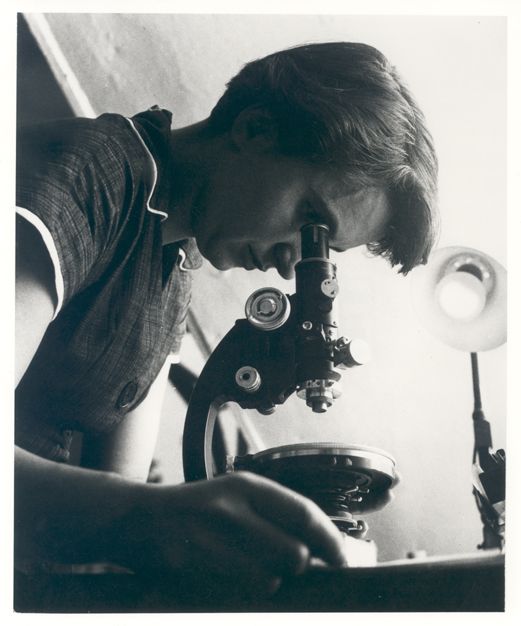
Rosalind Franklin
94% Profile Match

Bernard Gotfryd, 1981 · Library of Congress, Prints and Photographs Division · No known restrictions on publication
Proposed the existence of mobile genetic elements ("jumping genes") in the 1940s-50s, in direct contradiction to the field's prevailing model of a fixed genome -- an idea that drew substantial skepticism for decades before the field caught up and she received the 1983 Nobel Prize, more than thirty years after her first description of the phenomenon.
Built an unusually deep, near-intuitive technical mastery of maize cytogenetics over decades of sustained work at Cold Spring Harbor Laboratory, developing her own cytogenetic staining and chromosome-mapping techniques along the way.
Anticipated that her 1951 presentation on transposable elements would be poorly received by the genetics establishment at Cold Spring Harbor -- and presented the finding anyway rather than withholding it.
Knowingly presenting a finding she expected to be rejected, rather than holding it back, is the basis for the profile's risk_tolerance score. Risk Tolerance
Pursued an anomalous, unexplained pattern of chromosome breakage in maize specifically because the pattern itself intrigued her, rather than dismissing it as experimental noise -- the more common response, and the specific observation her Nobel-winning discovery grew out of.
Choosing to investigate an unexplained anomaly rather than write it off as noise is the basis for the profile's curiosity score. Curiosity
People whose overall profiles resemble theirs.


Not a rival — a different profile shape worth a look.