Rosalind Franklin
90% Profile Match
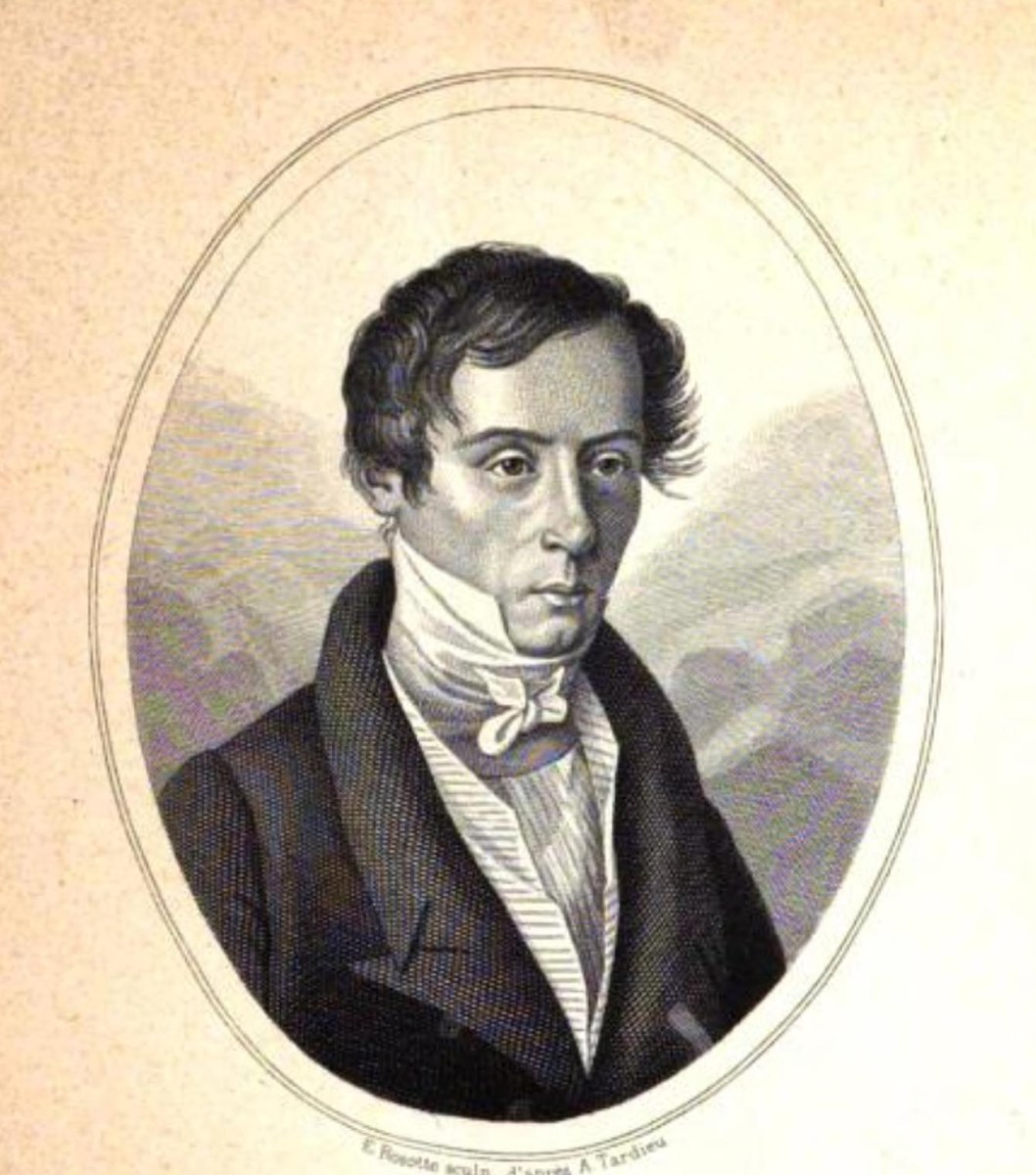
E. Rosotte after Ambroise Tardieu, portrait of Augustin Fresnel, in Oeuvres completes d'Augustin Fresnel, tome 1 (Paris, 1866), public domain · Frontispiece engraving of Augustin Fresnel signed 'E. Rosotte sculp. d'apres A. Tardieu' in the official edition 'Oeuvres completes d'Augustin Fresnel', tome 1 (Paris: Imprimerie imperiale, 1866), in the Internet Archive copy digitised from the New York Public Library (page image 2500 x 3275). The engraving is a later print after a portrait by Ambroise Tardieu; none of the sources read documents a sitting, so it is not presented as a likeness. This file is the engraving only, cropped from the scan and downscaled to 1058 x 1200 with no upscaling. · Public domain: published in Paris in 1866 (before 1931); the portrait it copies is by an artist who died in 1841
physicist · 19th Century
1788–1827
Not yet included in personality matching — the documented evidence doesn't yet cover enough of the personality model. Everything else on this page is fully available.
His diffraction and interference experiments and his mathematics of wavelets helped establish the wave theory of light at a time when most scientists favoured the particle theory, and he concluded that light is a transverse wave.
His 1819 diffraction memoir won the Academy of Sciences prize; Poisson's calculation from its mathematics predicted a bright spot at the centre of a disk's shadow, which was then observed.
He developed stepped lenses for lighthouses, with the first built at the Cordouan tower in 1823, replacing mirrors; the Fresnel lens is still widely used.
He attached a piece of black paper to one edge of a diffracting object, saw the bright bands inside the shadow disappear, and deduced which bands came from light from both edges.
This is consistent with testing an idea by changing one condition in a hands-on experiment. Experimentation
In 1821 he asserted with certainty that light is a transverse wave, a step too far for most colleagues (Arago among them), and then showed that double refraction followed from the idea.
This is consistent with holding to a minority conclusion that his own reasoning supported. Independent Thinking
In mid-1814, while building roads as a government engineer, he began experiments on light, and a few months after writing that he did not know what polarisation of light was he was among the leading physicists of his day.
This is consistent with taking up a new field through his own experiments alongside paid work. Experimentation
People whose overall profiles resemble theirs.


Not a rival — a different profile shape worth a look.