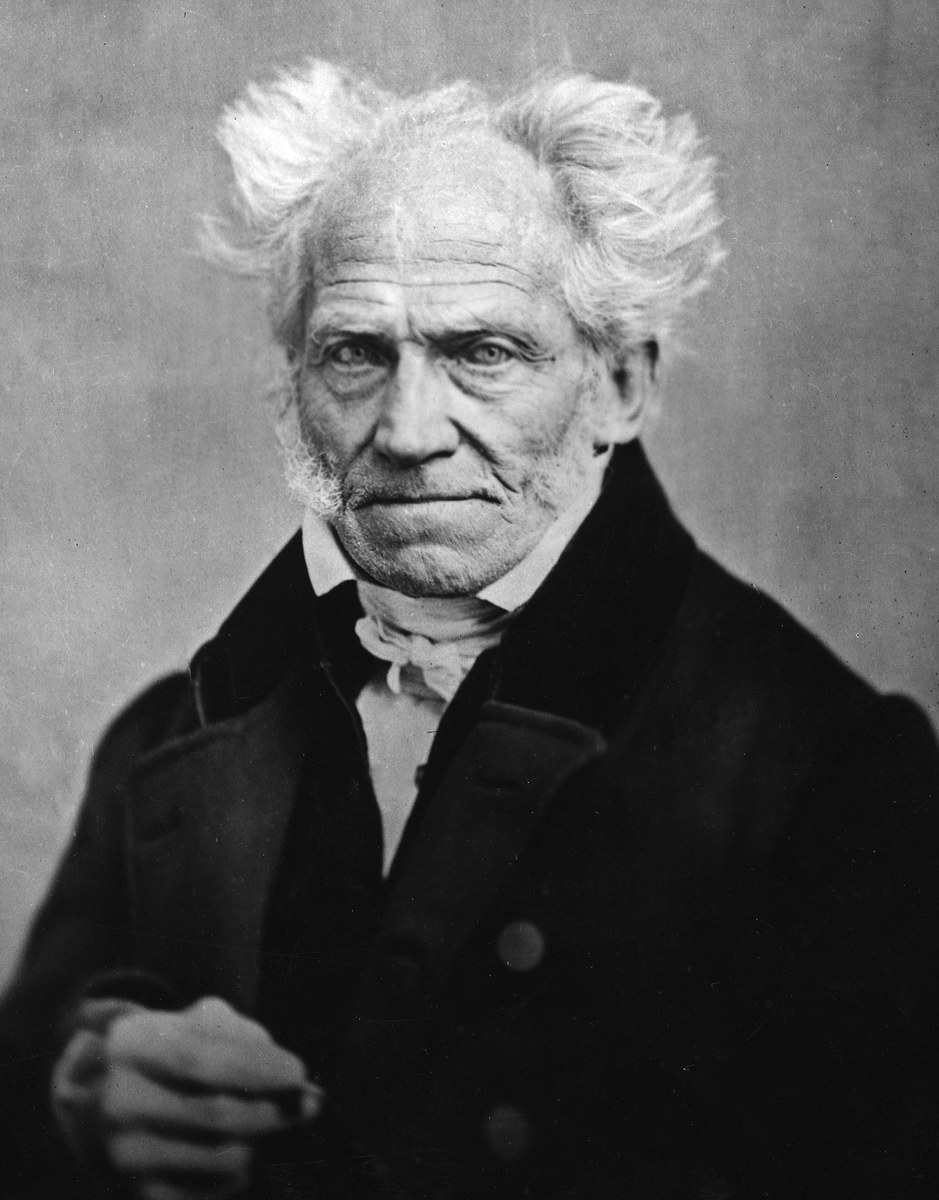

Johann Schaefer, Arthur Schopenhauer, photograph, 1859, Frankfurt University Library (Schopenhauer-Archiv), public domain · Studio photograph of Arthur Schopenhauer taken in 1859 by the Frankfurt photographer Johann Schaefer (1822-1904), one of two surviving frames of the sitting held in the Frankfurt University Library (Schopenhauer-Archiv holdings; the Commons file page cites the library's digital record 81000013 and dates the sitting to March 1859, while Mayer-Wegelin's 2011 article dates Schaefer's first photograph of Schopenhauer to April 1859, so the year 1859 is the safe statement). The Schopenhauer-Jahrbuch article independently documents that Schopenhauer sat to Schaefer in 1859 and gave permission for carte-de-visite prints. The scan was downscaled once from 1,997 x 2,552 pixels to 939 x 1,200 pixels; nothing was upscaled. The image carries no lettering; the sitter is identified by the library record as cited on Commons and by the documented sitting. Caveat: the library's item-level catalogue page (edocs host) was unreachable and the persistent-link resolver was behind a bot challenge, so the holder's own rights wording could not be read; the basis is the age of the photograph (1859) and the photographer's death in 1904. · Public domain (1859 photograph; photographer Johann Schaefer died 1904)
philosopher · 19th Century
Arthur Schopenhauer
1788–1860
Known For
Not yet included in personality matching — the documented evidence doesn't yet cover enough of the personality model. Everything else on this page is fully available.
Trait Constellation
Key Achievements
In The World as Will and Representation (1818/19) he set out a philosophy that treats the will as the inner reality behind appearances, the work for which Britannica says he is primarily important and which it links to later existential philosophy and Freudian psychology.
He built an ethics and aesthetics on that idea: art, with music highest, gives release from the will for a moment, while compassion points the way to its denial; his 1839 essay On the Freedom of the Will won the Royal Norwegian Society's prize.
After decades of neglect he won readers with Parerga and Paralipomena (1851), helped by an unsigned 1853 review in the Westminster Review.
Moments That Reveal Them
In 1820, newly licensed to lecture at the University of Berlin, he scheduled his course in the same hour as Hegel's; only his first lecture was actually held, and he kept scheduling at that hour for years.
This is consistent with a willingness to confront a dominant rival directly, at a cost to his own audience. Conflict Tolerance
When the Danish Academy gave no prize to his 1840 essay On the Basis of Morality, even though it was the only entry, he published it in 1841 with an introduction attacking the Academy's judgement.
This is consistent with holding to his own judgement of his work against an official verdict. Independent Thinking
Turning Points
In 1851 his Parerga and Paralipomena, a collection of essays and aphorisms for a general reader, was published, and within a couple of years an English review of his philosophy in the Westminster Review brought the recognition he had long hoped for.
This is consistent with continuing to publish through decades of neglect until an audience arrived. Persistence
Similar People
People whose overall profiles resemble theirs.

Averroes

Aung San Suu Kyi

Louis Pasteur

Albert Einstein

Alan Turing
Opposite Profile
Not a rival — a different profile shape worth a look.

Ernest Shackleton
Sources
- Arthur Schopenhauer (Q38193), verified live via the Wikidata API (2026-11-05): label 'Arthur Schopenhauer', description 'German philosopher (1788-1860)', born 22 February 1788, died 21 September 1860, Korean label 아르투어 쇼펜하우어. Orientation only; not used as support for any row.
- Stanford Encyclopedia of Philosophy, 'Schopenhauer' (Life: 1788-1860 section read in full, about 1,700 words). CANONICAL SIGNIFICANCE SOURCE: dissertation (1813), The World as Will and Representation (1818/19), the 1820 Berlin lectures scheduled against Hegel, the 1821-26 lawsuit by a fellow lodger, the settled Frankfurt routine from 1833, the 1839 Norwegian prize essay, the 1840 Danish Academy rejection and his defiant 1841 publication, Parerga and Paralipomena (1851) and the 1853 Westminster Review notice that brought recognition.
- Internet Encyclopedia of Philosophy, 'Arthur Schopenhauer' (Life section read in full, about 1,300 words). Independent scholarly account: school dismissal for a satire on a teacher, the break with Goethe over On Vision and Colors, the book making no impression on the public, the Hegel-hour lectures, the lost lawsuit, the 1841 introduction attacking the Danish Academy, the doubled 1844 second edition and the fame that followed the 1851 Parerga; also states that his system remained virtually unchanged from its first articulation.
- Encyclopaedia Britannica, 'Arthur Schopenhauer' by Arthur Hübscher (public-web portion read, about 2,000 words; the remainder is behind a paywall and was not opened). Authored by the long-time head of the Schopenhauer Society, so admiring in tone: states that he was primarily important as exponent of a metaphysical doctrine of the will in reaction against Hegelian idealism, the three years given exclusively to the main work, the Berlin lectures scheduled against Hegel (only the first held), the 1825 last attempt, and that after 1819 no further development of his philosophy occurred.
- Eberhard Mayer-Wegelin, 'Ich gebe Ihnen 20 Minuten Zeit...: Schopenhauers Verhaeltnis zur fruehen Photographie', Schopenhauer-Jahrbuch 2011 (scholarly article, about 3,900 words read from the Mainz University Schopenhauer-Archiv PDF; in German). Non-self behavioural source built on Hübscher's iconography and letters: 31 recorded photographs between 1842 and 1859, his impatience in sittings (per the photographer Mylius), his regular custom with the Frankfurt photographer Johann Schäfer from 1855, and the 1859 dispute with Schäfer over showing a portrait without permission.
- Encyclopaedia Britannica, eleventh edition (1911), 'Schopenhauer, Arthur', as reproduced on Wikisource (about 2,200 words read of the first part). Older critical account that reports specific episodes (a rude letter to his publisher Brockhaus in 1818, the rejection of a family creditor compromise, the failed Berlin lectures and his attribution of failure to Hegelian intrigue); its psychological and family-health asides were deliberately not used.
- Frankfurt University Library (Universitaetsbibliothek Johann Christian Senckenberg), 'Nachlass Schopenhauer' collection page (read in full). Describes the Schopenhauer-Archiv holdings (archival material, his private library and objects, photographs), the library's part in them and the digitised estate; used as the holder-side record for the portrait route. The item-level catalogue records for the photograph could not be opened.