Leonardo da Vinci
92% Profile Match
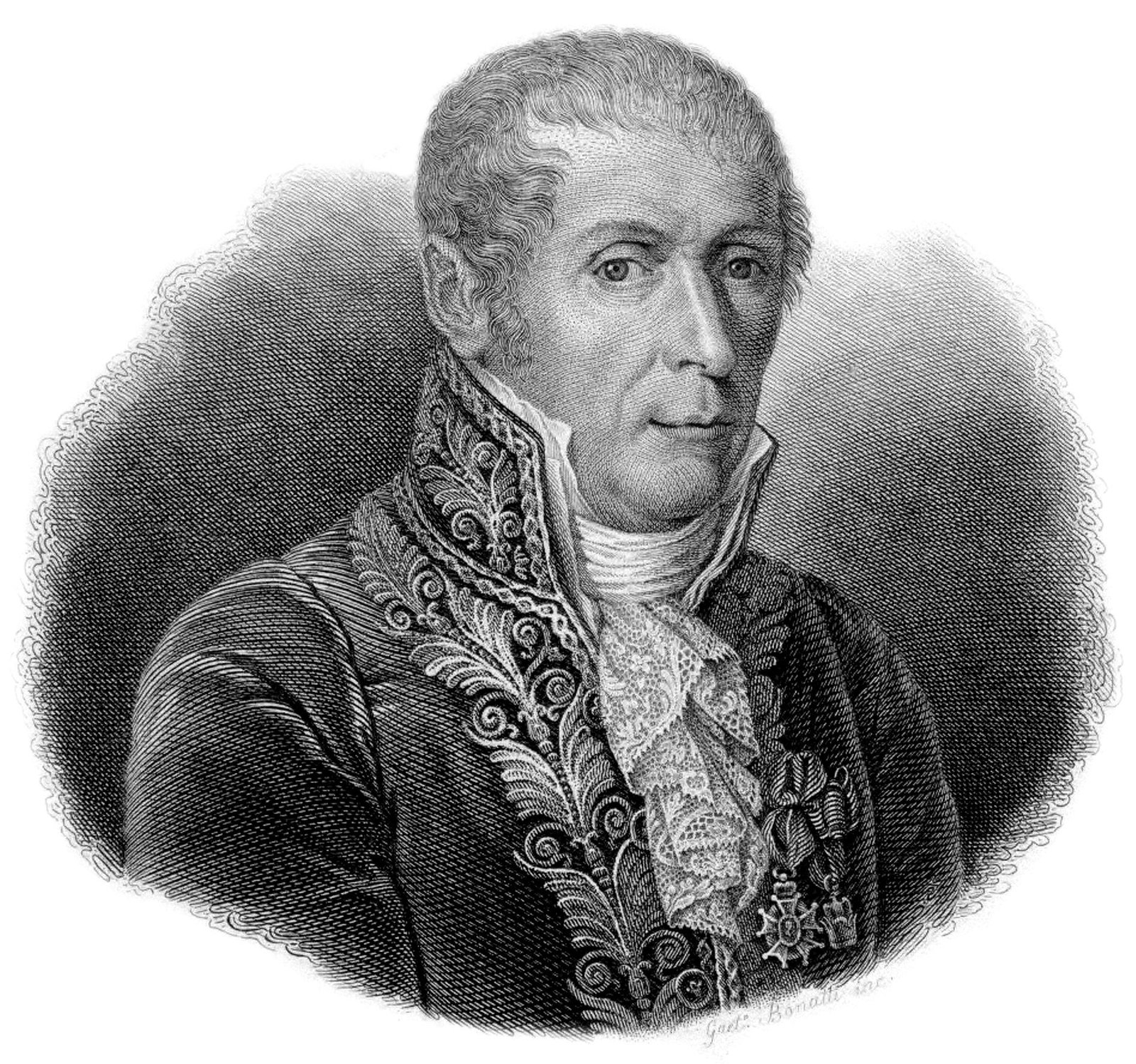
Engraving by Gaetano Bonatti ('Gaet. Bonatti inc.') after a drawing by Giovita Garavaglia (1790-1835), published before 1834; digitised from the Edgar Fahs Smith Image Collection, University of Pennsylvania. Penn Libraries rights statement: No Copyright - United States. · Wikimedia Commons file 'Volta A.jpg' (original 1896x1776, downsized to 1600x1499 without upscaling), from the Edgar Fahs Smith Image Collection, University of Pennsylvania (Penn Libraries catalogue record 'Alessandro Volta : Da un disegno fatto sul vero da Giovita Garavaglia', engraved by Gaetano Bonatti) · Public domain (engraving made before 1834; both named artists died before 1836, so life-plus-100 has long expired worldwide; tagged PD-old-100 on Commons)
physicist · Early Modern
1745–1827
Not yet included in personality matching — the documented evidence doesn't yet cover enough of the personality model. Everything else on this page is fully available.
In a letter to Sir Joseph Banks, read to the Royal Society on 26 June 1800, Volta described a column of alternating silver and zinc plates separated by card or leather soaked in a salt solution, and a variant chain of cups of salt solution joined by arcs of silver and zinc. The Society's summary says the apparatus acts without interruption and gives repeated shocks, and that Volta compared it to the electric organ of the torpedo.
After Luigi Galvani published his frog experiments in 1791, Volta repeated and extended them, and by 1793 he argued that most of the convulsions came from a weak electricity excited by two different metals touching, not from an electricity of the animal itself. Galvani and his nephew Giovanni Aldini defended animal electricity, and Carradori's 1817 history says physicists divided into two camps. The 1892 sketch says the pile grew out of this work.
In November 1776 Volta wrote to Father Carlo Campi that inflammable air could be collected from the bottoms of Lake Maggiore, Lake Como and many ponds and ditches by stirring the mud, and that it burned with a blue flame. Campi had earlier reported a bubbling gas spring near San Colombano. Volta's letters were printed in Milan in 1777 and translated into French.
In 1775 Volta wrote to Joseph Priestley announcing the electrophorus, a device that can supply electric charge repeatedly without being re-excited by friction, and asked how far it was new. Improving it led to the condenser, described in the Philosophical Transactions in 1782, which accumulates very small charges so that an electrometer can show them.
In early November 1776, boating on Lake Maggiore near Angera, Volta prodded the reeds' bottom with his stick, collected the rising bubbles in a large glass vessel and, judging by the smell, told his companions the gas would burn; it did, and he invited others to watch the next day. In the following days he stirred the bottoms of waters near Como and carried flasks of gas home in his pockets. He reported that it burned from every muddy bottom he tried except one, where a candle went out, and that bare stone gave none.
Putting an idea to the test in the field at once, inviting witnesses and recording the one exception is consistent with experimentation. Experimentation
In the memoir he read at the French Institute in November 1801, Volta first set out the three strongest objections to treating the galvanic fluid as ordinary electricity, including the decomposition of water, and then answered them. The English editor William Nicholson objected in print to his letter to de la Metherie, arguing that the liquids and chemical changes in the pile mattered and that Humphry Davy's pile of a single metal with different liquids told against giving everything to the metals. Volta kept his contact explanation.
Keeping to his own explanation while stating the objections himself is consistent with independent thinking; a contemporary critic's chemical objection shows the cost of that stance. Independent Thinking
Galvani's 1791 treatise on electricity in muscular motion led Volta to praise it as a 'beautiful and great' discovery and to repeat the frog experiments. In 1793 he told Tiberius Cavallo that he had found two different metals excite a weak electricity of their own, that he had been on the point of giving up animal electricity, and that after re-testing he kept a smaller role for it but had to renounce, 'not without regret', the idea that the electric fluid acts directly on muscle. Carradori says Volta soon dropped Galvani's theory altogether. The same line of experiments led to the pile of 1800.
Re-testing his own evidence and giving up an idea he liked, while keeping what survived, is consistent with belief updating; he held the contact explanation of the pile against later criticism, so the pattern was not unconditional. Belief Updating
People whose overall profiles resemble theirs.