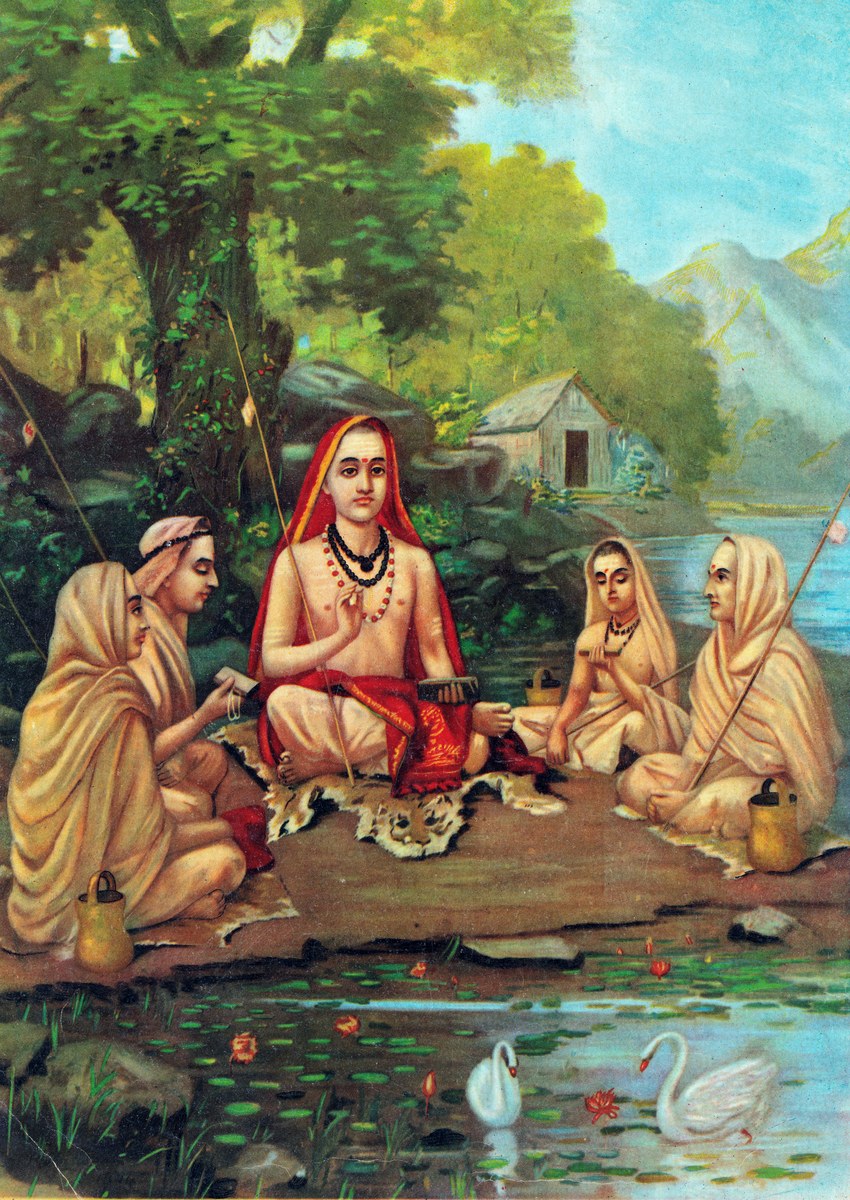
Raja Ravi Varma and Ravi Varma Press, Adi Shankaracharya, circa 1904, collection of The Ganesh Shivaswamy Foundation, Bengaluru, via Google Arts & Culture and Wikimedia Commons. · Colour oleograph print 'Adi Shankaracharya', Raja Ravi Varma and the Ravi Varma Press, circa 1904, 50 x 35 cm, showing him with four disciples, in the collection of The Ganesh Shivaswamy Foundation, Bengaluru (Google Arts & Culture item record) and reproduced on Wikimedia Commons from a 5146 x 7262 pixel scan. A later imagined devotional image made about eleven centuries after the sitter's traditional dates, so it is a depiction and not a likeness. The museum record states the print came from the Ravi Varma Press and was derived from a painting of Ravi Varma, and a Google Arts story cited in the research notes cautions that many Ravi Varma Press prints are not from Ravi Varma's own paintings; the creator is therefore credited to both. Public domain by age: the artist died in 1906 and a print published about 1904 in India is long out of copyright. Downscaled with no cropping to 850 x 1200; not upscaled. · Public domain (published c. 1904; artist died 1906)
philosopher · Medieval
Adi Shankara
788–820
Known For
Not yet included in personality matching — the documented evidence doesn't yet cover enough of the personality model. Everything else on this page is fully available.
Key Achievements
He wrote the earliest complete surviving commentaries on the Brahma Sutras, the Bhagavad Gita and the principal Upanishads, systematising the philosophy of nondual Brahman known as Advaita Vedanta.
His independent work the Upadeshasahasri (A Thousand Teachings) is counted among his works, while scholars doubt his authorship of hundreds of other texts attributed to him.
Stanford's encyclopedia calls him the most authoritative philosopher of Advaita Vedanta; tradition credits him with four or five monasteries, a claim that scholars treat as unverified.
Moments That Reveal Them
In his Brahma Sutra commentary he argued against Yogacara idealism and against what he took to be the Madhyamika position that nothing has an essential ground, defending his own account of nondual existence.
This is consistent with a thinker who built arguments against rival schools as well as expounding scripture. Analytical Rigour
Turning Points
Scholars place his work in the eighth century, but dependable records of his life beyond his writings are lacking, and the Shankaravijaya biographies were composed centuries after his death.
This is consistent with a figure whose historical identity rests mainly on his texts rather than on documented events of his life. Systems Thinking
Similar People
People whose overall profiles resemble theirs.


Warren Buffett

Alan Turing

Rosalind Franklin

Maimonides

Niels Bohr
Sources
- Ādi Shankara (Q180967) -- verified live via Wikidata (2026-10-30): English label 'Ādi Shankara', description 'An Indian philosopher and theologian who consolidated the doctrine of Advaita Vedanta and revitalized Sanskrit scholasticism', Korean label '샹카라', birth 788 and death 820 (traditional dates, year only), no citizenship value, P18 image 'Raja Ravi Varma - Sankaracharya.jpg'. Orientation only; not used as support for any row.
- Neil Dalal, 'Śaṅkara' (Stanford Encyclopedia of Philosophy, first published 4 October 2021), read in full for the life, works and method sections. CANONICAL SIGNIFICANCE SOURCE: it calls him one of the most widely known and influential Indian philosophers of the classical period and the most authoritative philosopher of Advaita Vedanta, says dates are disputed (788-820 CE by early scholars, 700-750 CE per Nakamura, late seventh to early eighth century per Potter), that there are no dependable historical records of his life beyond his works, that the Śaṅkaravijaya hagiographies were composed several centuries after his death, that he was a systematizer and not a founder, that his earliest complete extant commentaries cover the Brahma Sutras, the Bhagavad Gita and ten principal Upanishads plus the independent Upadeśasāhasrī, that hundreds of other attributed texts are of questionable authorship, and that he 'purportedly' established monastic orders and four or five monasteries. Scholarly university encyclopedia entry; the monastery and travel traditions are treated as unverified.
- Sangeetha Menon, 'Advaita Vedanta' (Internet Encyclopedia of Philosophy), history section read in full: that the Advaita tradition predates Śaṅkara and that he acknowledges it in his commentaries, that only Gauḍapāda and Govinda Bhagavadpāda have some historical certainty as earlier teachers, that scholars believe he lived in the eighth century, that his life 'as we understand from the digvijaya texts' is of almost superhuman quality, that his authorship of many attributed texts is established only for some, and that Mandana Miśra's version of Advaita differed from his. Peer-reviewed philosophy encyclopedia written by a professional philosopher; independent of the Stanford entry.
- INDOLOGY mailing list thread 'Works attributed to Śaṅkarācārya' (August 2018), messages by David Reigle, Johannes Bronkhorst and Michael Witzel, read in full: that S. K. Belvalkar considered 408 works attributed to Śaṅkarācārya and concluded that 24 were genuine, that Paul Hacker proposed criteria for authenticity, that Sengaku Mayeda tested the Kena Upanishad and Bhagavad Gita commentaries, that Gussner's stylometric study rejected fifteen of seventeen hymns, and that Ray and Sastri disagreed about the Dakṣiṇāmūrti hymn. Informal expert discussion among Sanskritists, used only to show that the authorship question is debated and with the named studies relayed second-hand; the original articles were not opened.
- Google Arts & Culture, 'Adi Shankaracharya' (Raja Ravi Varma and Ravi Varma Press, circa 1904), collection of The Ganesh Shivaswamy Foundation, Bengaluru, with the Wikimedia Commons file page for the same print, checked for the portrait only.