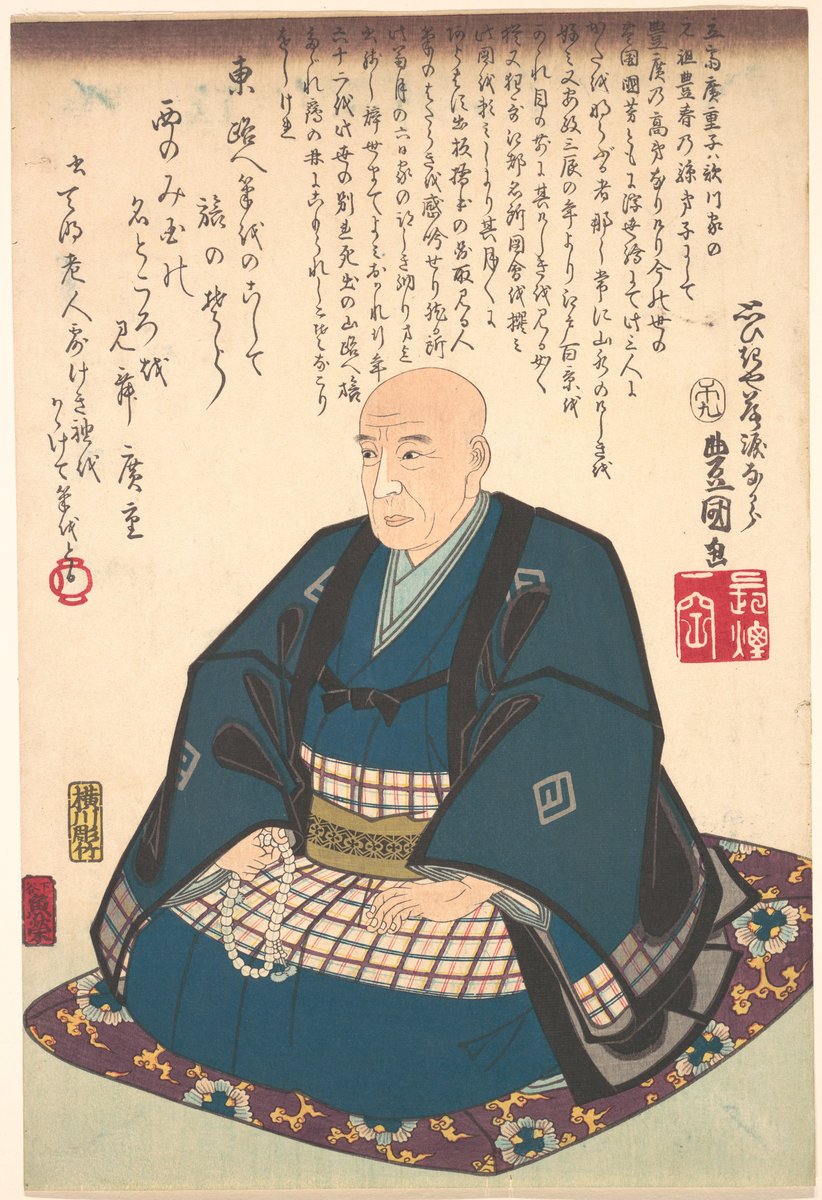

Utagawa Kunisada, memorial portrait of Hiroshige, 1858, The Metropolitan Museum of Art, JP2832, Open Access (CC0) · Memorial portrait of Hiroshige, polychrome woodblock print by Utagawa Kunisada, The Metropolitan Museum of Art, New York, accession JP2832 (Henry L. Phillips Collection, Bequest of Henry L. Phillips, 1939). The Met's Open Access API flags the object as public domain and the Commons copy carries a CC0 declaration. A posthumous memorial print made after his death in October 1858, so shown as a later depiction and not as a likeness taken in his lifetime (the Met record's date field gives only the artists' life dates; the 1858 date is Commons's). Original image 2631 x 3841 pixels from the Met, downscaled to 822 x 1200 with no cropping and no upscaling. · CC0 1.0 Universal (Met Open Access)
예술가 · 19세기
우타가와 히로시게
1797–1858
주요 업적 분야
아직 성격 매칭에 포함되지 않았습니다 — 기록된 근거가 성격 모델 전체를 다루기에는 충분하지 않습니다. 이 페이지의 다른 모든 내용은 자유롭게 확인하실 수 있습니다.
핵심 특성
주요 업적
에도와 교토를 잇는 길을 그린 《도카이도 53역참》(1833~34)으로 풍경 판화가로서 명성을 얻었고, 이 연작은 곧바로 상업적 성공을 거두었다.
쇠퇴하던 배우·미인 그림 대신 날씨와 계절, 일상 속 여행자를 시적으로 담은 풍경을 우키요에의 주요 소재로 끌어올렸고, 도카이도 이후 《기소가도 69역참》 같은 연작을 냈다.
마지막 연작 《명소에도백경》(1856~58)은 그의 사후 후계자 히로시게 2세가 완성했으며, 경매사 해설은 그의 판화가 반 고흐 같은 유럽 화가들에게 영향을 주었다고 전한다.
삶의 장면들
1855년 지진 이후인 1856년 시작한 에도 연작에서 그는 이름 없는 동네 장소를 자주 골라 조감 시점과 강한 원근 대비로 '명소'다운 그림으로 바꾸어 냈다.
이는 익숙한 소재를 독창적으로 다루는 방식과 부합한다. 창의적 독창성
학자들은 그가 삶의 마지막 순간까지 에도 연작 작업을 이어 갔다고 전한다.
이는 꾸준하고 지속적인 작업 습관과 부합한다. 자기 규율
전환점
스승 도요히로가 세상을 떠난 뒤인 1830년대 초 그는 본격적으로 풍경 판화에 나섰으며, 학자들은 정확한 동기는 분명하지 않지만 기존의 배우·미인 그림 전통이 정체되어 있었다고 설명한다.
이는 시장의 새로운 기회를 향해 움직이려는 성향과 부합하지만 그의 동기는 기록되어 있지 않다. 기회 감지
비슷한 인물
전체적인 프로필이 이 사람과 닮은 사람들이에요.


볼프강 아마데우스 모차르트

듀크 엘링턴

쿠사마 야요이

프리다 칼로
코코 샤넬
출처
- Utagawa Hiroshige (Q200798), verified live via the Wikidata API (2026-10-26): label 'Utagawa Hiroshige', description 'Japanese ukiyo-e artist (1797-1858)', born 1797, died 1858-10-12, citizenship Japan, Korean label present, P18 image 'Memorial Portrait of Hiroshige, by Kunisada.jpg'. Orientation only; not used as support for any row.
- Asian Art Museum (San Francisco), Education 'Artist Profile: Utagawa (Ando) Hiroshige (1797-1858)', read in full. CANONICAL SIGNIFICANCE SOURCE: born in Edo to a fire-brigade warden's family, orphaned at 13 and inheriting the post, his turn from Toyokuni to Toyohiro, retirement as fire warden to become a full-time artist (given there as 1822), his first landscapes (Famous Places in the Eastern Capital, 1825) adopting Western conventions, the Tokaido journey of 1832 (hedged as 'reportedly'), the Fifty-three Stations of the Tokaido, the Kiso Road series begun with Eisen, and the One Hundred Views of Edo (1856-1858). Museum teaching text; admiring, and its account of why a samurai became an artist is explicitly speculative.
- Takaaki Kumagai, essay on 'Fudo Waterfall at Oji' from One Hundred Famous Views of Edo, Spencer Museum of Art, University of Kansas (accession 1999.0151), read in full: his fire-brigade background and the speculation about fire-tower viewpoints, landscape as a market choice after ukiyo-e traditions stagnated, the early-1830s turning point whose 'exact motives remain unclear', the 1832 official journey, scholars' contrast between Hokusai's experiment and Hiroshige's lyricism, the choice of minor sites in the Edo series after the 1855 earthquake, and his work on it until his last moments. Academic museum essay citing Poster, Smith and Buck (2001); it contains an internal slip about the year of the cholera epidemic (1859 instead of 1858).
- Sotheby's, '21 Facts About Utagawa Hiroshige' (sothebys.com article), read in the biographical and works sections: Edo birth to a low-ranking samurai fire-warden family, orphaned young, his rejection by Toyokuni and Toyohiro before being taken in, the roughly 8,000 works he is thought to have produced, the Tokaido series' success and more than 20 later Tokaido series, the vertical format of the Edo series completed by Hiroshige II, his bokashi colour technique, reported poverty and debts, his 1856 retirement as a Buddhist monk, and his influence on European painters. Auction-house marketing copy: enthusiastic, partly unsourced, and its account of his rejection by both masters differs from the Asian Art Museum's, so it is used only for corroboration.
- Art Institute of Chicago, 'Catalogue of a Loan Exhibition of Colour Prints by Ichiryusai Hiroshige, 1797-1858' (April 1912), introduction read in full (about 4 pages, via the Internet Archive): his training under Toyohiro after Toyokuni's refusal, the Toto Meisho series, the publisher Takeuchi's Tokaido commission and its instant success, the possible journey to Kyoto (date uncertain), the change of his artist name to Ichiryusai ('One Standing Alone'), edition after edition of the Tokaido prints, his continuing energy, changes made to the designs between editions, and the later vertical-format works. Early twentieth-century exhibition catalogue by curators; admiring and now dated, and it says the date of the journey is not known.
- Yone Noguchi, 'Hiroshige' (1921, Cornell University Library copy via the Internet Archive), read in the sections on his place in ukiyo-e, the Tokaido and Kiso series and his relation to Hokusai (about one third of the 48,000-character text; the plate lists were not read): states the Tokaido series drew on sketches made on the journey, reports Usui Kojima's view that the Kiso series challenged Hokusai, and says Hiroshige reportedly judged other pictures by whether they showed Hokusai's influence. Interpretive essay by a Japanese poet-critic, now dated; he doubts the authenticity of Hiroshige's popular farewell verse and calls the artist partly 'a discovery or creation of the westerners'.
- The Metropolitan Museum of Art Open Access record JP2832 (object 53719), 'Memorial Portrait of Ichiryusai Hiroshige (1797-1858)', woodblock print by Utagawa Kunisada, Henry L. Phillips Collection, Bequest of Henry L. Phillips, 1939, flagged as public domain in the Met's API, checked for the portrait only; not used for any scoring.