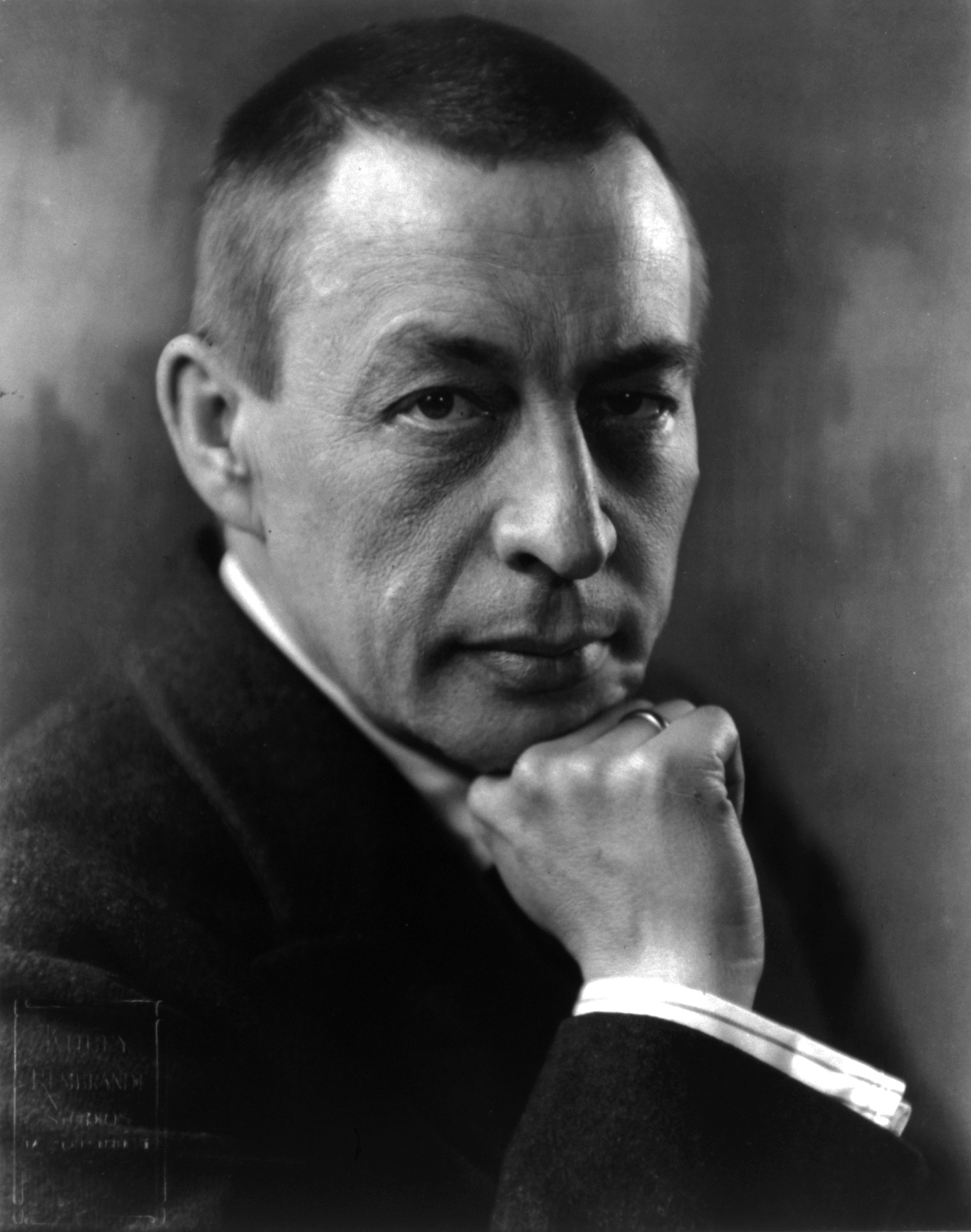

Kubey-Rembrandt Studios (Philadelphia), head-and-shoulders portrait, c1921 (LOC record: 'c1921', note 'Photo by Kubey Rembrandt, 1732 Chestnut St., Phila., Pa.'); Library of Congress Prints and Photographs Division, rights status not evaluated by LOC; a c1921 copyright date indicates publication before 1923 · Library of Congress Prints and Photographs Division, BIOG FILE (LC-USZ62-40236; hdl.loc.gov/loc.pnp/cph.3a40575), via Wikimedia Commons 'Sergei Rachmaninoff cph.3a40575.jpg' · Public domain
핵심 특성
주요 업적
라흐마니노프의 피아노 협주곡 2번은 1900년 6월부터 1901년 4월 사이에 작곡되어, 1901년 11월 9일 모스크바에서 알렉산드르 실로티의 지휘로 전곡이 초연되었다. 1909년 여름에 쓴 피아노 협주곡 3번은 1909년 11월 28일 뉴욕에서 월터 담로슈가 지휘하는 뉴욕 심포니 소사이어티와 작곡가 자신의 협연으로 세계 초연되었다. 차이콥스키가 높이 평가한 소품집 Op. 3 『환상적 소곡집』에 실린 「C샤프 단조 전주곡」은 수십 년 동안 앙코르로 요청받을 만큼 널리 연주되었다.
라흐마니노프는 1906~07년에 교향곡 2번을 작곡하고 1908년 1월 26일 상트페테르부르크 초연을 직접 지휘했다. 교향시 「죽음의 섬」도 같은 드레스덴 시기에 쓰였다. 1915년 겨울에는 러시아 정교회 성가 선율을 무반주 합창으로 엮은 「저녁 기도(전야 기도)」를 작곡했다. 1934년에는 스위스의 별장에서 「파가니니 주제에 의한 랩소디」를 썼고, 1934년 11월 7일 볼티모어에서 레오폴드 스토코프스키와 필라델피아 오케스트라의 반주로 직접 초연했다.
라흐마니노프는 1918년 11월 10일 뉴욕에 도착해 찰스 엘리스와 C. J. 폴리 두 매니저, 그리고 스타인웨이 사와 함께 연주 활동을 시작해 피아니스트로서 경력을 쌓았다. 그의 프로그램은 베토벤, 슈만, 리스트, 그중에서도 쇼팽을 중심으로 했다. 1943년 AP 부고는 그를 파데레프스키에 버금가는 피아니스트로 평하며 50년 가까이 청중 앞에 섰다고 전했다. 러시아를 떠나기 전에는 모스크바에서 볼쇼이 극장을 포함한 지휘직도 맡았다.
삶의 장면들
라흐마니노프는 1905~06년 샬랴핀에게 자신의 두 오페라의 베이스 역을 지도해 주겠다고 제안했고, 다른 작곡가의 오페라를 함께 준비할 때는 그의 회고대로 '봐주지 않고' 가수를 두세 시간 이상 피아노 앞에 붙들어 두어 자기 파트와 오페라 전체를 '관현악 편성의 세부까지' 익히게 했다. 그는 그 연습에서 자신이 '정말 가혹했다'고 말했다. 샬랴핀은 같은 협업을 두고, 라흐마니노프가 피아노를 칠 때는 '우리 둘이 함께 노래한다'고 회상했다. 지도 이야기는 리제만이 받아 적은 라흐마니노프 자신의 증언이다.
일류 가수를 세부까지 확실해질 때까지 반복해서 훈련시키고 그 점에서 스스로를 '가혹했다'고 평한 일은 완벽주의와 부합한다. 다만 이 서술은 본인의 증언이며, 샬랴핀의 회고록은 이런 반복 훈련보다 둘의 협업이 따뜻했다는 점을 전한다. 완벽주의
1906년 가을 제국극장과의 계약이 끝나자, 라흐마니노프는 '거의 무제한의 권한'을 주겠다는 제안에도 계약을 갱신하지 않고 가족과 함께 조용히 작곡할 수 있는 드레스덴으로 떠났다. 드레스덴 거리에서 마주친 지인에게 그는 '친구들에게서 도망쳐 왔다'고 말했다. 교향곡 2번과 「죽음의 섬」은 이 드레스덴 시기에 쓰였다.
작곡할 시간을 지키려고 막강한 직위를 포기한 일은 강한 자율성 욕구와 부합한다. 이 서술은 리제만이 기록한 본인의 회고에서 나온 것이다. 자율성 욕구
전환점
라흐마니노프의 교향곡 1번은 1897년 상트페테르부르크에서 알렉산드르 글라주노프의 지휘로 초연되었다. 연주는 좋지 않았고, 세자르 퀴이의 평은 혹독했으며, 림스키코르사코프는 리허설에서 이 음악이 마음에 들지 않는다고 말했다. 라흐마니노프는 훗날 작품의 결점이 실제로 있었다고 인정했다고 말하며 악보를 거두어들였고 한동안 작곡을 거의 하지 않았다. 1900~01년에는 사촌 실로티가 2년간 생활을 지원해 준 덕에 피아노 협주곡 2번을 썼고, 1901년 모스크바 초연은 성공을 거두었다.
교향곡을 변호하는 대신 비판이 어느 정도 옳았다고 받아들인 점은 믿음 갱신과 부합한다. 교향곡의 결점에 대한 판단은 본인의 회고이며, 림스키코르사코프의 회고록은 이 작품이 연주되었다는 사실만 기록한다. 입장 수정 성향
비슷한 인물
전체적인 프로필이 이 사람과 닮은 사람들이에요.
출처
- Sergei Rachmaninoff (Q131861) -- verified live via wbgetentities (2026-10-07): en label 'Sergei Rachmaninoff', description 'Russian composer, pianist and conductor (1873-1943)', instance of human, P569 1 Apr 1873 (Gregorian; a 20 Mar 1873 Julian value also listed), P570 28 Mar 1943, citizenship Russian Empire and United States, ko label '세르게이 라흐마니노프', P18 'Sergei Rachmaninoff, pianist (SAYRE 1608) (restored).jpg'. Orientation only; not used as support for any row.
- Wikipedia articles on Sergei Rachmaninoff, Piano Concerto No. 2, Piano Concerto No. 3, Symphony No. 2 and Rhapsody on a Theme of Paganini -- read as orientation for premiere dates only; not used as support for any scored row.
- Oskar von Riesemann, Rachmaninoff's Recollections Told to Oskar von Riesemann (New York: Macmillan, 1934; trans. Dolly Rutherford), Internet Archive full text -- SELF-TOLD memoir recorded by a friendly editor (Riesemann knew the composer from 1922, with an introduction by Daniel Gregory Mason); admiring, and Rachmaninoff's own words dominate, so it counts as a self source with editorial framing, not an independent perspective. Read locally in chunks: the introduction and preface; Ch. 3 (Sverev household, practice regime); Ch. 4 (the October 1889 break with Sverev, the Great Gold Medal exam, Gutheil, Aleko and the Tchaikovsky rehearsals); Ch. 5 (the First Symphony premiere of 1897, Cui's review, Rimsky-Korsakov's remark, the Fantasia and the bells advice); Ch. 6 (Mamontov Private Opera, first conducting failure and recovery, the Siloti-funded years of composition, Second Concerto period); Ch. 7 (Pan Voyevoda rehearsals, Chaliapin coaching, Baklanov, the 1906 decision to leave Moscow); Ch. 9 (first American tour, Mahler rehearsal, refusal of the Boston post); Ch. 10 (war-time charity concerts, Scriabin deputation, Vesper Mass, 1917 rewriting of the First Concerto, decision to become a full-time concert pianist in Scandinavia, Boston offers refused); Ch. 11 (arrival in New York, managers, programme choices, Stokowski, the neglect of composing). Chapter 12 (works survey) and Ch. 8 were only skimmed.
- Tchaikovsky Research (en.tchaikovsky-research.net), 'Sergei Rachmaninoff' -- scholarly reference wiki built on Tchaikovsky's letters, diaries and contemporaries' memoirs; INDEPENDENT of Rachmaninoff's own memoir. Read in full (first half closely): Tchaikovsky's 1891 letter calling Rachmaninoff's four-hand Sleeping Beauty arrangement lacking in courage, initiative and creativity, the 19-day composition of Aleko, the award of the Great Gold Medal (given twice before), Tchaikovsky's 1892 interview naming Rachmaninoff among promising younger composers and Rachmaninoff's letter about it, the 1893 Aleko premiere and Ippolitov-Ivanov's memory of the 1893 Taneyev soiree.
- Feodor Chaliapin, Man and Mask: Forty Years in the Life of a Singer (New York: Knopf, 1932; trans. Phyllis Mégroz), Internet Archive full text, chapter 'Serge Rachmaninov: A visit to Leo Tolstoi' and the Gorky passage -- PEER/COLLABORATOR perspective (non-self; Chaliapin was Rachmaninoff's close friend and frequent partner, so it is warm but is a different person's first-hand observation). Read in full for the passages on the Mamontov years, Rachmaninoff as accompanist and conductor, the 30 January 1900 visit to Tolstoy and the book recommendation that introduced Gorky to Chaliapin.
- Nikolay Rimsky-Korsakov, My Musical Life (New York: Knopf, 1923; trans. Judah Joffe), Internet Archive full text -- memoir of an older composer from the rival St. Petersburg school (independent, and professionally detached). Read the passages on the Belayev circle (Rachmaninoff 'kept apart'), the Russian Symphony Concerts programme with the D-minor symphony, and the autumn 1904 Moscow production of Pan Voyevoda with Rachmaninoff conducting.
- 'New Music by a Russian ... Third Pianoforte Concerto played by the Composer with the New York Symphony Orchestra', The Sun (New York), 29 November 1909, p. 7, Library of Congress Chronicling America OCR text -- contemporary newspaper review of the 28 November 1909 world premiere of the Third Concerto; mixed-to-reserved in judgement (too long, little contrast, 'not a great or memorable proclamation') but records the audience response and the pianist's manner. The OCR is garbled; only the review column was read.
- Associated Press obituary 'Requiem Mass Held for Rachmaninoff, Noted Concert Pianist', Evening Star (Washington, D.C.), 29 March 1943, p. 12, and 'Rachmaninoff's Body Is Placed in Crypt', 31 March 1943, p. 10, Library of Congress Chronicling America OCR text -- wire-service obituary; used only for dated public facts and the guarded-private-life and concert-conduct remarks it reports (the 'unruly audience' recital is a wire anecdote, not independently confirmed). Both read in full.