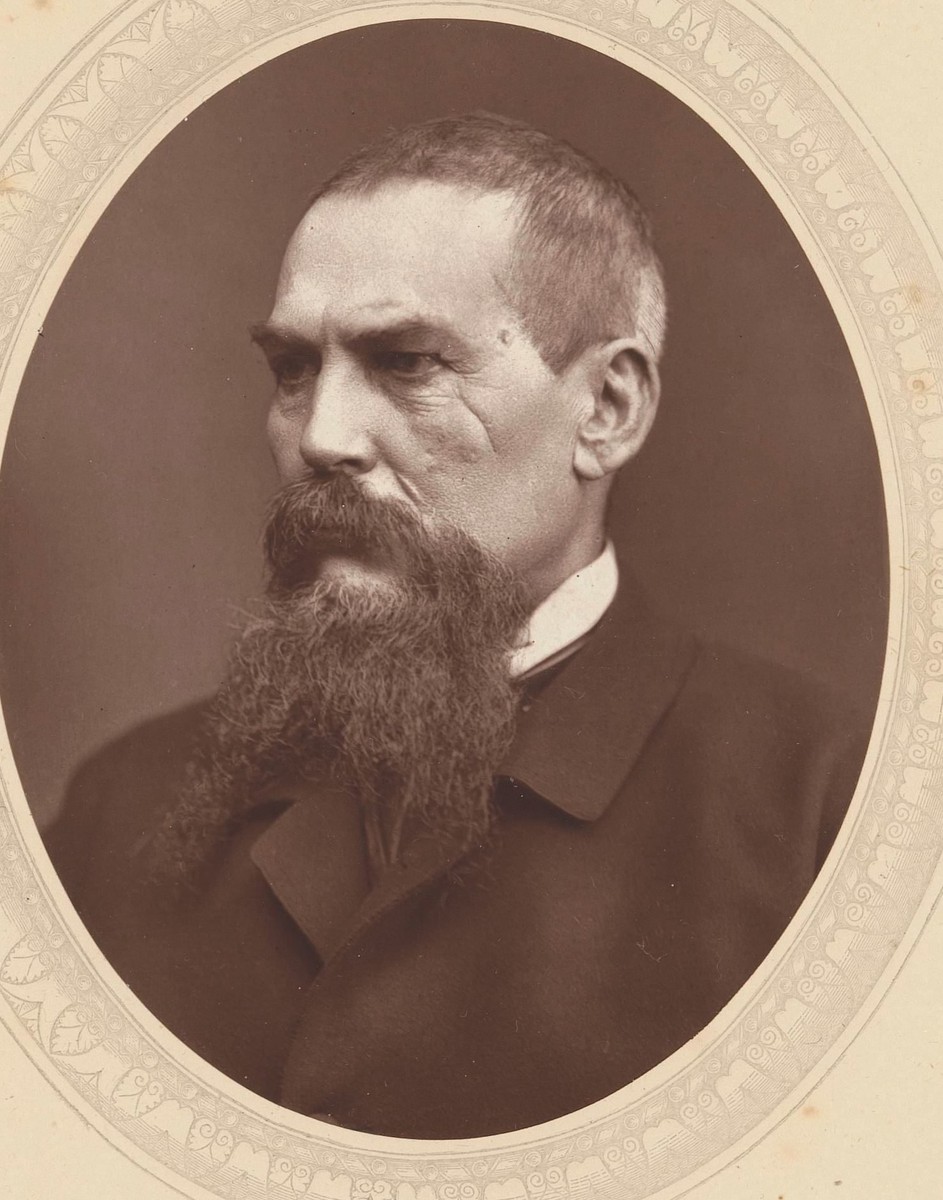

Lock & Whitfield, Captain Richard Francis Burton, about 1871-1876, woodburytype, Rijksmuseum, Amsterdam (RP-F-2001-7-235A-7), public domain · Woodburytype portrait print 'Captain Richard Francis Burton' by the London photographers Lock & Whitfield, about 1871 to 1876 (the museum's date range is 'in or before 1876'), 115 x 89 mm, tipped into a book, collection of the Rijksmuseum, Amsterdam (object RP-F-2001-7-235A-7, purchased with the support of several Dutch funds). The Rijksmuseum's own linked-art record (opened live) gives the photographer as Lock & Whitfield, the print title as Captain Richard Francis Burton, and an item-level Public Domain Mark on the image. The photographic studio worked in the 1860s to 1880s and the print was made well over 100 years ago. The file is the museum's full-resolution scan of the book spread (7146 x 4570 pixels), cropped to the oval portrait plate and reduced (downscaled only, never enlarged) to 943 x 1200 pixels. · Public domain (Rijksmuseum Public Domain Mark; 1870s photograph by Lock & Whitfield)
탐험가 · 19세기
리처드 프랜시스 버턴
1821–1890
주요 업적 분야
아직 성격 매칭에 포함되지 않았습니다 — 기록된 근거가 성격 모델 전체를 다루기에는 충분하지 않습니다. 이 페이지의 다른 모든 내용은 자유롭게 확인하실 수 있습니다.
핵심 특성
주요 업적
빅토리아 시대의 탐험가로, 1853년 무슬림 순례자로 변장해 메카와 메디나에 갔고 하라르를 방문했으며, 왕립지리학회의 동아프리카 탐험대를 이끌어 1858년 근대 들어 유럽인으로서 처음으로 탕가니카 호를 보았다.
『천일야화』(아라비안 나이트, 1885-88)와 『카마수트라』를 번역했고 여행과 관찰을 담은 책을 많이 썼다. 1911년판 브리태니커는 『천일야화』 번역을 그의 최고 업적으로 꼽으면서도 학문적 균질성이 부족하다고 비판한다.
여러 언어를 익혔고, 이를 변장과 함께 활용해 방문한 지역 사람들의 종교와 관습, 생활을 기록했다. 『옥스퍼드 영국사 안내서』는 이 책들을 그의 가장 훌륭한 기념비라고 평한다.
삶의 장면들
1853년 비무슬림의 출입이 목숨을 건 금지였던 시기에 아프가니스탄 사람으로 변장해 메디나와 메카로 가는 순례 대상에 합류했고, 이 경험을 쓴 책으로 유명해졌다.
이는 외부인에게 닫힌 장소를 직접 보고 기록하기 위해 큰 개인적 위험을 감수하려 한 모습과 일치한다. 위험 감수
1858년 스피크가 빅토리아 호를 나일강의 발원지라고 주장하자 버턴은 이를 받아들이지 않고 『중앙아프리카의 호수 지역』(1860)에서 반박했다. 이 공개 논쟁은 1864년 예정된 토론 전날 스피크가 숨질 때까지 이어졌다.
이는 논란이 된 주장을 두고 오랜 공개 논쟁을 이어가려 한 모습과 일치하지만, 탐험 전문 매체는 이 문제에서 그가 틀렸다고 본다. 갈등 감내
전환점
1842년 옥스퍼드에서 퇴학당한 뒤 동인도회사 군대에 들어갔고, 구자라트와 신드에서 7년간 무슬림들 사이에서 힌디어와 아랍어 등을 익히며 변장 여행을 시작했다.
이는 정규 교육에서 벗어나 현지에서 생활하며 언어와 관습을 익히는 방식으로 옮겨간 모습과 일치한다. 분야 횡단성
비슷한 인물
전체적인 프로필이 이 사람과 닮은 사람들이에요.
출처
- Richard Francis Burton (Q125057), verified live via the Wikidata API (2026-11-01): label 'Richard Francis Burton', description 'British explorer, army officer, writer and scholar (1821-1890)', born 19 March 1821, died 20 October 1890, citizenship United Kingdom, Korean label present, image a 1864 portrait photograph by Rischgitz. Orientation only; not used as support for any row.
- Roy C. Bridges, 'Burton, Sir Richard', The Oxford Companion to British History, via Encyclopedia.com, read in full. CANONICAL SIGNIFICANCE SOURCE: traveller, Arabist and 'great Victorian outsider' who joined the Indian army in 1842 and learned many languages and much lore about Islam, reached Mecca disguised as an Arab in 1853, led an expedition to Harar, was chosen by the Royal Geographical Society to lead its 1856 East African expedition and discovered Lake Tanganyika in 1858, translated The Arabian Nights and the Kama Sutra, and left books containing a great deal of cultural information, which the entry calls his best monuments; it adds that he was happier as a traveller than as a strictly scientific explorer, that his quarrels with Speke made him insist for a time that Tanganyika was the source of the Nile, that he viewed Africans through the eyes of Arab traders and favoured the racist outlook of the Anthropological Society, and that his wife destroyed most of his papers. A scholarly reference entry; short and partly critical.
- 'Richard Francis Burton', EBSCO Research Starters (history), read in full: dismissal from Oxford in 1842 for disobedience, East India Company army service (1842-49) and languages learned among Muslims, intelligence work in disguise and a 1845 report on brothels, the 1853 pilgrimage to Mecca disguised as an Afghan doctor, the 1854 visit to Harar, the 1855 Somali attack in which he was wounded in the jaw, the 1857-59 Nile expedition (first European in modern times to see Lake Tanganyika on 13 February 1858) that wasted nearly six months near Zanzibar through poor organisation, the public feud with Speke and Lake Regions of Central Africa (1860), consular posts, translations of the Kama Sutra, The Perfumed Garden and The Arabian Nights, output of forty-three volumes of travel, twenty-eight translated volumes and mastery of more than forty languages and dialects, and the criticisms by McLynn and Brodie noted in its reading list. Encyclopedic summary; its Speke story is told from Burton's side and its numbers are generous.
- S. L.-P. (Stanley Lane-Poole), 'Burton, Sir Richard Francis', Encyclopaedia Britannica, eleventh edition (1911), via Wikisource, read in full: his upbringing in France and Italy and language fluency, rustication from Oxford, language learning in the Bombay army, the 1853 Mecca pilgrimage in disguise, Harar and the Somali javelin wound, the discovery of Lake Tanganyika with Speke in 1858 and the dispute over credit, his consular posts, the translation of The Thousand Nights and a Night called his greatest achievement but criticised for uneven scholarship, archaic diction and explicit notes, and his character as restless, combative and eccentric, 'an Elizabethan born out of time'; it cites Thomas Wright's 1906 life questioning his originality and his debt to John Payne's translation. A period reference entry by a contemporary orientalist, written in the voice of its time.
- 'Richard Francis Burton', Encyclopedia of World Biography (Gale), with the Science and Its Times entry by Jim Marion, via Encyclopedia.com, read in full: raised in England, France and Italy, dismissed from Oxford for disobedience, languages and writings on Goa and Sind during his Indian army years, the disguised Mecca and Medina journey, Harar, Lake Tanganyika, consular posts including West Africa (called the 'Foreign Office grave', where he failed to persuade the king of Dahomey to end the slave trade), translations, his use of disguise and gift for languages, observations on peoples, religion, customs, flora and fauna ('a true encyclopedist'), his frequent conflicts with colleagues, controversy over his erotic translations, and his wife's burning of most of his diaries. Notes inconsistencies between its sources in dates and volume counts. Reference summary compiled from other works.
- 'Legends Series: Richard Francis Burton', ExplorersWeb, read in full: his habit as a young officer of travelling disguised as a local, language skill (29 languages, able to 'break the back' of a language in six weeks), the Mecca journey and the account that made him famous, Harar and the Somali attack, the Tanganyika expedition with Speke, the observation that his wide curiosity pulled him in many directions and kept him less focused on the geographical question, the Speke dispute in which the article says Burton was wrong about Lake Victoria, later consular travels producing hastily written, erudite but often dull two-volume books, his prejudices by modern standards, and the point that he was a traveller and observer more than a geographer. Independent exploration-press assessment, openly critical in places.
- 'Richard Francis Burton: The Englishman Who Went to Mecca and East Africa', Mental Floss, read in full: his Mecca identity as 'Abdullah', preparation by reading on Islamic customs and earlier travels, the Yanbu-Medina caravan attacked by Bedouin, the sketched floor plan of the Kaaba, the Harar visit and Somali attack (an inquiry then accused him of not posting an adequate watch and later cleared him), the Nile expedition's fevers, Speke's claim of 25 August 1858 and Burton's doubts about its evidence, the RGS debate scheduled for 1864 on the day after which Speke died, Stanley's later confirmation of Lake Victoria as a Nile source, and criticism of his Arabian Nights translation. Popular-history press; the book counts it gives (58 books) differ from other sources.
- National Library of Scotland, 'Secret text tells of feud between Victorian age explorers' (6 September 2017), read in full: John Hanning Speke's 1858 claim to have found the source of the Nile, Burton's refusal to accept it, the unpublished eight-page 'Tail' in Speke's 1864 book that accused Burton of not paying porters, the twelve privately printed copies, the planned debate of 16 September 1864 and Speke's fatal shooting accident the day before; it gives no verdict on Burton and presents the porter accusation only as Speke's. A library news release; used only to show the dispute as a documented public feud, never to score the unproven accusation.
- Rijksmuseum, Amsterdam, linked-art catalogue record for the print 'Captain Richard Francis Burton' (woodburytype by Lock & Whitfield, about 1871 to 1876, object RP-F-2001-7-235A-7), read live for the portrait review only. Not used for any row.