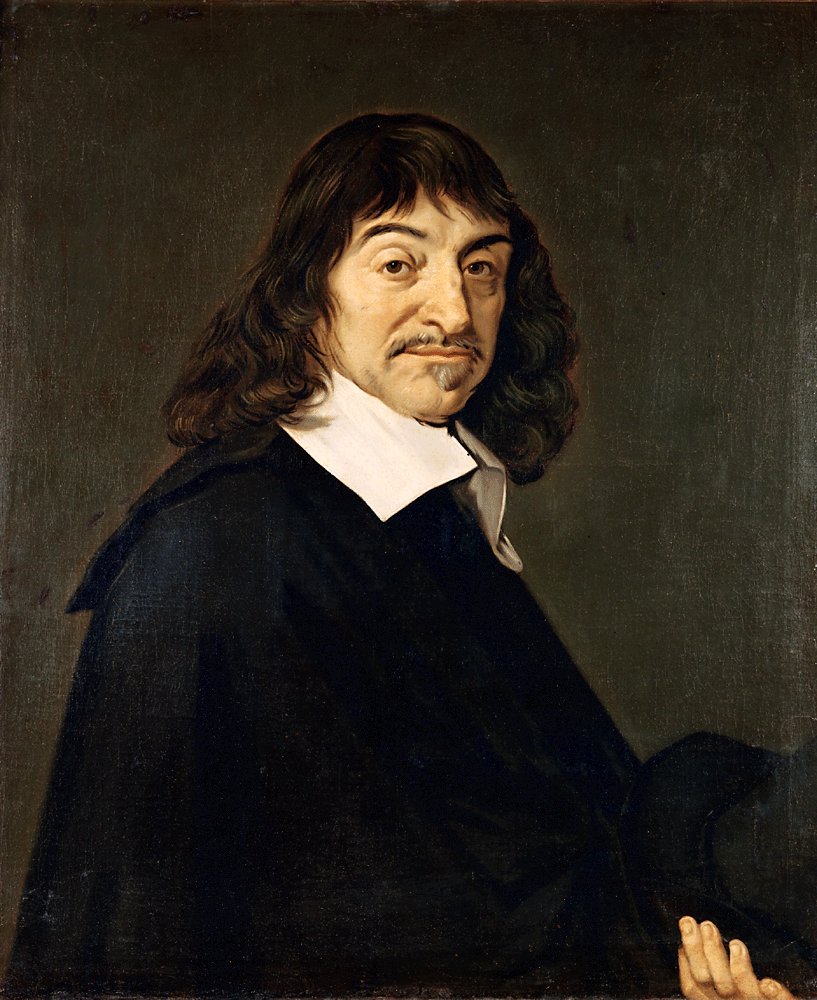

After Frans Hals (1582/83-1666), Portrait of René Descartes, oil on canvas, Musée du Louvre (INV. 1317); public domain (PD-Art, artist died 1666); unaltered resave of the Wikimedia Commons file · Musée du Louvre (INV. 1317, painting 'after Frans Hals'), via Wikimedia Commons · Public domain
핵심 특성
주요 업적
1637년 『방법서설』이 레이던에서 인쇄되어 저자 이름 없이 출간되었고, 『굴절광학』『기상학』『기하학』 세 편의 시론이 함께 실렸다. 학계의 설명에 따르면 이 책은 그가 『세계론』을 접어 둔 뒤 자신의 철학을 제한된 범위에서 먼저 선보인 것이다.
『제일철학에 관한 성찰』(『성찰』)은 1641년(재판 1642년)에 카테루스, 홉스, 아르노, 가상디, 부르댕 등 비판자들이 낸 반론과 그에 대한 데카르트의 답변을 함께 실어 출간되었다. 1639년 11월 13일 그는 메르센에게, 공개하기 전에 가장 학식 있는 신학자 스무 명 내지 서른 명에게 보낼 분량만 먼저 인쇄해 무엇을 바꾸고 고치고 덧붙이면 좋을지 그들에게서 배우겠다고 썼다.
삶의 장면들
1633년 11월 말 데카르트는 메르센에게, 레이던과 암스테르담에서 갈릴레오의 책을 수소문했더니 책이 로마에서 모두 불태워지고 저자는 벌금형을 받았다는 답을 들었다고 썼다. 그는 이 소식에 몹시 놀라 자신의 원고를 모두 태우거나 적어도 아무에게도 보여 주지 않기로 거의 마음먹었다고 했으며, 교회가 못마땅하게 여길 만한 말이 한마디도 자기 손을 떠나지 않기를 바라고, 원고를 ‘불구가 된’ 채로 내놓느니 차라리 거두겠다고 했다. 1634년 4월에는 그 원고를 누구에게도 보이지 않기로 결심했다고 메르센에게 알렸다.
그의 편지는 이 결정을 교회 권위와의 충돌을 피하려는 것으로 설명하며, 이는 그런 종류의 위험에 대한 신중한 태도와 부합한다. 다만 한 학술적 설명은 네덜란드에 살던 그에게 실제로 위험이 있었는지 의심하는 학자들도 있다고 지적하고, 이후 푸티우스와 벌인 공개 논쟁은 그가 모든 갈등을 피한 것은 아니었음을 시사한다. 위험 감수
1643년 5월 6일(구력)/16일(신력)자 편지에서 보헤미아의 엘리자베트 공주는 영혼이 사유하는 실체일 뿐이라면 어떻게 신체의 자발적 운동을 결정할 수 있는지 데카르트에게 물었다. 그는 5월 21일 답장에서 이것이 자신이 펴낸 글에 비추어 가장 정당하게 제기될 수 있는 질문이라고 하면서, 영혼과 신체의 결합에 관해서는 거의 아무 말도 하지 않았다고 인정했다. 공주가 6월 10일(구력)/20일(신력)에 다시 편지를 보내자 그는 6월 28일 편지에서, 그녀 덕분에 자신이 빠뜨린 점들을 짚어 볼 기회를 얻었다고 썼다.
이는 데카르트가 자신의 글을 방어하는 데 그치지 않고 여러 통의 편지에 걸쳐 상대의 반론을 끝까지 따져 본 한 사례로 볼 수 있다. 1630년 베이크만과의 서신 교환이 질책 속에 끝난 것처럼 협력이 이어지지 못한 다른 사례들과 함께 놓고 보아야 한다. 협업 성향
전환점
이삭 베이크만의 일지에는 데카르트가 1628년 10월 8일 도르드레흐트로 자신을 찾아왔다고 적혀 있고, 그의 서간집 편집자들에 따르면 프라네커 대학의 학생 명부에는 1629년 4월 16일자로 그의 이름이 올라 있다. 한 현대 학술적 설명에 따르면 그는 그 무렵 미완성이던 『정신 지도를 위한 규칙』을 중단하고 네덜란드 공화국에 자리를 잡았으며, 1649년 스웨덴으로 떠나기 전까지 프랑스에는 드물게만 돌아갔고 주소를 비밀로 하면서 자주 옮겨 다녔다.
이러한 양상은 어디서 어떻게 연구할지를 스스로 정하려는 성향과 부합한다. 다만 그 동기에 대한 주된 근거는 데카르트 자신이 쓴 글이며, 그는 훗날 스톡홀름으로의 초청을 받아들였다. 자율성 욕구
비슷한 인물
전체적인 프로필이 이 사람과 닮은 사람들이에요.
출처
- René Descartes (English Wikipedia) -- orientation only (dates, places, occupations); not used as support for any scored row. Downloaded and skimmed.
- René Descartes (Q9191) -- identity verified live through the Wikidata API (wbgetentities): en label 'René Descartes', en description 'French philosopher, mathematician, and scientist (1596–1650)', ko label '르네 데카르트', P27 France (Q142), P569/P570 31 Mar 1596 / 11 Feb 1650, P18 'Frans Hals - Portret van René Descartes.jpg'. Orientation only.
- 르네 데카르트 (Korean Wikipedia) -- opened to confirm the conventional Korean rendering of the name and of the titles of the works (방법서설, 성찰, 세계론). Orientation only.
- Gary Hatfield, 'René Descartes', Stanford Encyclopedia of Philosophy (first published 2008, substantive revision 23 Oct 2023) -- modern scholarly account (secondary; it retells the Adam-Tannery and Cottingham correspondence). Read section 1 'Intellectual Biography' (1.1-1.5): the 1628 move to the Netherlands with secret address and frequent moves, Franeker registration April 1629, suppression of The World after Galileo's condemnation, the anonymous Discourse (1637), the Nov 1639 plan to obtain theologians' judgements and the seven sets of objections published with replies, and the Utrecht/Voetius and Regius controversies. Downloaded and read.
- Kurt Smith, 'Descartes' Life and Works', Stanford Encyclopedia of Philosophy (2001, substantive revision 1 Mar 2023) -- a second scholar's account (secondary). Read 'Early Years' and 'The World and Discourse': Beeckman at Breda, 1628 departure from Paris, Amsterdam 1630, Deventer 1632, the decision against publishing The World after Galileo's condemnation (Nov 1633 letter to Mersenne) with the remark that some scholars question the expressed fear because he lived in the Netherlands, and the move to Leiden in 1636 to arrange publication of the Discourse. Downloaded and read; its private-life passages were not used.
- Desmond Clarke, 'Henricus Regius', Stanford Encyclopedia of Philosophy (2008, substantive revision 3 Mar 2026) -- scholar's account (secondary) of the Utrecht controversy. Read section 2 'Dispute with Voetius and Descartes': Descartes's 1641 advice to Regius (avoid needless controversy and accusations of heresy; omit rather than reject substantial forms), the December 1641 disputation, the Letter to Dinet (1642) and Epistola ad Voetium (1643), the Vroedschap's ban and committee of inquiry, Schoock's Admiranda methodus (1643), the 1645-48 break with Regius and Descartes's Notae in programma quoddam (1648). Downloaded and read.
- C. Adam & P. Tannery (eds.), Oeuvres de Descartes, vol. I, Correspondance avril 1622-février 1638 (Paris: Cerf, 1897; archive.org scan, OCR text downloaded and searched locally). Read in French: Descartes to Ferrier 18 Jun 1629 (VII); Descartes to Beeckman Sept/Oct 1630 (XXIII, XXIV); Descartes to Mersenne [Deventer, Nov/Dec 1632] (XLVI), late Nov 1633 (XLIX) and Apr 1634 (LIII) on The World; Constantijn Huygens to Descartes 28 Oct 1635 (LXII); the editors' notes (Franeker album entry of 16 Apr 1629, successive residences 1632-36, Jan Maire printing the Discourse, Beeckman's 1629 letters to Mersenne). Descartes's own letters are one self perspective; the Huygens letter and the Beeckman letters quoted in the notes are independent. Baillet-derived passages in the editors' notes were not relied on.
- Adam & Tannery, Oeuvres de Descartes, vol. II, Correspondance mars 1638-décembre 1639 (Paris: Cerf, 1898; archive.org scan, OCR searched locally). Read in French: Descartes to Mersenne 3 May 1638 (CXXII) and 29 Jun 1638 (CXXVI) on the exchange with Fermat and his friends (with the 'Extrait' of Fermat's letter as printed there); Descartes to Mersenne 13 Nov 1639 (CLXXVII): plan to print twenty or thirty copies of the Metaphysics for theologians, and his reply to gossip about his visits to a butcher and about dissections. Self letters (one perspective); Fermat's own words appear only in extract.
- Adam & Tannery, Oeuvres de Descartes, vol. III, Correspondance janvier 1640-juin 1643 (Paris: Cerf, 1899; archive.org scan, OCR searched locally). Read in French/Latin: Huygens to Descartes 14 Aug 1640 (CCI) and 17 Jul 1641 (CCXLVII); Descartes to Mersenne 24 Dec 1640 (CCXXIII); Princess Elisabeth to Descartes 6/16 May 1643 (CCCI) and 10/20 Jun 1643 (CCCVIII) with Descartes's replies of 21 May (CCCII) and 28 Jun 1643 (CCCX); the editors' documentary notes quoting the Utrecht city council minutes (15 Mar 1642 decree on Regius; 5 and 13 Jun 1643 committee and citation over Descartes's Epistola ad Voetium). Huygens, Elisabeth and the Utrecht minutes are independent non-self voices; Regius letters preserved only through Baillet were not relied on.
- Adam & Tannery, Oeuvres de Descartes, vol. V, Correspondance mai 1647-février 1650 (Paris: Cerf, 1903; archive.org scan, OCR searched locally). Read: Descartes to Chanut 26 Feb 1649 (DXL) and 31 Mar 1649 (DXLIX). The Chanut letters printed in this volume survive only as quoted in Baillet's 1691 Vie (a Cartesian-circle source, weakly independent), so they were read for context but are NOT relied on in any row. Descartes's letters are the self perspective.
- Adam & Tannery, Oeuvres de Descartes, vol. X (Paris: Cerf, 1908; archive.org scan, OCR searched locally): the 'Descartes et Beeckman' sections (1618-19 and 1628-29) transcribing Isaac Beeckman's Journal (Middelburg MS., via C. de Waard), read in Latin with the editors' French notes -- Beeckman's entries of Nov-Dec 1618 (lute strings; over-blown pipe; 'Physico-mathematici paucissimi'), the Compendium Musicae given to him at the new year, and the entry of 8 Oct 1628 ('Historia Des Cartes ejusque mecum necessitudo') with his notes on the glass prism and lens; plus Leibniz's undated manuscript note on the Descartes papers in Clerselier's hands (editors' Avertissement to the 'Opuscules de 1619-1621'). Beeckman is an independent firsthand collaborator (friendly when writing, later in dispute with Descartes); Leibniz an independent later witness to papers. Transcriptions taken as given, not checked against the manuscripts.