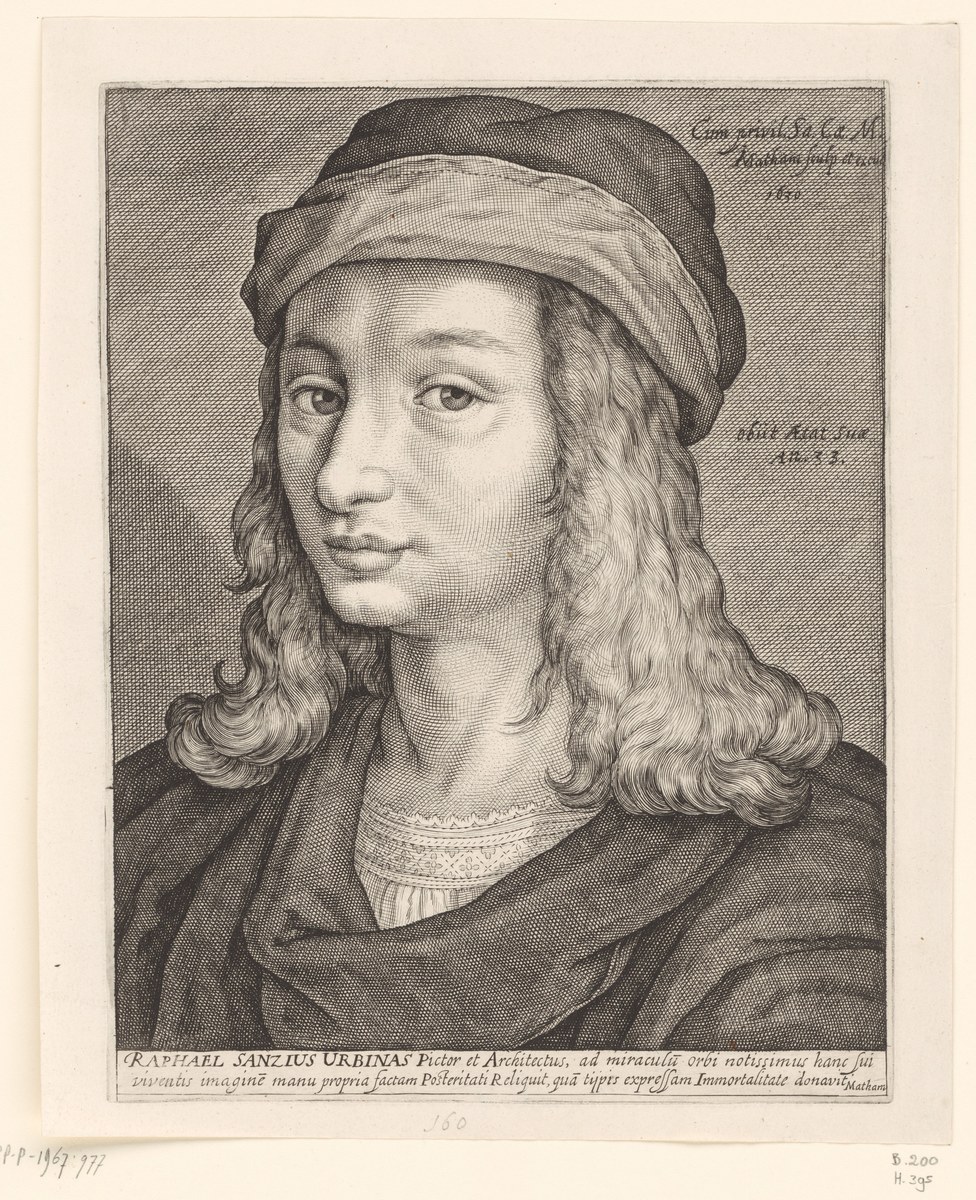

Jacob Matham, 1630, engraving after Raphael; Rijksmuseum, Amsterdam (RP-P-1967-977), Public Domain · Wikimedia Commons, 'Portret van Rafael, RP-P-1967-977.jpg' -- Jacob Matham, engraving, Haarlem, 1630, after a painting by Raphael (Rijksmuseum, Amsterdam, RP-P-1967-977); original Commons file 4816 x 5920 pixels, downscaled once to 976 x 1200 (never upscaled). Includes the plate border and caption. A later copy after Raphael's self-portrait, not a likeness drawn from life; its caption wrongly gives his age at death as 33. · Public Domain (CC0 Rijksmuseum digital file; engraving of 1630)
화가 · 근세
라파엘로 산치오
1483–1520
주요 업적 분야
아직 성격 매칭에 포함되지 않았습니다 — 기록된 근거가 성격 모델 전체를 다루기에는 충분하지 않습니다. 이 페이지의 다른 모든 내용은 자유롭게 확인하실 수 있습니다.
핵심 특성
주요 업적
1508년 로마로 불려 가 교황 율리우스 2세의 거처를 장식한 그는 1508년부터 1524년까지 자신의 공방과 함께 바티칸 스탄차를 그렸고, <아테네 학당>이 포함된 서명실 프레스코로 시작했다.
율리우스 2세, 레오 10세, 발다사레 카스틸리오네의 초상화와 성모상은 그의 가장 높이 평가받는 작품들이며, 영국 내셔널 갤러리는 두 교황의 얼굴이 지금도 우리가 그들을 보는 방식을 규정한다고 말한다.
1514년부터 성 베드로 대성당의 수석 건축가로 일했고 레오 10세로부터 고대 로마 건축물 조사를 의뢰받았으며, 줄리오 로마노와 잔프란체스코 펜니가 물려받은 대규모 공방을 이끌었다.
삶의 장면들
바사리는 라파엘로가 병이 들자 유언장을 작성해 제자 줄리오 로마노와 일 파토레(잔프란체스코 펜니)에게 재산을 남겼다고 전하며, 두 사람은 이후 그의 공방을 이어 갔다.
가장 가까운 조수들이 공방을 이어 가도록 묶어 둔 스승의 태도와 일치하지만, 바사리는 후대의 호의적인 전기 작가라는 점에 유의해야 한다. 협업 성향
1514년 브라만테가 사망하자 그는 성 베드로 대성당의 수석 건축가가 되었고, 이후 고대 유물 관리를 맡았으며 레오 10세로부터 고대 로마 건축물 조사를 의뢰받았다.
회화에서 건축과 고대 연구로까지 활동 영역을 넓힌 화가라는 점과 일치한다. 분야 횡단성
전환점
1504년 무렵 그는 피렌체로 옮겨 레오나르도와 미켈란젤로를 비롯한 그곳 예술가들에게 배웠고, 그들의 작품을 보고 스케치했으며, 이후 1508년 로마의 부름을 받았다.
이미 독립한 거장이면서도 당대 최고 예술가들을 계속 연구한 태도와 일치한다. 숙련 지향
비슷한 인물
전체적인 프로필이 이 사람과 닮은 사람들이에요.
출처
- Raphael (Q5597) -- verified live via the Wikidata API (2026-10-11): English label 'Raphael', description 'Italian painter and architect (1483-1520)', Korean label present, born 1483 (several dates recorded), died April 1520. Orientation only; not used as support for any row.
- The National Gallery, London, 'A brief introduction to Raphael's life and times' (The Credit Suisse Exhibition: Raphael, 2004-05) -- CANONICAL SIGNIFICANCE SOURCE: the Gallery's overview of his work as painter, draughtsman, designer for tapestry, prints, sculpture and stage sets, architect and archaeologist; the 1508 call to Rome for Julius II's apartments (the Stanze, including The School of Athens); the portraits of Julius II, Leo X and Castiglione; his 1514 appointment as chief architect of St Peter's and Leo X's commission of a survey of ancient Rome; and the Mantuan ambassador Pandolfo Pico's letter of 7 April 1520 on his death. Read in full.
- The National Gallery, London, artist page 'Raphael' -- the Gallery's short biography: regarded for centuries as the supreme High Renaissance painter, an independent master from 1500, a noted portraitist and painter of Madonnas in Florence, called to Julius II's court in 1508 and appointed architect of St Peter's in 1514, whose example dominated the academic tradition of European painting until the mid-19th century. Read in full.
- Vatican Museums, 'Stanze of Raphael' and 'Room of the Segnatura' -- museum pages stating that the four rooms were part of the apartment chosen by Julius II as his residence, that the decoration was executed by Raphael and his school between 1508 and 1524, and that the Segnatura frescoes (1508-1511), with the School of Athens, Parnassus and Disputation, were the first work he executed in the Vatican. Read both pages' main text.
- Giorgio Vasari, 'Life of Raffaello da Urbino', Lives of the Most Eminent Painters, Sculptors and Architects, vol. 4 (translated by Gaston du C. de Vere, 1912-15), Project Gutenberg ebook 28420 -- the 1550/1568 biography, a LATER, PARTISAN and idealizing Florentine biographer who wrote after Raphael's death and presents him as gentle, courteous and loved by his workshop; treated as one perspective only. Used for the workshop passages ('some fifty painters' who accompanied him), the work on cartoons and architecture, his will naming Giulio Romano and Gianfrancesco Penni (Il Fattore) as heirs, and Bembo's epitaph as reported there. Read the Life from the Roman commissions to the end; the early chapters on his apprenticeship were skimmed.
- The Open University (OpenLearn), 'Artists and authorship: the case of Raphael' (Level 3 course, first published 2016, updated 2018) -- university course on how Raphael's life and authorship were constructed; sections 2.2 (Vasari and the reception of Raphael), 2.5-2.6 (the primary reports of his death: Michiel's diary of 6 April 1520, Pico's and Lippomano's letters, with the age and portent discrepancies), 2.10.2 (Castiglione's 'letter from Raphael', shown by Shearman to be Castiglione's own fiction) and 2.11.1 (Raphael and Michelangelo as paired personas). Read through the page text summarised by the fetch tool, not the original line by line; critical of Vasari.
- Ingrid D. Rowland, 'The Gentle Genius', The New York Review of Books, 10 January 2013 -- review of the 'Late Raphael' exhibition (Prado, Madrid, and Louvre, Paris, 2012-13) and its catalogue by Tom Henry and Paul Joannides: the workshop as a diversified company of up to fifty people producing art in virtually every medium, the trust placed in young associates Giulio Romano and Gianfrancesco Penni, Penni's role as manager of accounts, and Raphael's hands-on intervention. INDEPENDENT MODERN critic reporting curatorial scholarship, admiring in tone. Read in full.
- Apollo Magazine, 'Michelangelo and Sebastiano's fraught but fertile friendship' (review of the National Gallery exhibition 'Michelangelo & Sebastiano', 2017) -- reports Sebastiano del Piombo's July 1518 letter to Michelangelo, written while his Raising of Lazarus competed with Raphael's Transfiguration, and the argument that the two joined forces chiefly to counter their common Roman rival. RIVAL-CAMP perspective, second-hand through a reviewer. Read in full.
- Rijksmuseum, Amsterdam, collection record RP-P-1967-977, Jacob Matham, 'Portret van Rafael' (engraving, Haarlem, 1630, after a painting by Raphael) -- museum page used only to check the rights notice and attribution for the portrait (marked Public domain). Not used for any scoring.