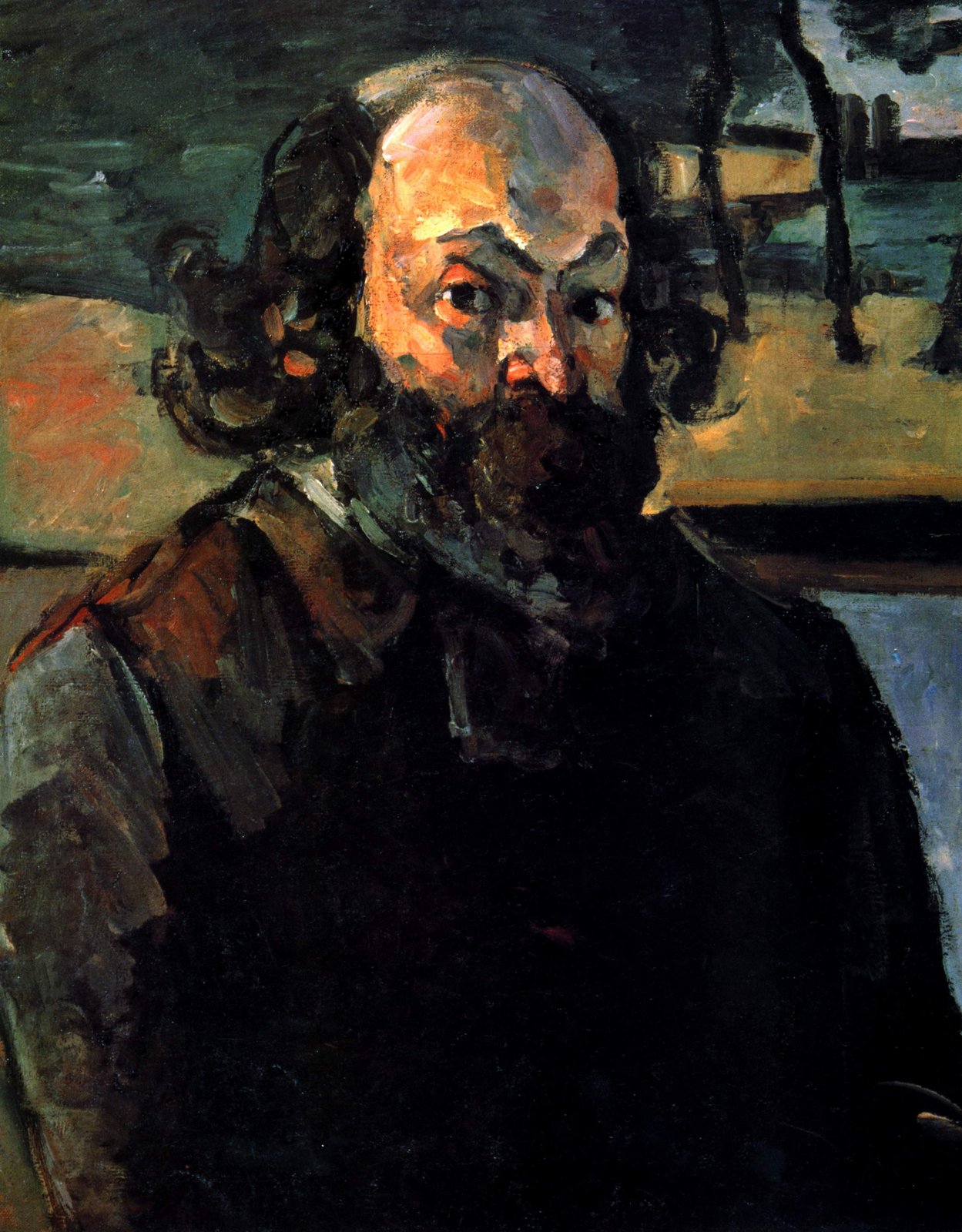
Paul Cezanne, Self-portrait, c. 1875, Musee d'Orsay, Paris; faithful reproduction (The Yorck Project) of a public-domain painting; downscaled · Paul Cezanne, Self-portrait (Portrait de l'artiste), c. 1875, oil on canvas, 64 x 53 cm, Musee d'Orsay, Paris (RF 1947 29; Wikidata Q17495197); photographic reproduction from The Yorck Project (2002), 10.000 Meisterwerke der Malerei, via Wikimedia Commons · Public domain
핵심 특성
주요 업적
세잔은 새로운 표현 방식을 도입하고 20세기 초 아방가르드 운동에 영향을 주었으며 19세기 말 인상주의와 20세기 초 입체주의를 잇는 다리 역할을 한 후기 인상주의 화가다. 앙리 마티스와 파블로 피카소는 그를 '우리 모두의 아버지'라고 말했다고 전해진다.
세잔은 서른아홉 살 무렵부터 고향 엑상프로방스 가까이에 있는 생트빅투아르산을 연작으로 그리기 시작했는데 이는 그가 전에 그려 본 적 없는 소재였고, 이후 1906년까지 이 산으로 돌아가곤 했다. 1890년대에는 아버지 영지의 농장 일꾼들을 모델로 삼아 카드 놀이하는 일꾼들을 다섯 점 완성했다. 마지막 10년 동안에는 자신이 그린 가장 큰 그림인 여성 목욕객 대작 세 점에 매달렸고, 런던 내셔널 갤러리는 이를 그가 1870년대부터 이어 온 주제의 정점이라고 부른다.
세잔은 1874년 파리에서 열린 첫 인상주의 그룹전에 작품을 냈고, 이 전시에서 〈목매단 사람의 집(The House of the Hanged Man)〉을 수집가 도리아 백작이 사 갔다. 1904년에는 파리 가을 살롱이 그에게 방 하나를 통째로 내주었고, 화상 앙브루아즈 볼라르는 언론 평이 여전히 적대적이었지만 그때부터 수집가들이 그의 그림을 점점 더 찾았다고 기록한다.
삶의 장면들
1899년 화상 앙브루아즈 볼라르는 매일 아침 8시부터 11시 30분까지 세잔의 초상화 모델로 앉았다. 볼라르 자신의 기록에 따르면 세잔은 115회의 작업 끝에 손 부분에 칠하지 않은 작은 빈자리 두 곳을 남긴 채 초상화를 미완성으로 두었다. 1904년에는 화가 에밀 베르나르가 세잔이 해골 정물화 한 점을 한 달 동안 매일 아침 고쳐 그리는 모습을 지켜보았다.
이처럼 오랜 수정 작업을 전하는 두 사람의 서로 다른 목격담은 이 프로필의 높은 완벽주의 점수와 부합한다. 같은 자료들은 그 대가도 보여 준다. 많은 캔버스가 미완성으로 남거나 폐기되었다. 완벽주의
1866년 살롱 심사위원단이 출품작 두 점을 모두 낙선시키자, 세잔은 미술감독관 니외베르케르크 백작에게 두 차례 편지를 보냈다. 루브르 문서고에 보존된 4월 19일자 편지에서 그는 자신이 선임하지도 않은 사람들의 판단을 받아들일 수 없다며 낙선전을 다시 열어 달라고 요구했다. 편지 여백에 적힌 공식 회신은 이를 거절했다.
이 편지는 이 프로필에서 점수화한 독립적 사고를 보여 주는 문서화된 사례 가운데 하나다. 다만 그는 이후에도 같은 살롱에 계속 출품했는데, 이는 그가 여전히 공식적인 인정을 원했음을 보여 준다. 독립적 사고
전환점
1872년 무렵부터 1874년까지 세잔은 오베르쉬르우아즈에 살며 카미유 피사로 가까이에서 작업했다. 인상파 화가들과 교류한 비평가 테오도르 뒤레는 그때까지 세잔이 야외에서 풍경화를 그리는 일이 드물었으나 오베르에서 더 밝고 환한 색채로 야외 작업을 시작했다고 쓴다. 볼라르는 피사로가 옛 거장들에게 지배당하지 말라고 그에게 조언했다고 기록한다.
이러한 방법의 변화는 이 프로필의 실험성 점수와 부합한다. 다만 그 시기는 세잔 자신의 기질뿐 아니라 피사로와 함께 작업한 경험의 영향도 반영한다. 실험 성향
비슷한 인물
전체적인 프로필이 이 사람과 닮은 사람들이에요.
출처
- Paul Cézanne (English Wikipedia) -- orientation only; not used as support for any scored row. Korean Wikipedia title '폴 세잔' confirmed via the Wikidata kowiki sitelink.
- Paul Cézanne (Q35548) -- verified live via wbgetentities (2026-10-02): en label 'Paul Cézanne', description 'French painter (1839–1906)', ko label '폴 세잔', born 1839-01-19, died 1906-10-22 (a second P570 value gives 1906-10-23), citizenship Q142 (France), P18 'Paul-Cezanne.jpg' (not used), kowiki '폴 세잔'. Orientation only.
- Ambroise Vollard, Paul Cezanne: His Life and Art, authorized trans. Harold L. Van Doren (New York: Nicholas L. Brown, 1923; French original 1914), archive.org OCR full text (paulcezannehisli00voll) -- DEALER/FIRSTHAND perspective: Vollard organised Cezanne's first solo exhibition (1895), visited him at Aix (1896) and sat for his portrait (1899); admiring but anecdotal and often comic in tone, and commercially interested in Cezanne's reputation. Read: ch. III pp. 38-53 (the 1866 Salon refusal and Cezanne's letter of 19 April 1866 to Nieuwerkerke transcribed from the Louvre archives with the official marginal reply; 1872-74 at Auvers with Pissarro; a fragment of a letter to his parents on wanting his liberty); ch. IV pp. 54-74 (1874 and 1877 group exhibitions, Choquet, the yearly Salon submissions refused until the 1882 admission as 'pupil of M. Guillemet', the 1890 Brussels Bathers slashed and reworked, Tanguy); ch. VI pp. 96-107 (his own 1896 visit to Aix: the studio, the still life retrieved from the cherry tree to be worked on further, dinner conversation); ch. VIII pp. 120-141 (HIS OWN FIRSTHAND account of sitting for his portrait 1899: sittings 8-11.30 a.m., Louvre/Trocadero copying in the afternoons, conditions for work, the uncovered spots on the hand, 115 sittings and the portrait abandoned unfinished; Cezanne's practice of laying canvases aside and taking landscapes up again in following years; destroyed canvases); ch. XI pp. 175-185 (Cezanne's letters to Vollard of 2 April 1902 and 9 Jan. 1903 withholding canvases because not yet satisfied; the 1904 Saint Louis rejection and the room given him at the 1904 Salon d'Automne; Vollard's last visit, late 1905). The 1906 death circumstances and health remarks in ch. XI were read but deliberately not used.
- Emile Bernard, Souvenirs sur Paul Cezanne (Paris: Societe des Trente / A. Messein, 1912; first published in Mercure de France, 1907), archive.org OCR of the Google-digitised copy (souvenirs-sur-paul-cezanne), read in French -- FIRSTHAND VISITOR/PAINTER perspective: Bernard (1868-1941) stayed in Aix for about a month in Feb.-March 1904 and worked in the downstairs room of Cezanne's Lauves studio, and visited again in 1905; admiring but also critical (he judges Cezanne's method self-hampering) and his recollections of Cezanne's spoken words are reconstructions. Read: the arrival and first day (the visit 'sur le motif' below Sainte-Victoire; Bernard leaving him at work until 4 p.m.); 'Notre etablissement a Aix' pp. 18-26 (lunch conversation incl. Cezanne's remarks on Zola and L'Oeuvre as Bernard reports them; the Lauves studio; Bernard's own observation of the daily routine -- studio 6 to 10.30 a.m. in all seasons, then 'sur le motif' until 5 p.m. -- and of the still life of three skulls worked on every morning for a month and changing 'almost every day'; the unfinished nudes worked from youthful Atelier Suisse drawings); pp. 33-34 (abandoned landscape beginnings in the rue Boulegon garret; Bernard's observation, from the room below, of Cezanne pacing, going down to the garden and back up while working); the joint outing to paint Sainte-Victoire; the departure in 1904. Bernard's account of a quarrel over physical contact was read and deliberately not used (private/psychological).
- Cezanne's OWN letters as transcribed in period sources -- SELF perspective, one perspective, never sole support for a row: to Emile Bernard, 15 April 1904, 12 May 1904 and 21 Sept. 1906 (printed in Bernard, Souvenirs sur Paul Cezanne, 1912, pp. 69-90: 'je procede tres lentement, la nature s'offrant a moi tres complexe, et les progres a faire etant incessants'; 'J'etudie toujours sur nature'); to Ambroise Vollard, 2 April 1902 and 9 Jan. 1903, and to his son, 15 Oct. 1906 (printed in Vollard 1923, ch. XI: postponing a Salon submission because 'not satisfied as yet with the results'; 'I work obstinately'); to the Surintendant des Beaux-Arts Nieuwerkerke, 19 April 1866 (printed in Vollard ch. III from the Louvre archives).
- Emile Zola, Correspondance: Lettres de jeunesse (Paris: Fasquelle, 1907), archive.org OCR (correspondancele00zolauoft), read in French -- CONTEMPORARY INSIDER perspective (boyhood friend, not Cezanne himself; private letters written at the time to their schoolfriend Baptistin Baille, so not retrospective and not written for publication). Read: Zola to Baille, Paris, 10 June 1861 (pp. 58-61: Cezanne's daily routine in Paris -- mornings at the Academie Suisse, painting Zola's portrait at midday, drawing at Villevieille's the rest of the day; Zola's frank description of his friend's obstinacy, dislike of argument and talk of returning to Aix soon after arriving); the letter that follows it (pp. 174-75, 'je vois Cezanne assez rarement'); Zola to Baille, undated, c. Aug. 1861 (pp. 176-80: Zola retracting his earlier general verdict as unjust; six hours a day together while Cezanne painted his portrait 'avec acharnement'; his repeated discouragement and plans to go back to Aix; the portrait begun twice and then destroyed, with Cezanne packing to leave). Used for 1861 behaviour only; the later Zola-Cezanne relationship and L'Oeuvre (1886) are not scored.
- Theodore Duret, Manet and the French Impressionists, trans. J. E. Crawford Flitch (London: Grant Richards; Philadelphia: Lippincott, 1910), archive.org OCR (manetfrenchimpre00dure) -- CRITIC/CONTEMPORARY perspective: Duret (1838-1927) was a critic, collector and early historian of the Impressionist group who knew its members personally; sympathetic, not a close intimate of Cezanne. Read: the chapter 'Cezanne', pp. 177-190 (abandoning law for painting; the failed Beaux-Arts admission and the spell in his father's bank; study at the Academie Suisse and the Louvre 'according to his own ideas'; the shift to open-air painting at Auvers with Pissarro, 1873; persistent Salon submissions refused before and after 1870, the single 1882 admission via Guillemet; withdrawal from group exhibitions after 1877 while continuing to paint; Duret's description of his scrupulous method, the 'enormous number of sittings', the bare canvas left uncovered rather than worked over by formula, and the many canvases discarded at the sketch stage; living on his father's allowance, so poverty was not a factor); and the group-history passages pp. 41-44, 140-147 mentioning him. Some dates differ from Vollard (Duret places the first Paris stay in 1862); not relied on for dates.
- The National Gallery, London -- MUSEUM/SCHOLARLY perspective, modern and independent of the period memoirs. Web pages read in full 2026-10-02: artist page 'Paul Cezanne (1839-1906)' (his remark to Renoir that it took him twenty years to realise painting was not sculpture; 'worked slowly and methodically, selecting subjects he could study for long periods'; the quoted ambition to make of Impressionism 'something solid and durable like the art of museums'); and the Overview and In-depth texts for Bathers (Les Grandes Baigneuses) (three large bathers canvases worked on in the last decade, all showing reworking; NG picture possibly begun 1898-9 and finished 1905; the top of the canvas folded over the stretcher to reduce the sky), Curtain, Jug and Dish of Fruit (from 1886 he repeatedly painted the same set of objects in his studio, rendering them from different perspectives), Still Life with Water Jug (an unfinished canvas showing his staged method; one of half a dozen with the same jug in the 1890s), and Self Portrait c.1880-1.
- The Courtauld, London -- MUSEUM perspective: collection highlight page 'The Card Players' (Paul Cezanne, around 1892-96), read 2026-10-02: he took up the subject of labourers playing cards in autumn 1890 and completed five paintings of it during the 1890s, refining the composition down to two players; farm workers from his father's estate posed. Short page; used only as corroboration for the serial working method.