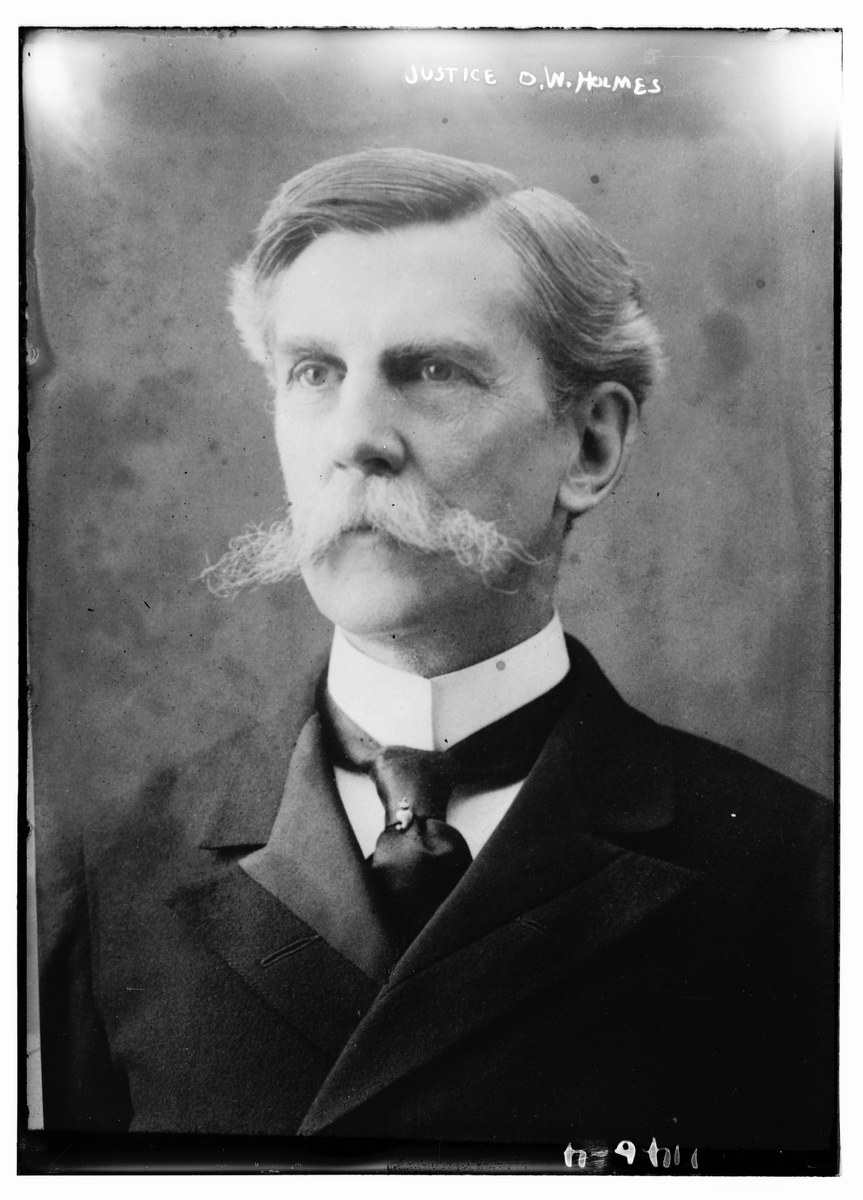

Bain News Service, Library of Congress, George Grantham Bain Collection (ggbain.05767); photographer not credited; date not recorded (before the mid-1920s) · Library of Congress, Prints and Photographs Division, George Grantham Bain Collection, glass negative captioned 'Justice O.W. Holmes', digitised as ggbain.05767 and hosted on Wikimedia Commons: publisher Bain News Service, photographer not credited, no date recorded; the Bain collection runs from about 1900 to the early 1920s, so the negative predates 1925 and shows Holmes during his Supreme Court service. The Library states no known restrictions on publication for the Bain collection and the Commons page quotes that statement; the Library's own item page could not be opened (bot protection, HTTP 403), so the statement was verified through Commons. Original 4147 x 5766; downscaled once to 863 x 1200 (no upscaling). The Wikidata image (Harris & Ewing, c. 1930, edited copy of a Library of Congress film negative) was not used because the Bain image has a clearer pre-1925 basis. · Public domain (US); Library of Congress: no known restrictions on publication
법학자 · 20세기
올리버 웬들 홈스 2세
1841–1935
주요 업적 분야
아직 성격 매칭에 포함되지 않았습니다 — 기록된 근거가 성격 모델 전체를 다루기에는 충분하지 않습니다. 이 페이지의 다른 모든 내용은 자유롭게 확인하실 수 있습니다.
핵심 특성
주요 업적
1881년 『보통법』을 펴내 '법의 생명은 논리가 아니라 경험'이라고 주장하며, 법이 형식적 공리가 아니라 사회와 함께 발전한다고 보았다.
매사추세츠 대법원에서 약 20년을 근무한 뒤 1902년부터 1932년까지 연방대법원에서 일했으며, 짧고 인용되는 의견과 선출된 입법부에 대한 존중으로 알려졌다.
1919년 '명백하고 현존하는 위험' 기준을 밝힌 솅크 판결문과 1905년 로크너, 1919년 에이브럼스 반대의견을 썼으며, 후자에서 '사상의 자유 시장'을 강조했다.
삶의 장면들
로크너 반대의견에서 홈스는 이 사건이 나라가 공유하지 않는 경제 이론에 근거했으며, 자신의 동의 여부는 다수가 의견을 법에 담을 권리와 무관하다고 썼다.
이는 개인적 선호가 아니라 재판 방식에 관한 원칙을 내세워 다수 의견에 반대한 모습과 일치한다. 독립적 사고
코터는 홈스의 첫 서면 반대의견인 1904년 노던 시큐리티스 사건 반대의견이 그를 지명한 시어도어 루스벨트와의 관계를 영구히 소원하게 했다고 전한다.
이는 자신을 지명한 대통령과의 관계를 잃더라도 반대의견을 낸 모습과 일치한다. 갈등 감내
전환점
1882년 홈스는 막 얻은 하버드 법대 교수직을 교수진에 미리 알리지 않고 떠나 매사추세츠 대법원 판사직을 받아들였으며, 오예즈는 이를 학계 생활이 충분하지 않다고 느낀 데 연결한다.
이는 학계 경력보다 재판 실무를 택한 모습과 일치한다. 숙련 지향
비슷한 인물
전체적인 프로필이 이 사람과 닮은 사람들이에요.
출처
- Oliver Wendell Holmes (Q360574) -- verified live via the Wikidata API (2026-10-24): English label 'Oliver Wendell Holmes', description 'American jurist (1841-1935); US Supreme Court justice from 1902 to 1932', born 1841-03-08, died 1935-03-06, citizenship United States, Korean label '올리버 웬들 홈스 2세', P18 image 'Oliver Wendell Holmes Jr circa 1930.jpg'. Orientation only; not used as support for any row.
- Oyez (Chicago-Kent College of Law / Cornell LII / Justia), biography of Justice Oliver Wendell Holmes Jr. (via the Oyez people API), read in full: Harvard class poet, Massachusetts infantry officer wounded three times, Harvard Law, teaching and writing, The Common Law published at 40, twenty years on the Massachusetts Supreme Court, 1902 nomination by Theodore Roosevelt confirmed without objection, service on the Fuller, White, Taft and Hughes Courts, a pragmatic view of law balanced against scepticism of human nature, short opinions studded with vivid phrases, a daily walk of about two and a half miles to Court, and missed no session in 25 of his 29 years. CANONICAL SIGNIFICANCE SOURCE. Institutional biography, admiring in tone.
- Daniel A. Cotter, 'Justice Oliver Wendell Holmes, Jr. (1841-1935): The Oldest Justice at Retirement from the Supreme Court' (Constituting America, 2017), read in full: The Common Law (1881) describing common law as evolving with society and rejecting formalist theories, The Path of the Law (1897), appointment to the Massachusetts court and Harvard friction, Otis v. Parker as his first Supreme Court opinion, Schenck (1919), 'Great Dissenter' with only 72 separate dissents against almost 900 majority opinions, the Lochner and Abrams dissents, the 1904 Northern Securities dissent that permanently strained his relationship with President Roosevelt, more opinions for the Court than any other justice of his era, a deference to states as arenas of experiment that produced apparent inconsistency between Schenck and Abrams, and the Buck v. Bell opinion described as harsh and infamous. Lawyer-author's essay combining praise and criticism, written for a civic-education site; the author states the opinions are his own.
- Biography.com, 'Oliver Wendell Holmes Jr.' (biography.com), read in full: Civil War service, Harvard Law, American Law Review editorship 1870-1873, The Common Law in 1881, Massachusetts Supreme Court from 1883 and chief justice from 1899, appointment in 1902, 'the Great Dissenter' for opposing his fellow justices, Lochner dissent, Schenck and the 'clear and present danger' test, the Abrams dissent and the 'free trade in ideas' passage, and retirement in January 1932. Contains an inconsistent retirement year (1931 in its summary, January 1932 in its body); the body date, which agrees with Oyez-linked and other sources, is used. General-audience biography.
- Harvard Gazette, 'Lessons in an unappealing law' (news.harvard.edu, October 2013), read in full: a Harvard seminar led by Professor Noah Feldman on Buck v. Bell (1927), calling Holmes 'one of the greatest justices of all time' but the case 'not a case about which to be terribly proud', noting that only the constitutional question and not the facts were before the Court, the 8-1 decision, Holmes's almost humorous tone and 'a confidence in his own superiority', the contemporary view of eugenics as progressive, and the decision never having been overturned. University news report on a scholar's assessment; used only to document the Buck v. Bell episode and its critical reception, not to score any trait.
- University of Illinois Law Review Online, 'Disenchanting Justice Holmes' (2021, 2021 U. Ill. L. Rev. Online 330), read in full: a law-student author's advocacy essay arguing the Buck v. Bell opinion was legally unsupported (five paragraphs, one case cited, disregard of earlier state-court decisions striking sterilisation laws, the vaccination analogy to Jacobson v. Massachusetts, mistaken facts about Carrie Buck and her family) and urging institutions to stop venerating Holmes, relying on scholarship by Nourse, Siegel and Lombardo. Adversarial, one-sided and evaluative; used only as the counter-voice on the Buck v. Bell opinion, never as a source of personality claims.
- Lochner v. New York, 198 U.S. 45 (1905), text of the Court's opinion and Justice Holmes's dissent (Cornell Legal Information Institute), dissent read in full: that the case 'is decided upon an economic theory which a large part of the country does not entertain', that his 'agreement or disagreement has nothing to do with the right of a majority to embody their opinions in law', and that 'the 14th Amendment does not enact Mr. Herbert Spencer's Social Statics'. A primary legal text: the documented judicial work, not an outside account of his behaviour.
- Abrams v. United States, 250 U.S. 616 (1919), Justice Holmes's dissent (Cornell Legal Information Institute), dissent passages read: that the ultimate good is better reached by 'free trade in ideas', that the Constitution is 'an experiment, as all life is an experiment', that courts should be 'eternally vigilant against attempts to check the expression of opinions that we loathe' unless they imminently threaten immediate interference with the lawful purposes of the law, and his reading of the Sedition Act history. A primary legal text; documented judicial work.
- Buck v. Bell, 274 U.S. 200 (1927), opinion of the Court by Justice Holmes (Cornell Legal Information Institute), read in full (five short paragraphs): upholding a Virginia compulsory sterilisation statute against due process and equal protection challenges by reference to the statute's procedural safeguards and the compulsory vaccination precedent Jacobson v. Massachusetts, ending with the sentence 'Three generations of imbeciles are enough.' A primary legal text, documented as a controversial episode; it is NOT used as evidence for any trait row (see provenance notes).
- Oliver Wendell Holmes Jr., 'The Common Law' (1881), Project Gutenberg eBook 2449, opening passages of Lecture I read: the statement that 'the life of the law has not been logic: it has been experience', with the felt necessities of the time and judges' own prejudices said to shape the law more than the syllogism, and the argument that law embodies a nation's development and cannot be treated like mathematics. His own published work: documented authorship, used for the scope of the book and not as outside corroboration of his character.
- Wikimedia Commons file page 'Justice O.W. Holmes LCCN2014685760.jpg' (wikitext and image record), checked for the portrait: Library of Congress, Prints and Photographs Division, George Grantham Bain Collection glass negative captioned 'Justice O.W. Holmes', publisher Bain News Service, photographer not credited, no date recorded; the file page quotes the Library's statement of no known restrictions on publication. Original 4147 x 5766. Not used for any scoring.