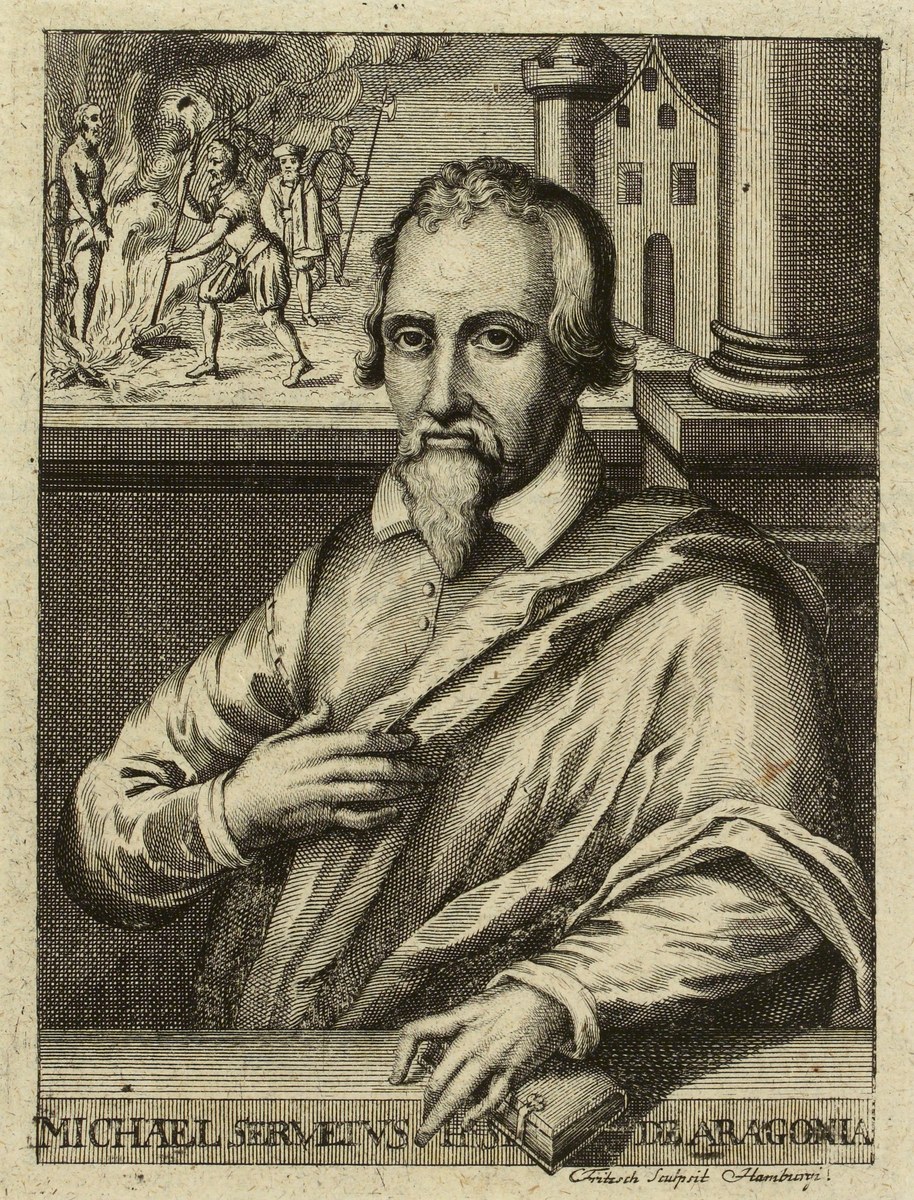

Christian-Friedrich Fritzsch, 18th century, Musee Carnavalet - Histoire de Paris / Paris Musees (G.19347), CC0 · Engraving 'Michael Servetus Hisp. de Aragonia', signed 'Fritzsch sculpsit Hamburgi' (Christian-Friedrich Fritzsch, active 1695-1769), 18th century, burin; Musee Carnavalet - Histoire de Paris, inventory G.19347. A later printed portrait made about two centuries after his death, not a portrait from life; the 1911 Britannica says no original likeness is known. Cropped to the plate from the museum image (2037 x 2673 pixels as published on Wikimedia Commons) and downscaled to 914 x 1200 (never enlarged). · CC0 1.0 (Paris Musees item-level mark on the museum's own page; the engraving is also public domain by age)
의사 · 근세
미카엘 세르베투스
1511–1553
주요 업적 분야
아직 성격 매칭에 포함되지 않았습니다 — 기록된 근거가 성격 모델 전체를 다루기에는 충분하지 않습니다. 이 페이지의 다른 모든 내용은 자유롭게 확인하실 수 있습니다.
핵심 특성
주요 업적
1531년 『삼위일체의 오류에 관하여』와 1553년 『기독교의 회복』에서 정통 삼위일체 교리를 비판했으며, 브리태니커는 이 저작들이 유니테리언주의가 등장하는 데 중요한 자극이 되었다고 설명한다.
파리에서 의학을 공부하고 이후 비엔에서 의사로 일한 그는 『기독교의 회복』에서 거의 부수적으로 폐순환의 발견을 알렸으며, 혈액이 심장 오른쪽에서 폐를 거쳐 흐른다고 설명했다.
가톨릭과 개신교 당국 양쪽에서 이단으로 정죄받아 1553년 제네바 근처 샹펠에서 화형당했고, 이 처형은 이단에 대한 사형을 둘러싼 개신교 내부의 논쟁을 불러일으켰으며 라일리우스 소키누스에게 영향을 주었다.
삶의 장면들
1546년 그는 장 칼뱅에게 증보한 『기독교의 회복』 원고를 보내 더 급진적인 견해를 거듭 주장하는 편지를 썼고, 1553년에는 칼뱅에게 보낸 편지 서른 통을 출간된 책에 실었다.
이는 당대 가장 영향력 있던 개혁가와의 논쟁을 피하지 않고 밀어붙이려 했다는 점과 부합하지만, 처벌할 수 있는 당국 앞에서는 그만큼 솔직하지 않았다. 갈등 감내
1536~38년 파리에서 의학을 공부하며 해부 실습을 도왔고, 유니테리언 인명사전은 그가 혈액의 변환이 심장이 아니라 폐에서 일어난다고 결론지어 갈레노스와 다른 견해에 이르렀다고 전한다.
이는 신학에서처럼 자신의 판단을 근거로 분야의 기존 권위에서 벗어나려는 태도와 부합한다. 독립적 사고
전환점
1530년 후원자 후안 데 킨타나를 따라 볼로냐의 카를 5세 대관식에 갔다가 교황의 호화로움에 괴로워하며 후원자를 떠나 바젤과 스트라스부르에서 종교개혁 지도자들을 만났고, 1531년 삼위일체에 관한 첫 책을 펴냈다.
이는 안정적인 후원자와 기존의 길에서 벗어나 자신의 신학적 견해를 추구하기로 한 결정과 부합한다. 독립적 사고
비슷한 인물
전체적인 프로필이 이 사람과 닮은 사람들이에요.
출처
- Michael Servetus (Q185914), verified live via the Wikidata API (2026-11-04): label 'Michael Servetus', description 'Spanish physician and theologian', birth recorded as 1511 with day variants 19 and 29 September, death 1553-10-27, Korean label 미카엘 세르베투스. Orientation only; not used as support for any row.
- Encyclopaedia Britannica, 'Michael Servetus' (Britannica Editors), article body read in full. CANONICAL SIGNIFICANCE SOURCE: Spanish physician and theologian (born 1511?, died 27 October 1553) whose unorthodox teachings led to condemnation as a heretic by Protestants and Roman Catholics and to execution by Calvinists from Geneva; De Trinitatis erroribus (1531), Dialogorum de Trinitate (1532), the annotated Ptolemy Geographia and Pagnini Bible editions at Lyon, medical studies at Paris from 1538, physician to the archbishop of Vienne, Christianismi restitutio (1553, 1,000 copies printed secretly at Vienne) in which he 'almost incidentally' made known his discovery of the pulmonary circulation of blood; his execution produced a Protestant controversy on the death penalty for heresy and influenced Laelius Socinus. Scholarly reference; modern summary.
- Encyclopaedia Britannica, eleventh edition (1911), 'Servetus, Michael', as transcribed on Wikisource, the passages on Vienne, the printing of the book, the 1553 arrest and trial, and his doctrine read: twelve years (1541-53) as confidential physician at Vienne while outwardly a conforming Catholic; the 1546 correspondence with Calvin and Calvin's remark that he would not let him leave Geneva alive; two Basel publishers declined the book; secret printing of 1,000 copies; interrogation and escape from Vienne prison; arrest at Geneva after attending church; a sentence on 26 October and execution at Champel; the only likeness is a small 1607 copperplate by C. van Sichem whose original is not known and whose authenticity is uncertain; his system 'not easily described in terms of current systems' and abhorrent to Catholics and Protestants alike. Older scholarly reference, independent of the modern Britannica article; its judgments are dated.
- Dictionary of Unitarian and Universalist Biography (Unitarian Universalist Historical Society), 'Servetus, Michael', full entry read: dated life from Villanueva in Aragon and law at Toulouse, service under Juan de Quintana, Basel and Strasbourg, the 1531 book and the 1532 Dialogues that did not soften his rhetoric, flight to Paris as Villeneuve after the Spanish Inquisition summoned him, medical studies and dissection under Gunther in 1536-38, the 1538 dispute with the Paris faculty over astrology, editorial work for Lyon printers, twelve years at Vienne, the letters to Calvin and Calvin's reaction, arrest and Geneva trial, Castellio's reply; the author notes that because Servetus expressed the new circulation knowledge only as a metaphor in a proscribed theological work it did not influence Harvey, and that 'most persons lack sufficient understanding of his views'. Unitarian historical society entry: sympathetic to him but a scholarly, dated narrative.
- Philip Schaff, History of the Christian Church, Volume VIII (1892), section on the trial of Servetus (Christian Classics Ethereal Library), full section read: how the Vienne authorities learned of the book through Guillaume Trie, the Vienne interrogations in which Schaff records that Servetus gave false answers about his identity and writings and said he had once personated 'Servetus' in correspondence, his escape on 7 April 1553, the Vienne sentence of 17 June, burning in effigy, and Schaff's footnote that Servetus himself printed thirty of his letters to Calvin in the book. A Reformed Protestant church historian writing in 1892: a critical, orthodox-leaning counter-voice that treats Calvin's role as indirect agency and an excess of zeal; its moral judgments are not used.
- EBSCO Research Starters, 'Michael Servetus Describes the Circulatory System', full entry read: law and mathematics studies, editing medical works for Lyon publishers, Paris medical studies with anatomical dissection and praise from the anatomy professor Johann Gunther von Andernach, his questioning of the Galenic claim of pores in the heart septum, the description of blood passing from the right ventricle through the lungs to the left, its theological setting in the discussion of the Holy Spirit and 'triple spirit', and the failed search for a willing publisher before secretly printing the work at his own expense. A modern encyclopaedic overview aimed at students; a few of its statements (dating the discovery to 1546, 'published posthumously') conflict with the other sources and are not used.
- Christianity Today, Christian History, 'The Servetus Affair' (1986), full article read: presents the trial from a Calvinist-sympathetic angle, says Servetus had been condemned in absentia in Catholic and Protestant Europe, that he went to Geneva after escaping a Catholic prison, was recognised while Calvin was preaching, that Calvin visited him in jail and, when sentence was passed, asked the city government for a more humane death. A short popular article from an evangelical magazine; used as the Calvin-side counter-voice, not as evidence of Servetus's motives.
- University of Texas Medical Branch research record for A. Bosmia and colleagues, 'Michael Servetus (1511-1553): Physician and heretic who described the pulmonary circulation', International Journal of Cardiology 167 (2013), pages 318-321: ABSTRACT ONLY was read (the article is paywalled): a peer-reviewed review that says writers have praised Servetus's commitment to educating colleagues about what he heralded as the truth and criticised his perceived arrogance, and that he contributed to geography, astrology, theology and medicine. Used only to confirm the medical-history framing; not used for any row.
- Paris Musees collections, Musee Carnavalet - Histoire de Paris, 'Michael Servetus Hisp. de Aragonia', engraving by Christian-Friedrich Fritzsch, 18th century, inventory G.19347 (item page, marked CC0). Holder record for the portrait only.