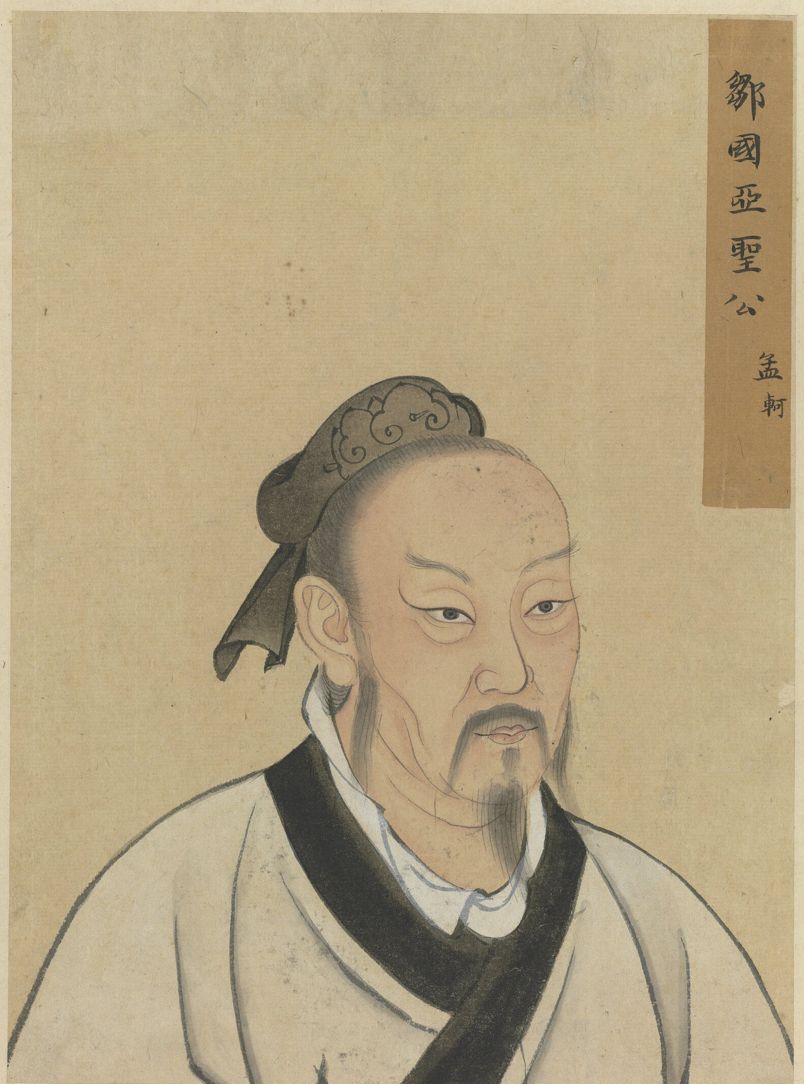

Anonymous (Yuan dynasty), Half Portraits of the Great Sage and Virtuous Men of Old, leaf for Meng Ke. The National Palace Museum, Taipei, open data (CC0 low-resolution tier; cropped and downscaled) · Leaf for Meng Ke (孟軻) from the album 'Half Portraits of the Great Sage and Virtuous Men of Old', anonymous, Yuan dynasty (after 1330), ink and colours on paper, 33.3 x 24.3 cm, National Palace Museum, Taipei (object number 中畫000329N000000003). The leaf's inscription reads 鄒國亞聖公 (Duke of Zou, Second Sage) with the name 孟軻 (Meng Ke), and the museum's catalogue entry names the sitter. It is a conventional portrait made more than 1,600 years after Mencius died, not a likeness from life. The file is a crop of the leaf (museum colour card and mount edge removed) from the museum's own image service, downscaled from about 1580 x 2130 source pixels to 804 x 1084 with no upscaling. · CC0 (the museum's open-data declaration for images up to about 1 million pixels; the painting is also public domain by age)
철학자 · 고대
맹자
372 BCE–289 BCE
주요 업적 분야
아직 성격 매칭에 포함되지 않았습니다 — 기록된 근거가 성격 모델 전체를 다루기에는 충분하지 않습니다. 이 페이지의 다른 모든 내용은 자유롭게 확인하실 수 있습니다.
주요 업적
그는 사람의 본성이 선하다고 주장했다. 사람은 연민 같은 덕의 싹을 타고나며 수양으로 그것을 키울 수 있다는 논지로, 《맹자》에 담긴 이 주장 덕분에 유교의 '아성(亞聖)'으로 불린다.
제자들이 엮은 그의 대화와 말씀 모음인 《맹자》는 훗날 주희가 《대학》, 《논어》, 《중용》과 함께 사서(四書)로 묶었고, 이는 과거 시험의 정통 교재가 되었다.
그는 양주와 묵자의 학설에 맞서 유교 윤리를 옹호했고, 제자들을 가르쳤으며, 이들과 함께 《시》와 《서》를 정리하고 자신의 가르침을 글로 남겼다.
삶의 장면들
사람들이 왜 그를 논쟁을 좋아한다고 하느냐는 물음에, 그는 어쩔 수 없어서 논쟁할 뿐이며 천하에 가득한 양주와 묵자의 학설에 맞서 성인의 도를 지키려는 것이라고 답한다.
이는 당대의 두 주류 학설에 모두 맞서 자신의 입장을 세운 사상가의 모습과 일치한다. 독립적 사고
고자가 인간의 본성을 깎아 만드는 나무와 흐르는 물에 비유하자, 맹자는 나무를 잔으로 깎는 것은 나무의 본성을 거스르는 일이고 물의 본성은 아래로 흐르는 것이라고 답하며, 사람을 악하게 만들 수는 있어도 본성은 그대로라고 말한다.
이는 상대의 비유를 하나씩 따져 검토하는 논객의 모습과 일치한다. 분석적 엄밀성
전환점
사마천에 따르면, 그가 섬긴 군주들이 그의 가르침을 현실과 거리가 멀다고 여겨 쓰지 않자, 그는 물러나 만장 등 제자들과 《시》와 《서》를 정리하고 공자의 뜻을 서술해 《맹자》 7편을 지었다.
이는 궁정에서 말을 들어줄 곳을 찾던 데서 가르침과 저술로 옮겨 간 전환과 일치한다. 숙련 지향
비슷한 인물
전체적인 프로필이 이 사람과 닮은 사람들이에요.
출처
- Mencius (Q188903), verified live via the Wikidata API (2026-11-01): label 'Mencius', description 'Chinese Confucian philosopher (372-289 BC)', birth 372 BC and death 289 BC (year precision), Korean label 맹자, image the Yuan-dynasty album leaf at the National Palace Museum. Orientation only; not used as support for any row.
- Stanford Encyclopedia of Philosophy, 'Mencius' (Bryan Van Norden), life and Confucian background, opponents and later-influence sections read. CANONICAL SIGNIFICANCE SOURCE: a Confucian philosopher of the fourth century BCE called the 'Second Sage', best known for the claim that human nature is good; our main access is the Mencius, a collection of his dialogues, debates and sayings probably compiled by his disciples or their disciples and edited by Zhao Qi in the second century CE; he called himself a follower of Confucius yet urged reading the classics critically ('better not to have the Documents than to believe everything in it', 7B3); he argued against Yang Zhu's egoism and Mozi's impartial caring, with a swift reductio against a rival definition of nature (6A3) and the child-at-the-well thought experiment (2A6); he was criticised by Zhuangzi and by Xunzi, who attacks him by name; later Neo-Confucians elevated him and Zhu Xi grouped the Mencius with the Great Learning, the Analects and the Mean as the Four Books, whose interpretations became the civil-service orthodoxy. Scholarly reference; its praise of influence is retrospective.
- Internet Encyclopedia of Philosophy, 'Mencius (Mengzi)' (Warring States Confucian philosopher, c. 372-289 BCE), history, text and interpreters sections read: the historical Mencius is available only through the text bearing his name, which most scholars think was assembled by Mencius and his immediate disciples shortly after his death; the biography in Sima Qian's Shiji says he came from Zou and is said (doubted by most modern scholars) to have studied with Confucius's grandson Zisi; his office in Qi was probably honorary; he gathered a circle of disciples; his philosophical concerns show consistency unusual in early Chinese writing; in the Gaozi dialogue (6A) he answers Gaozi's wood and water analogies for human nature 'in Socratic fashion'; Xunzi rejects his view of nature as originally good. Independent scholarly reference.
- Sima Qian, 'Records of the Grand Historian', chapter 74, 'Biographies of Mencius and Xunqing' (Chinese Wikisource, original Chinese read): the Mencius paragraph says he was from Zou, received instruction from Zisi's disciples, travelled to serve King Xuan of Qi and then Liang, and that the rulers found his talk of the virtue of Yao, Shun and the Three Dynasties remote from affairs and did not use it; he then withdrew and, with Wan Zhang and others, set in order the Odes and Documents, set out the ideas of Zhongni (Confucius) and made seven chapters of the Mencius. Written about two centuries after his death; the nearest surviving independent biography; brief and partly dismissive.
- The Mencius (Mengzi), Chinese original on Wikisource, passages read in books 2A (knowing words, nourishing the vital force, the child at the well), 3B (3B1, 3B2, 3B9 on why he opposes the schools of Yang Zhu and Mozi, 3B10) and 7A (7A20, the three joys of the exemplary person, the third being to gain the gifted of the world and educate them); the text records his teaching, debates and sayings and is a compilation by his disciples, so it is treated as self or near-self report. Used only for what he is recorded as arguing and doing in disputes and teaching, never for doctrine presented as legend, and never as sole support for a row.
- Xunzi, 'Human Nature Is Bad' (chapter 23) and 'Against the Twelve Masters' (chapter 6), Chinese original on Wikisource, the passages naming Mencius read: Xunzi quotes Mencius's claim that human nature is good and answers 'this is not so', arguing that goodness comes from deliberate effort; in chapter 6 he says Zisi led and Mencius followed in setting out an old scheme of 'five conducts' that the vulgar Confucians took on trust, and blames both. The hostile fellow-Confucian counter-voice, written within about a century of Mencius.
- World History Encyclopedia, 'Mencius' (Joshua J. Mark, 2020), read: a Confucian philosopher of the Warring States period regarded as the greatest after Confucius for interpreting and spreading Confucian ideas, whose central claim was basic human goodness; he taught his own school and counselled rulers, and the Mencius was composed by his students. Popular reference; its anecdotes about his mother and the funeral are legend or late tradition and are NOT scored.