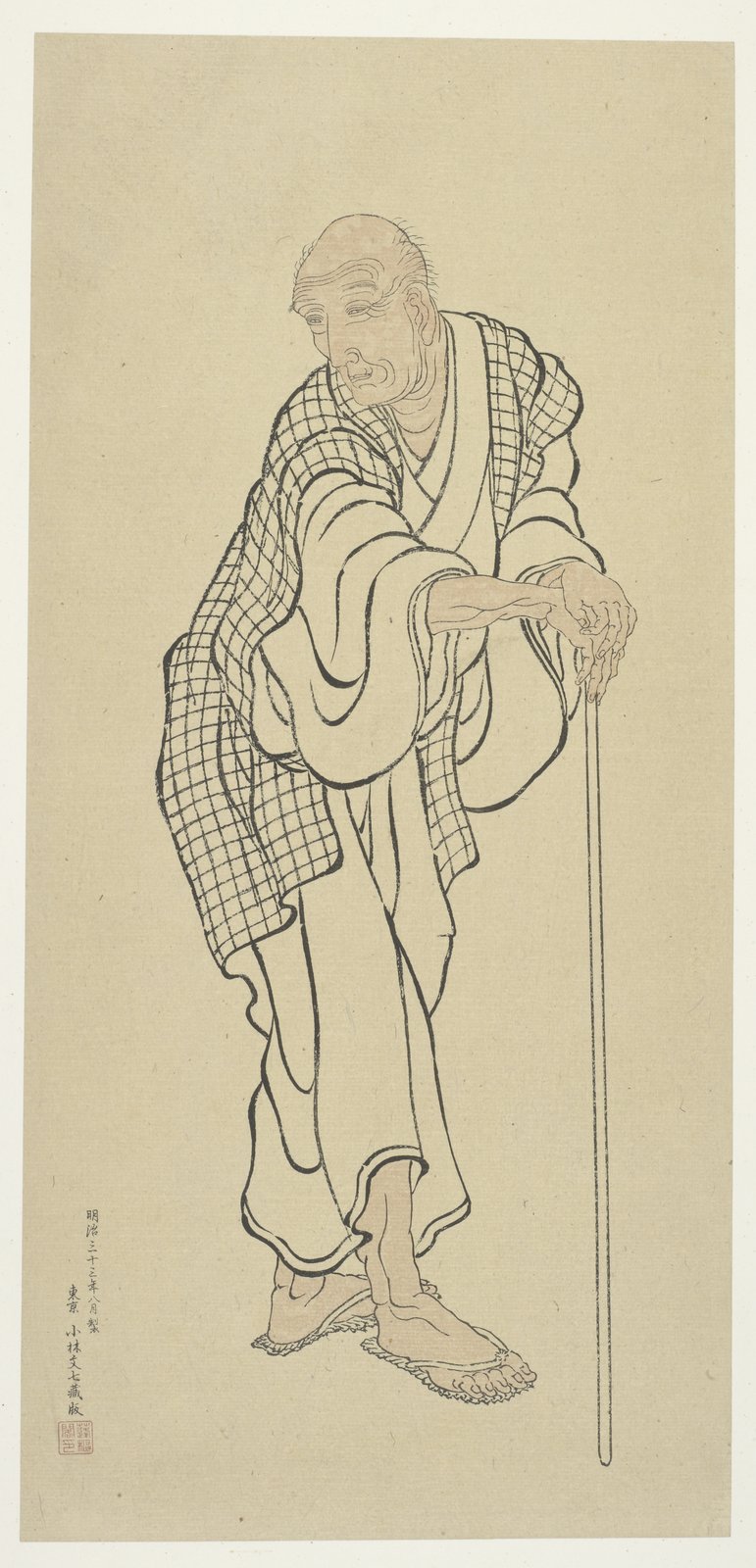

Woodblock print depicting Hokusai as an old man, printed in Tokyo in August 1900 (Meiji 33, per the colophon; blocks held by Kobayashi Bunshichi), 51 years after his death; maker of the earlier image not stated by the museum. National Museum of Asian Art, Smithsonian Institution, F1904.282, CC0. · Smithsonian National Museum of Asian Art (Freer Gallery of Art), F1904.282 'Hokusai as an old man', woodblock print, gift of Charles Lang Freer; copy via Wikimedia Commons · CC0 1.0 Universal (Public Domain Dedication)
핵심 특성
주요 업적
1830~32년경 호쿠사이는 채색 목판화 연작 《후가쿠 36경》을 만들었고, 이 연작은 모두 46점으로 늘어났다. 〈가나가와 해변의 높은 파도 아래〉(흔히 '거대한 파도')와 〈개풍쾌청〉이 여기에 들어 있다. 이 그림들은 후지산을 여행자와 일하는 사람들, 날씨와 함께 담아냈다. 영국박물관의 팀 클라크는 '거대한 파도'의 원판 하나에서 많게는 5,000~8,000장이 인쇄되었고, 한 장 값이 국수 두 그릇 값을 조금 넘는 정도였다고 추정한다.
호쿠사이는 1814년부터 《만가(漫画)》를 펴냈다. 사람과 동물, 식물, 풍경, 직업, 전설을 담은 작은 그림이 빼곡한 목판 스케치북 연작이다. 클라크는 1814년부터 1819년 사이에 한 권당 약 서른 면으로 된 열 권이 나왔다고 설명하며, 이 연작은 결국 열다섯 권까지 이어졌는데 마지막 권들은 그가 죽은 뒤 남은 스케치를 모아 엮었다. 스트레인지는 이 책을 일본 생활의 백과사전이라고 불렀다.
19세기 후반 일본 판화가 대량으로 파리에 들어왔고, 호쿠사이는 그와 함께 이름이 알려진 작가 가운데 한 사람이었다. 클라크는 그를 자포니슴의 선두에 선 인물로 보며, 빈센트 반 고흐가 '거대한 파도'를 날카롭게 평가한 글을 쓴 유럽 최초의 사람들 가운데 하나였다고 말한다. 클라크는 1896년에 나온 에드몽 드 공쿠르의 호쿠사이 연구를 유럽 최초의 본격적인 평전이라고 부른다.
삶의 장면들
미셸 르봉이 1896년 연구서에서 전하는 이야기로, 그 자리에 있었던 도자키라는 사람의 기억에 바탕을 둔다. 쓰가루의 영주가 호쿠사이에게 병풍 그림을 청했으나 답이 없자, 사자가 두 차례 찾아와 환영 선물로 금 다섯 닢을 내밀었다. 호쿠사이는 두 번 모두 거절했다. 사자가 그를 죽이겠다고 위협하자 호쿠사이는 그저 금을 돌려보내겠다고 답했다. 몇 달 뒤 그는 청하지도 않았는데 영주의 저택을 찾아가 병풍에 야생마 무리를 그렸고, 이 병풍은 쓰가루 성에 보관되었다.
이 일화는 후원자의 부름이 아니라 스스로 마음이 동할 때 일을 맡으려는 강한 독립 욕구를 보여 주는 사례로 읽을 수 있다. 다만 늦게 전해진 목격자 한 사람의 이야기에 근거한다. 자율성 욕구
르봉과 앙리 포시옹이 전하는 일본 화가 열전의 기록에 따르면, 1811년 소설가 바킨은 함께 만들던 삽화 소설에서 한 인물이 나막신을 입에 문 장면을 그리라고 고집했고, 호쿠사이는 그렇게 하는 사람은 없다며 먼저 직접 해 보라고 말하고 거절했다. 1807년부터 이미 다툼이 잦았던 두 사람의 협업은 여기서 끝났다. 르봉은 나막신 하나만으로 결별을 설명하기는 어렵다고 본다.
편집자나 후원자의 요구를 거절한 다른 일화들과 함께 보면, 의견 충돌이 생겨도 물러서지 않고 맞서는 태도와 부합한다. 다만 르봉과 포시옹 모두 바킨을 고지식하고 권위적인 사람으로 묘사하므로, 이 다툼을 호쿠사이 한쪽만 까다로웠다는 증거로 읽을 수는 없다. 갈등 감내
전환점
1788년경 호쿠사이는 스승의 공방에서 쫓겨난 뒤 화풍과 이름을 계속 바꾸다 형편이 몹시 어려워져, 거리에서 고춧가루와 달력을 팔았다. 그러던 중 단오 축제용 깃발에 귀신 쫓는 신 쇼키를 그려 달라는 주문을 받았고, 금 두 료를 받았다. 르봉이 호쿠사이가 훗날 서적상에게 해 준 이야기를 바탕으로 전하는 바에 따르면, 그는 이때 평생을 그림에 바치기로 결심하고 새벽부터 해질 때까지 그리고 그 뒤로도 몇 시간씩 공부했다. 이듬해인 1789년에는 많은 책에 삽화를 그렸다.
이 결심은 호쿠사이가 훗날 직접 한 이야기로만 전해지므로, 그가 자신의 전환점을 어떻게 이해했는지를 보여 주는 이야기로 읽는 편이 낫다. 이는 이 프로필의 강한 숙련 지향과 부합한다. 숙련 지향
비슷한 인물
전체적인 프로필이 이 사람과 닮은 사람들이에요.
출처
- Katsushika Hokusai (Q5586) -- verified live via wbgetentities (2026-10-04): en label 'Katsushika Hokusai', description 'Japanese artist (1760-1849)', birth 31 Oct 1760, death 10 May 1849, citizenship Japan, ko label '가쓰시카 호쿠사이', ja label '葛飾北斎'. The look-alike entity Q11621042 (Katsushika Hokusai II, Japanese ukiyo-e artist, Japanese Wikipedia only) was checked and is not this person. Orientation only; not used as support for any row.
- Hokusai (English Wikipedia) -- orientation only: read for the broad chronology (Manga from 1814, Thirty-six Views of Mount Fuji c. 1830-32, One Hundred Views from 1834, the 1839 fire) and the later European reception; never used as support for any scored row.
- Michel Revon, Etude sur Hoksai (Paris, 1896; doctoral thesis by a professor at the Tokyo law faculty), Internet Archive full text -- SCHOLAR with Japanese witness testimony: draws on Iijima Handjiro's 1893 Katsushika Hokusai den, Japanese compendia of ukiyo-e artists, and interviews with surviving acquaintances (Yokota Baigen, Koshu Rogi, Tozaki and others), most of them friendly to Hokusai; also relays Bakin's side of their quarrels. Read in full: the life chapter (early training and break with Katsukawa Shunsho, 1787-88 poverty, the 1804 performance before the shogun, the quarrels with Bakin and the actor Baiko, Nagoya 1817-18, Kyoto, Shinano, Uraga 1834-36, the 1836 famine, the 1839 fire, his studio and habits, money, the last moves and illness).
- Edmond de Goncourt, Hokousai (Paris, 1896; Internet Archive copy of the 1916 edition) -- French collector-critic, admiring; relies on translations by Hayashi Tadamasa and documents from Bing and Gonse. Read for: the Dutch scroll commission and its price dispute, the letters from Uraga (rates paid, a single robe), the quarrel with Bakin over text and illustrations, the 1839 fire, the family (a troublesome son and grandson, the daughter Oyei who divorced and lived with him), the number of his dwellings, and his last words. Several dates in it are corrected by later writers.
- Juliet Rix, 'Tim Clark - interview: This set of Hokusai's drawings is a really important piece of the jigsaw', Studio International, 30 Oct 2020 -- interview with the British Museum's long-time Hokusai curator after the museum acquired 103 rediscovered drawings of 1829 for 'The Great Picture Book of Everything'. MODERN SCHOLAR / MUSEUM CURATOR perspective (non-self, independent of the nineteenth-century biographers): his insistence on top block-cutters, the January 1830 letter to publishers, the Manga, the European perspective in the Great Wave, Japonisme, his devotion to Nichiren Buddhism, and his late works. Fetched and read in full.
- Henri Focillon, Hokousai (Paris: Felix Alcan, 1914), Internet Archive full text -- French art historian's critical synthesis; follows Goncourt and Revon for the facts but gives its own, more critical reading of Hokusai's temper. Read: the chapters on his maturity, the quarrels with Bakin and Baiko, the exile at Uraga, the famine, the fire and the old man's studio.
- Edward F. Strange, Hokusai, the Old Man Mad with Painting (London/New York, 1906; by a Victoria and Albert Museum curator), Internet Archive full text -- English compilation from Goncourt, Revon and the Japanese life of Hokusai (not an independent perspective on the facts); read in full, including its account of why Japanese critics ranked Hokusai low and the 'peasant' label he used for himself. Its dating of the Fuji series (1823-29) is outdated.
- Hokusai's own postscript to One Hundred Views of Mount Fuji (1834, written 'at seventy-five' by East Asian reckoning, signed Gakyo Rojin, the old man mad about drawing), as translated in C. J. Holmes, Hokusai (London, 1899) and quoted in Goncourt's book -- SELF perspective only; never the sole support for any row.