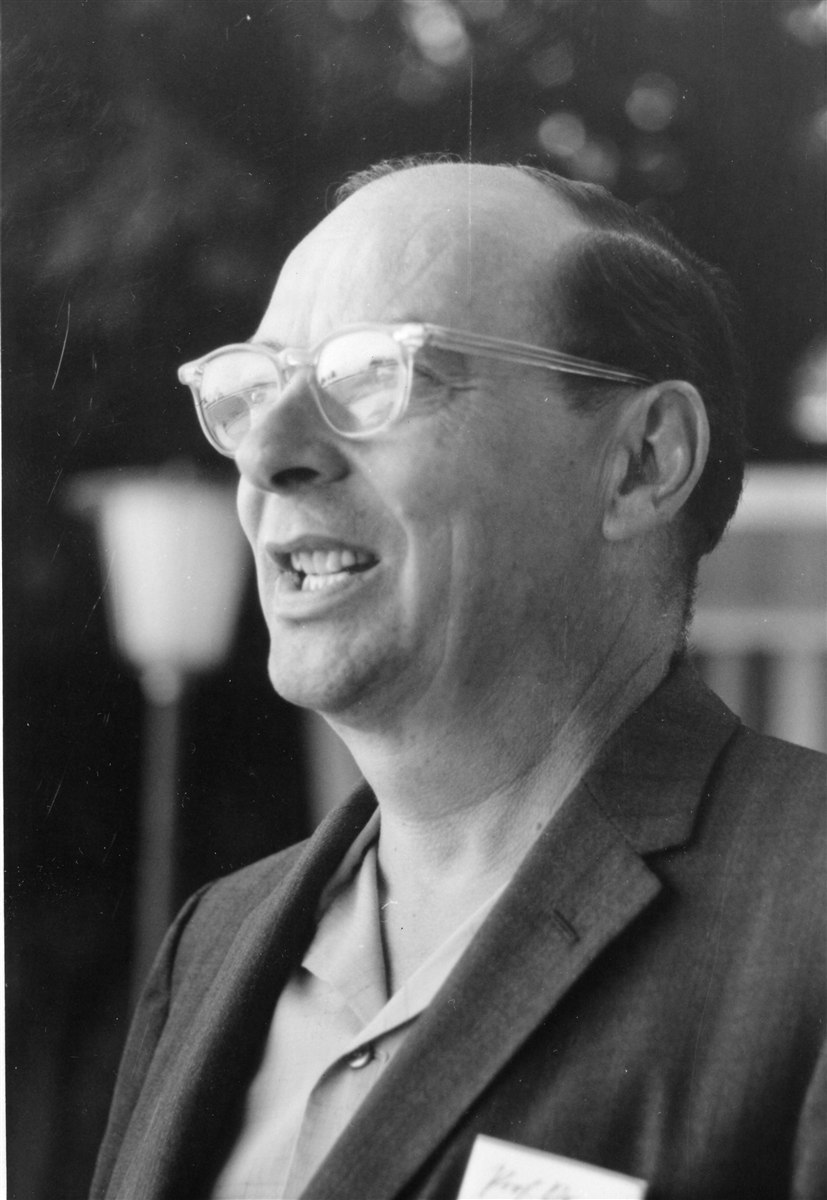

Segre Collection, AIP Emilio Segre Visual Archives, 1961 (photographer not individually named), reused with AIP's stated permission · 'Portrait of John Bardeen in Lindau' (1961), AIP Emilio Segre Visual Archives, Segre Collection, uploaded to Wikimedia Commons as 'John Bardeen in Lindau.jpg' (original 2422 x 3513) with the AIP statement that American Institute of Physics is the copyright holder and freely gives permission to use the image with the credit line, matching the AIP archive's published copyright guide. Identity: the Commons caption comes from the AIP archive, and a conference name tag reading 'Prof. Dr. Bardeen' is visible in this and in a second 1962 photograph from the Staatsarchiv Freiburg. Downscaled to 827 x 1200; no upscaling. CAVEAT: the AIP repository page (repository.aip.org/bardeen-lindau) returned HTTP 403 to automated requests, so the item's own Copyright Holder line could not be seen directly; the basis rests on the Commons page quoting AIP and the AIP guide. If the lead considers that insufficient, hold this portrait. · CC BY 4.0
물리학자 · 20세기
존 바딘
1908–1991
주요 업적 분야
아직 성격 매칭에 포함되지 않았습니다 — 기록된 근거가 성격 모델 전체를 다루기에는 충분하지 않습니다. 이 페이지의 다른 모든 내용은 자유롭게 확인하실 수 있습니다.
핵심 특성
주요 업적
1940년대 후반 벨 연구소에서 월터 브래튼과 함께 트랜지스터 효과를 발견했고, 1956년 브래튼, 윌리엄 쇼클리와 함께 노벨 물리학상을 공동 수상했다.
1957년 리언 쿠퍼, 로버트 슈리퍼와 함께 초전도 현상에 대한 최초의 성공적 설명인 BCS 이론을 제안했으며, 세 사람은 1972년 노벨 물리학상을 받았다.
물리학상을 두 번 받은 유일한 인물로 소개되며, 1951년부터 일리노이 대학에서 반도체 연구실과 이론 그룹을 세웠다.
삶의 장면들
1948년 1월 쇼클리가 트랜지스터 특허에 자기 이름만 올리겠다고 하자 브래튼은 큰 소리로 항의했고 바딘은 말없이 자리를 떴으며, 이후 벨의 변호사들은 바딘-브래튼 소자로 특허를 출원했다.
이는 분쟁을 공개적으로 맞서기보다 조용히 피하는 성향과 부합한다. 갈등 감내
일리노이에서 초전도 연구를 이끌며 박사후연구원 쿠퍼와 대학원생 슈리퍼에게 자기 아이디어를 추구할 자유를 주었고, 이후 두 사람을 미국물리학회 학회에 보내 BCS 이론을 발표하게 했다.
이는 후배 동료와 공을 나누는 협력적 방식과 부합한다. 협업 성향
전환점
벨 연구소에서 쇼클리와 갈등을 겪은 뒤인 1951년 그는 일리노이 대학의 전기공학·물리학 교수가 되었고, 그곳에서 초전도 이론에 매진했다.
이는 자신의 연구를 직접 이끌 여지를 찾는 태도와 부합한다. 자율성 욕구
비슷한 인물
전체적인 프로필이 이 사람과 닮은 사람들이에요.
출처
- John Bardeen (Q949) -- verified live via the Wikidata API (2026-10-26): English label 'John Bardeen', description 'American physicist and engineer (1908-1991)', born 1908-05-23, died 1991-01-30, citizenship United States, P18 image 'Bardeen.jpg' (280 x 396, Nobel Foundation; not used, see notes). Orientation only; not used as support for any row.
- Nobel Foundation, 'The Nobel Prize in Physics 1972' (summary page) and the award ceremony speech by the Royal Swedish Academy of Sciences, both read in full. CANONICAL SIGNIFICANCE SOURCE: the prize was awarded jointly to John Bardeen, Leon Neil Cooper and John Robert Schrieffer 'for their jointly developed theory of superconductivity, usually called the BCS-theory'; the speech describes the 1957 paper as a complete theoretical explanation that predicted new effects and stimulated theoretical and experimental research. Award-body text: authoritative and admiring.
- Nobel Foundation, 'The Nobel Prize in Physics 1956' (summary page) and the award ceremony speech by the Royal Swedish Academy of Sciences, read: the prize to William Bradford Shockley, John Bardeen and Walter Houser Brattain 'for their researches on semiconductors and their discovery of the transistor effect'; the speech explains conductors, insulators and semiconductors and says that the discovery of transistor action in 1948 gave Shockley, Bardeen and Brattain the key to the control mechanism. Award-body text, joint credit stated.
- Nobel Foundation, 'John Bardeen - Biographical' (written at the time of the 1956 award, published in 'Les Prix Nobel', with the later 1972 addendum), read in full: Wisconsin electrical engineering degree, geophysical prospecting at Gulf Research Laboratories, mathematical physics at Princeton under Wigner, Harvard Junior Fellowship, Minnesota, wartime Naval Ordnance Laboratory, Bell Telephone Laboratories (1945-51), Professor of Electrical Engineering and Physics at Illinois from 1951, research fields, and the 1957 BCS proposal 'the first successful explanation of superconductivity'. Institutional biography. Family passages were read and excluded.
- PBS/WGBH 'Transistorized!' site, pages 'Patent Battles' and 'Shockley, Brattain and Bardeen: Clashing Egos to the End', read in full: the January 1948 meetings in which Shockley said he intended to be the only name on the transistor patent; Brattain's and Bardeen's different reactions; Bell Labs lawyers filing on the Bardeen-Brattain device after finding Lilienfeld's earlier patent; Bardeen calling the situation 'intolerable' and later taking a job at the University of Illinois where he could direct his own work; Brattain recalling the staged press photograph. A public-broadcasting history presenting the documented professional rift with Shockley, relying on interviews and archival quotations (Brattain 1974). COUNTER-VOICE on the Bell Labs episode; descriptions of Shockley's later conduct were not used.
- David Pines, 'John Bardeen: genius in action' (Physics World, 1 May 2003, review of Hoddeson and Daitch, 'True Genius'), read in full: Bardeen's modesty, interest in applications and ability to collaborate with experimentalists and theorists; the Bell Labs invention of the transistor with Brattain in 1947; the six years of sustained effort that produced BCS theory with Cooper and Schrieffer, his emphasis on experimental facts, his freedom given to younger colleagues, his consultancy to Xerox on xerography; the review's remark that Shockley was single-handedly responsible for Bardeen leaving Bell Labs in 1951; and the reviewer's criticism that the book covers the Illinois years less well. Review by a former younger colleague: admiring but specific.
- J. Robert Schrieffer, review of Hoddeson and Daitch, 'True Genius: The Life and Science of John Bardeen, the Only Winner of Two Nobel Prizes in Physics' (Physics Today, February 2003), read in full: Bardeen as a modest, quiet man; Bell Labs work with Brattain on the point-contact triode; Shockley, who led the group, thought he should receive major credit because of an earlier (incorrect) suggestion; the move to Illinois, where he founded a semiconductor laboratory and a theory group; bringing together Cooper and Schrieffer; his teaching students to decompose complex problems into simple pieces. Review by a BCS co-laureate: close, admiring and not independent.
- Fermilab 'FermiNews' (27 June 2003), feature on Lillian Hoddeson's biography 'True Genius', read in full: Bardeen as unlike the 'mad scientist' stereotype, nicknamed 'Whispering John', sending his students Cooper and Schrieffer to announce the BCS theory at an American Physical Society meeting, learning from Wigner to reduce problems to their essentials, tackling problems persistently, preferring to work in collaboration and seeking problems that would benefit society; quotes Hoddeson and Bardeen's son. Laboratory news feature based on the biographer's account.
- Kirkus Reviews, review of Hoddeson and Daitch, 'True Genius: The Life and Science of John Bardeen' (15 July 2002), read in full: calls it a serviceable and slow biography; says Bardeen had a gift for decomposing large problems and formulated an elegant theory of surface states that made the transistor practicable; that the transistor material largely duplicates Hoddeson's earlier 'Crystal Fire'; and that the book's ordinary-man emphasis becomes a 'curious disquisition' on genius. Independent trade review; COUNTER-VOICE on the biography's quality, not on the scientist.
- AIP Emilio Segre Visual Archives, Segre Collection, 'Portrait of John Bardeen in Lindau' (1961), the Wikimedia Commons file page 'John Bardeen in Lindau.jpg' (AIP copyright-holder statement), the AIP guide 'Determining Copyright and Permissions'; also the Landesarchiv Baden-Wuerttemberg terms of use for a second candidate photograph. Checked for the portrait only.