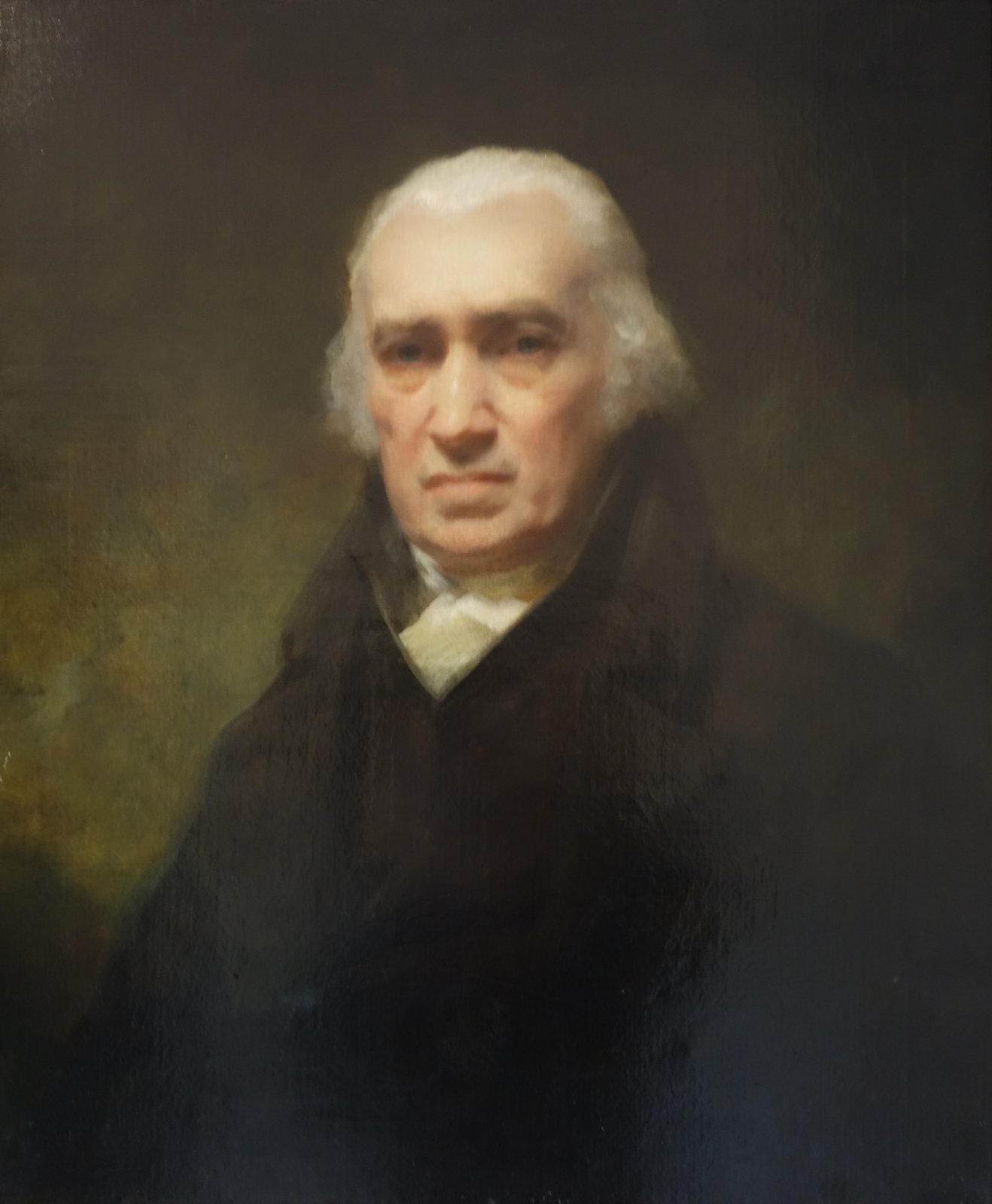
Henry Raeburn, James Watt, 1815, oil on canvas, Huntington Art Museum, San Marino, California; photograph by Daderot, CC0 (the painting is public domain: artist died 1823); cropped to the canvas and downscaled · The Huntington Library, Art Museum, and Botanical Gardens, San Marino (Henry Raeburn, oil on canvas, 1815), photographed by Daderot, via Wikimedia Commons · CC0 (photograph); painting public domain
핵심 특성
주요 업적
조지프 블랙의 훗날 증언에 따르면, 와트는 1765년 초에 뉴커먼 기관이 매 행정마다 실린더를 식히느라 증기를 낭비한다는 점을 파악했고, 증기를 별도의 용기에서 응축하면 이 낭비를 피할 수 있다고 보았다. 이렇게 개량한 설계의 기관은 1770년대 중반부터 볼턴 앤드 와트 사가 제작했으며, 처음에는 광산 배수용으로, 나중에는 기계 구동용으로 쓰였다.
제임스 피커드가 1780년에 크랭크에 대한 특허를 얻은 뒤, 와트는 1781년 특허에서 기관의 왕복 운동을 회전 운동으로 바꾸는 다섯 가지 대안적 방법을 제시했고, 그가 속한 회사는 그중 태양-유성 기어를 실제로 사용했다. 1784년 특허에는 빔 엔진의 피스톤 로드를 거의 직선에 가까운 경로로 안내하는 링크 장치인 평행 운동 기구가 명시되었다.
삶의 장면들
1763~64년 겨울, 와트는 글래스고 대학이 보유한 뉴커먼 기관 작동 모형의 수리를 맡았는데, 그 보일러가 모형을 계속 돌릴 만큼의 증기를 공급하지 못한다는 것을 알게 되었다. 이를 곁에서 지켜보았고 훗날 와트 측의 특허 소송을 위해 진술한 존 로버슨에 따르면, 와트는 가열 면적을 넓히고 나무 보일러와 덮개를 씌운 실린더를 시험해 보았으며, 증기의 4분의 3 이상이 응축되어 낭비되고 있음을 보였다.
모형을 고치는 데 그치지 않고 변경을 하나씩 시험하며 손실을 측정한 이 방식은 이 프로필의 높은 실험 성향 점수와 부합한다. 다만 로버슨의 진술은 약 30년 뒤에, 소송의 한쪽 편을 위해 작성된 것이라는 점을 유의해야 한다. 실험 성향
1777~79년 콘월에서 볼턴 앤드 와트의 첫 양수 기관을 설치하는 동안, 와트는 광산 출자자들과 대금 조건을 정하러 와 달라고 볼턴에게 거듭 편지를 썼다. 1779년 윌 유니언에서 열린 험악한 회합에서는 끝나기 전에 자리를 떴고 그런 대우를 견딜 수 없다고 적었지만, 새 기관의 조건이 확정되기 전에는 설계도를 그리지 않겠다고도 썼다. 스마일스가 이 편지들을 인용하고 있으며, 브램웰도 별도로 와트가 흥정을 꺼렸다고 서술한다.
이 편지들은 대면 협상은 동업자에게 맡기고 조건에 대해서는 글로 단호하게 밝히는 성향과 나란히 놓이며, 이는 이 프로필의 평균 이하 갈등 감내 점수와 맞아떨어진다. 갈등 감내
전환점
와트의 1769년 특허 지분 3분의 2를 가지고 있던 존 로벅은 1770년대 초에 파산했고, 매슈 볼턴이 약 1,200파운드의 채무를 대신해 로벅의 지분을 넘겨받았다. 스코틀랜드에서 측량가이자 운하 기술자로 일하던 와트는 1774년 5월 버밍엄으로 옮겼고, 1775년에는 의회가 특허 기간을 연장했으며 볼턴 앤드 와트의 동업이 시작되었다.
첫 번째 협력 관계가 무너졌을 때 스코틀랜드와 측량 일을 떠나 새로운 동업으로 옮긴 것은 이 프로필의 적응력과 부합하지만, 스몰과 볼턴의 거듭된 초청 역시 이 이동의 한 요인이었다. 적응력
비슷한 인물
전체적인 프로필이 이 사람과 닮은 사람들이에요.
출처
- James Watt (English Wikipedia; lead section fetched via the MediaWiki API) -- orientation only (identity, dates, occupations); not used as support for any scored row. The Korean Wikipedia page 'ko:제임스 와트' was checked to exist (title only).
- James Watt (Q9041) -- identity verified live through the Wikidata API (wbgetentities: labels, descriptions, claims): en label 'James Watt', description 'British engineer (1736-1819)', ko label '제임스 와트', born 1736-01-19, died 1819 (two day-level values, 19 and 25 Aug; only the year is used), citizenship Scotland (Q22, mapped to GB), P18 'James Watt by Henry Howard.jpg'. Orientation only.
- Samuel Smiles, Lives of Boulton and Watt (London, 1865), Project Gutenberg #52069, full text downloaded and searched locally -- independent Victorian biographer working 'principally from the original Soho MSS' (family-supplied archive; admiring, self-help tone; one perspective). Read closely: ch. V-VIII (Glasgow years, the Newcomen model, Kinneil, surveying), X-XVII (Boulton partnership, Cornwall, the crank/Pickard episode, rotary motion, Hornblowers, mills, workmen), the water-composition and Lunar Society passages of ch. XVIII, the lawsuit and Murdock passages of ch. XX-XXI and ch. XXIII (last years, Scott/Jeffrey testimony). Quotes many letters by Watt, Boulton, Small, Roebuck and Robison that were not opened directly.
- John Robison's narrative of his acquaintance with Watt (Glasgow, 1758-67) as reproduced in J. P. Muirhead, The Life of James Watt (American ed., 1859), ch. VI, archive.org OCR full text (noisy; legible passages only) -- FIRSTHAND account by a close friend and fellow student, written c.1796 as testimony for Watt's side in the patent suit Boulton and Watt v. Hornblower and Maberley, recollecting events some thirty years earlier (interested, from memory). Muirhead was a kinsman of Watt and the editor of his papers (compiler only, weakly independent).
- Joseph Black's short narrative of Watt's improvement of the steam engine, as reproduced in Muirhead, Life of James Watt (1859), ch. VI (same archive.org OCR volume) -- FIRSTHAND account by Watt's friend and the Glasgow professor of chemistry, also prepared c.1796 for the patent litigation (interested, from memory). Different author from Robison; both were reproduced by the same editor.
- Watt's own narrative in his 'Notes on Robison' (History of the steam engine, c.1814), as reproduced in Muirhead, Life of James Watt (1859), ch. VII, first part read (c.1759-64: the Papin-digester experiments, the college model, the flask measurements) -- SELF-AUTHORED (one perspective, together with Watt's letters quoted by Smiles); used only where flagged self and never as the sole support for a row.
- Frederick J. Bramwell, 'Watt, James (1736-1819)', Dictionary of National Biography vol. 60 (1899), Wikisource text -- independent secondary biography by a consulting engineer who had read the Boulton-Watt correspondence held by the Tangye family; critical in places (the crank/sun-and-planet passage, the patent specification, the 'inventor' misconception). Fetched via the Wikisource API and read in full.
- George Selgin and John L. Turner, 'Strong Steam, Weak Patents, or, the Myth of Watt's Innovation-Blocking Monopoly, Exploded' (working paper, 8 April 2009; published Journal of Law and Economics 54(4), 2011), PDF downloaded and read in full -- independent scholarly (economic-history) article that reviews Watt's patents, the Bull and Hornblower/Maberley suits and his attitude to high-pressure steam; it argues a thesis (that the patent did not block high-pressure steam), so factual statements are used sparingly and its interpretive claims are not relied on.
- Henry Brougham, Lives of Men of Letters and Science who flourished in the time of George III, vol. 1 (London, 1845), chapter 'Watt' (pp. 352-365 and 400-401 read), archive.org OCR text -- independent secondary sketch by a contemporary lawyer and politician who says he knew Watt; largely derived from Robison, Muirhead and Arago, so treated as weakly independent and used only for the organ episode and for Arago's judgment of Watt's drawings. The middle of the chapter (the water-composition controversy) was not read.