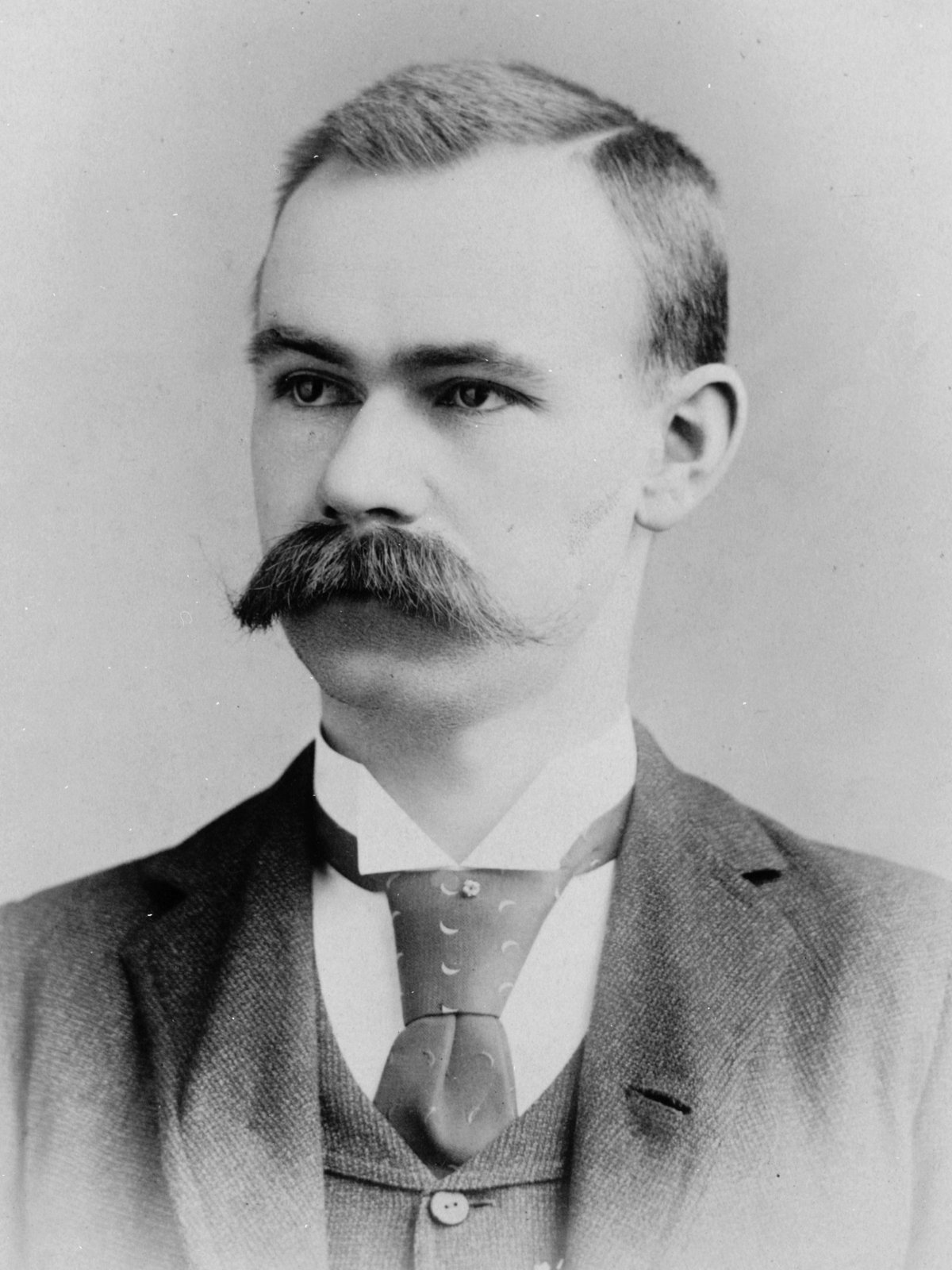

C. M. Bell (Charles Milton Bell, approximately 1849-1893), '[Herman Hollerith, head-and-shoulders portrait, facing left]', cabinet card photograph, ca. 1888, Washington, D.C.; Library of Congress Prints and Photographs Division (LC-USZ62-115982), no restriction recorded · Library of Congress Prints and Photographs Division, LOT 12259 (LC-USZ62-115982; hdl.loc.gov/loc.pnp/cph.3c15982), via Wikimedia Commons 'Hollerith.jpg' (cropped to the photograph) · Public domain
핵심 특성
주요 업적
홀러리스는 한 사람의 인구조사 항목을 카드의 구멍으로 기록하고 이를 전기로 작동하는 기계가 세는 전기 집계 체계를 고안했다. 첫 특허 출원은 1884년 9월에 했고 특허는 1889년 1월에 나왔다. 1889년 세인트루이스 조사구역에서 치른 시험에서 그의 방식은 집계에 5시간 28분이 걸렸고, 헌트(Hunt) 방식은 55시간 22분, 피진(Pidgin) 방식은 44시간 41분이 걸렸으며, 인구조사국은 그의 방식을 채택했다. 1890년에는 미국 전체 인구의 1차 집계가 6주 남짓 만에 끝났고, 잠정 총인구는 1890년 10월 28일에 발표되었다.
홀러리스는 1896년 태뷸레이팅 머신 컴퍼니(Tabulating Machine Company)를 설립하고 러시아 최초의 전국 인구조사(1897)에 쓸 기계 공급 주문을 따냈다. 오스트리아의 한 공방은 1890년 오스트리아 인구조사를 위해 그의 방식을 제작할 면허를 받았고, 노르웨이와 프랑스도 이 방식을 썼으며, 1897년부터는 뉴욕 센트럴 철도가 상업 고객이 되었다. 미국 인구조사국도 1900년에 다시 그의 기계를 임차했다. 1911년 그는 이사진과 함께 회사를 매각했고, 이 회사는 합병되어 컴퓨팅-태뷸레이팅-레코딩 컴퍼니(CTR)가 되었으며 1924년 IBM(International Business Machines)으로 이름을 바꿨다. 그는 자문 엔지니어로 남았다.
홀러리스는 1902년부터 기업 고객을 위해 장비를 새로 설계했다. 1907년 무렵 그의 두 번째 체계는 건반식 천공기, 분류기, 합산 집계기에 플러그보드 방식의 프로그래밍과 자동 카드 판독기를 더하고 45열 카드를 중심으로 했으며, 이후의 80열 카드는 표준 IBM 카드가 되었다. 공동 작업자였던 태프트-피어스(Taft-Peirce) 사의 유진 포드(Eugene Ford)는 건반식 천공기 설계에서 핵심 역할을 했다.
삶의 장면들
1895년 뉴욕 센트럴 철도는 홀러리스의 합산 집계기가 믿을 수 없다는 이유로 시험 사용을 중단했다. 홀러리스는 몇 달 만에 같은 용도의 새 합산 집계기를 고안했고, 두 번째 시험을 거쳐 채택되어 1897년부터 이 철도가 고객이 되었다.
시험이 실패한 뒤 고객을 포기하지 않고 새로 설계한 기계를 들고 돌아간 일은 끈기와 부합한다. 이 서술은 한 학자가 기록 보관소의 서신을 읽어 정리한 것이다. 끈기
1894년 홀러리스는 노르웨이 통계국에 집계기를 무상으로 시험해 보라고 제안하고, 직접 노르웨이로 가서 조립했다. 시험 결과가 좋아 통계국은 이듬해 1,100달러에 이 기계를 구입했고, 기계는 1900년 노르웨이 인구조사에 쓰였다.
주문이 있기도 전에 무상 기계를 해외로 가져가 직접 설치한 일은 주도적 행동성과 부합한다. 선제적 행동력
전환점
1904~05년 회계연도에 인구조사국은 더 낮은 임차 요율을 얻어 냈고, 홀러리스는 양보에 반대했으나 이사진이 그의 뜻을 눌렀다. 1905년 인구조사국은 1906년에 만료될 그의 초기 특허를 바탕으로 자체 집계 기계를 개발할 예산을 확보했다. 정부가 집계 기계에 관한 실험 작업을 하지 않는다는 그의 조건을 인구조사국이 거부하자, 그의 회사는 임차했던 기계를 돌려받았고 1920년대 후반에야 다시 인구조사국에 기계를 공급했다.
고객이 자체 실험을 하지 않는다는 조건을 계약에 단 일은 자신의 설계에 대한 통제를 지키려는 강한 욕구와 부합한다. 트루스델(Truesdell)의 인구조사국 역사서는 당시 요율을 '과도하고 터무니없다'고 평가하므로 이 분쟁에는 양쪽의 입장이 있었다. 자율성 욕구
비슷한 인물
전체적인 프로필이 이 사람과 닮은 사람들이에요.
출처
- Herman Hollerith (Q192145) -- verified live via wbgetentities (2026-10-08): en label 'Herman Hollerith', description 'American statistician and inventor (1860-1929)', P569 29 Feb 1860, P570 17 Nov 1929, citizenship United States (Q30), instance of human, place of birth Buffalo (Q40435), P18 'Hollerith.jpg'. Orientation only; not used as support for any row.
- Herman Hollerith -- Wikipedia article, raw wikitext read as orientation only (used to find the Heide, Truesdell and Wright references); not used as support for any scored row.
- Leon E. Truesdell, The Development of Punch Card Tabulation in the Bureau of the Census, 1890-1940 (U.S. Department of Commerce, Bureau of the Census, 1965), Internet Archive full text -- official institutional history written by a long-time Census Bureau statistician, i.e. from the side of the customer that later became Hollerith's competitor. Read locally: the chapter 'The Originators of the System' (Hollerith's career to 1884, the Billings question), the 1889 test, the 1890 system and first count, the 1900 machinery, and Chapter VI (1900-1910: the rental rates, the Census Machine Shop, Hollerith's 1909 offer, the 1910 patent suit). Balanced in tone: it credits Hollerith's invention and also calls the 1904-05 rental rates 'excessive and exorbitant'.
- Lars Heide (Copenhagen Business School), 'Herman Hollerith', Immigrant Entrepreneurship: German-American Business Biographies, 1720 to the Present (German Historical Institute, Washington, D.C.) -- scholarly business-history biography by the author of Punched-Card Systems and the Early Information Explosion (2009), built on archival correspondence (Hollerith Papers at the Library of Congress, IBM Archives, Department of Commerce records) and on Geoffrey Austrian's biography; read in full. INDEPENDENT of Hollerith and of IBM; it also states his limits (one-man management style, no research department, conservative).
- Thomas Commerford Martin, 'Counting a Nation by Electricity', The Electrical Engineer (New York), 11 November 1891, reprinted pamphlet, Internet Archive full text -- contemporary trade-press report by the journal's editor after visiting the Census Office; admiring of the machines but written while the 1890 census was still being tabulated and while the press was criticising it. Read in full. Used for the 1889 test timings, the six-week first count, Hollerith's reluctance to release early figures, and the abuse the system drew in 1890-91.
- Herman Hollerith, 'An Electric Tabulating System', The Quarterly of the Columbia University School of Mines, vol. 10 (1889), Internet Archive full text (SELF source; his Columbia doctoral dissertation). Read for his own account of why and how he built the system (the 'barbarous' census methods, experimenting 'on quite a large scale'); never the sole perspective for any row.
- Carroll D. Wright, assisted by William C. Hunt, The History and Growth of the United States Census (Washington: Government Printing Office, 1900), Internet Archive full text -- official census history; read for the passage on the Eleventh (1890) Census adopting the Hollerith electric tabulating system after a preliminary test and for the statistics that the system made possible. Note that co-author Hunt was a losing competitor in the 1889 test, which makes the favourable passage the more notable.
- Computer History Museum, CHM Revolution exhibition, 'Making Sense of the Census: Hollerith's Punched Card Solution' -- museum exhibition text (read in full): the 1890 competition, the tabulator and punch, the card sized to US banknotes so existing bins could be used, the 1911 merger and Hollerith's disagreement with Thomas Watson.
- Engineering and Technology History Wiki (IEEE/ETHW), 'Herman Hollerith' biography page -- brief institutional overview (read in full; it contains a date slip, '1990 U.S. Census', and is not used for any scored row).
- J. J. O'Connor and E. F. Robertson, 'Herman Hollerith', MacTutor History of Mathematics archive (University of St Andrews) -- compiled biography (read in full); several details differ from Truesdell and Heide (for example the timing of the 1890 count), so it is used only as a cross-check and not for any scored row.