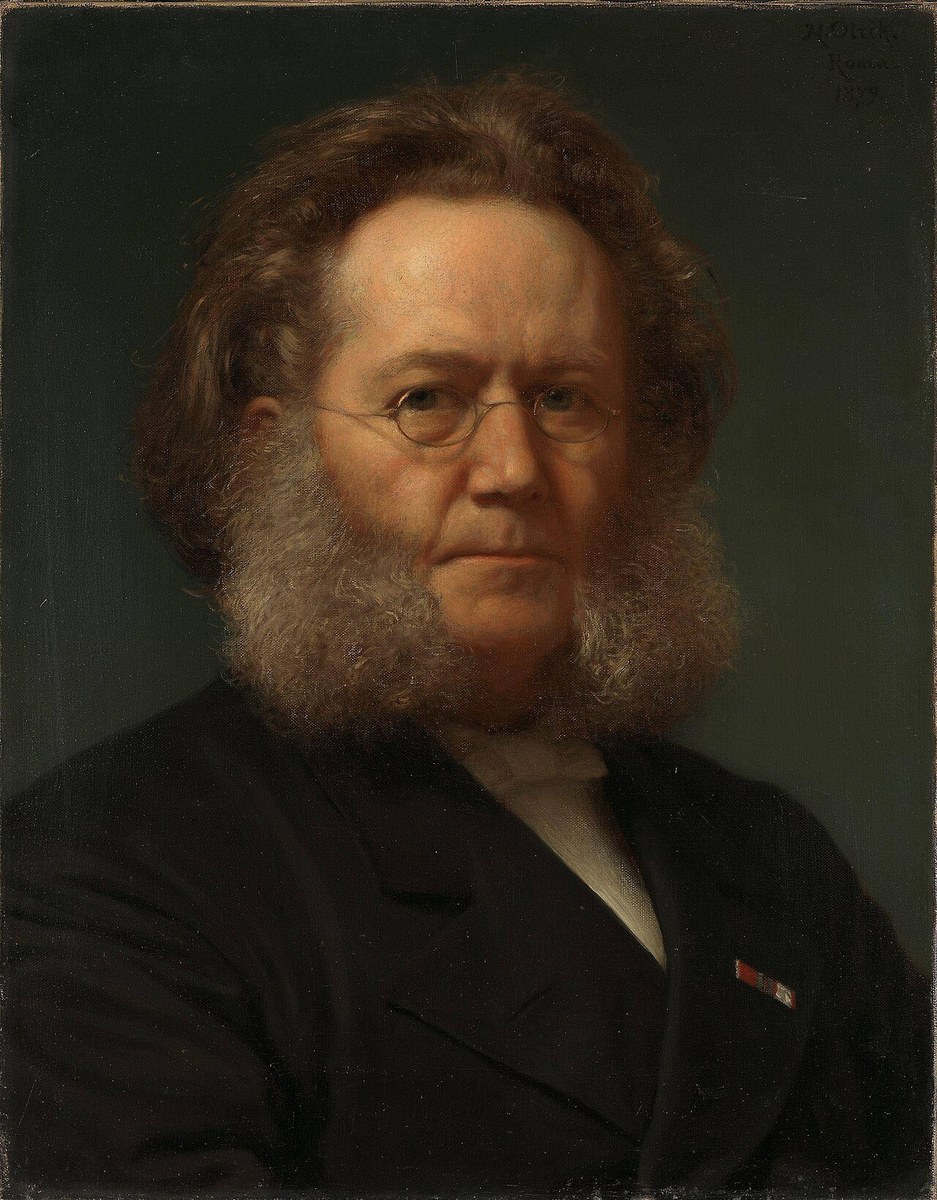

Henrik Olrik, portrait of Henrik Ibsen, 1879, Nasjonalmuseet, Oslo (public domain) · Portrait of Henrik Ibsen by Henrik Olrik, oil on canvas, 55 x 43.5 cm, dated 1879 (the canvas is signed 'H. Olrik, Roma 1879'), Nasjonalmuseet, Oslo, inventory NG.M.00355, acquired 1890, via Wikimedia Commons file 'Ibsen by Olrik.jpg' (original 2342 x 3000). The painter died in 1890, so the work is in the public domain worldwide and in the United States by its pre-1931 date; the Commons page states a faithful reproduction of a two-dimensional public-domain work adds no new copyright. The museum's collection record gives no conflicting copyright notice. The stored file was downscaled only, from a 1280 x 1640 Commons rendition to 937 x 1200 pixels, never enlarged. No source I read states that Ibsen sat for this painting, so it is presented as a painted portrait, not as a photograph; the lead may upgrade the classification if a documented sitting is found. · Public domain (painter Henrik Olrik died 1890)
작가 · 19세기
헨리크 입센
1828–1906
주요 업적 분야
아직 성격 매칭에 포함되지 않았습니다 — 기록된 근거가 성격 모델 전체를 다루기에는 충분하지 않습니다. 이 페이지의 다른 모든 내용은 자유롭게 확인하실 수 있습니다.
핵심 특성
주요 업적
그는 중산층 배경 속에 새로운 도덕적 분석을 담은 사실주의적 현대극을 유럽 무대에 선보인 노르웨이의 주요 극작가였다.
「인형의 집」(1879)으로 국제적 돌파구를 마련했고, 「유령」(1881)과 「민중의 적」(1882)이 같은 흐름으로 이어졌다.
그는 희곡 26편과 시 약 300편을 썼으며, 운문극 「브란」(1866)과 「페르 귄트」(1867)도 그 가운데 있다.
삶의 장면들
그는 글쓰기, 식사, 카페까지의 산책과 신문 읽기로 이루어진 일과를 정해 두고 지냈으며, 대략 2년에 한 편씩 새 희곡을 냈다.
이는 매우 규칙적인 작업 규율과 부합한다. 자기 규율
「인형의 집」과 「유령」 이후 비평가들이 그를 맹비난했고, 그는 불편한 진실을 말해 '민중의 적'으로 선포되는 주인공을 그린 「민중의 적」으로 응수했다.
이는 비판 앞에서 물러서기보다 논쟁적인 작품을 계속 쓰는 태도와 부합한다. 갈등 감내
전환점
1862년 크리스티아니아의 극장이 파산한 뒤 1864년 노르웨이를 떠나 이탈리아로 갔고, 27년을 해외에서 보내며 로마에서 「브란」과 「페르 귄트」를, 이후 대표작 대부분을 썼다.
이는 직업적 좌절 뒤에도 자신의 방식으로 작업을 이어가려는 지속성 및 자율성 욕구와 부합한다. 자율성 욕구
비슷한 인물
전체적인 프로필이 이 사람과 닮은 사람들이에요.
출처
- Henrik Ibsen (Q36661), verified live via the Wikidata API (2026-10-25): label 'Henrik Ibsen', description 'Norwegian playwright and theatre director (1828-1906)', Korean label in Hangul, born 1828-03-20, died 1906-05-23, several P18 images including 'Ibsen by Olrik.jpg'. Orientation only; not used as support for any row.
- Encyclopaedia Britannica, 'Henrik Ibsen', read in full. CANONICAL SIGNIFICANCE SOURCE: major Norwegian playwright of the late nineteenth century who brought realistic contemporary social drama to the European stage; early theatre work in Bergen and Christiania and the unsuccessful early plays and bankrupt theatre; 27 years abroad from 1864; the verse dramas Brand and Peer Gynt; the prose plays from Pillars of Society to A Doll's House (1879), Ghosts (1881), An Enemy of the People, The Wild Duck and Rosmersholm; the scandalised reaction and the critics who denounced him. Reference entry with interpretive commentary: factual, admiring, and its character readings of the plays are not used as evidence of his own character.
- University of Oslo, Ibsen Centre, 'Short biography' and 'Chronological survey of Ibsen's life and works' (Ibsen archive and Virtual Ibsen Centre), both read in full: Grimstad apprenticeship, first poem 1849, debut play Catiline 1850 under a pseudonym, six years in Bergen writing and staging six plays and learning the theatre as a director, the bankruptcy of the Christiania theatre in 1862, departure in 1864, publication in Copenhagen from Brand onward, Emperor and Galilean (1873), the contemporary plays from 1877, A Doll's House as the international breakthrough, 26 dramatic works and about 300 poems, and the year-by-year list of writing and first stagings. University research-centre biography: factual and admiring.
- Kirsten Shepherd-Barr, review of Ivo de Figueiredo's 'Henrik Ibsen: The Man and the Mask' (Yale, 2019), Scandinavica vol. 59 no. 1 (2020), read in full. Independent scholarly review of a biography: Ibsen's rigidly methodical daily routine and a new play about every two years, his careful management of his reputation and publication and his distance from movements that sought to claim him, the finding that his early plays were more successful with Nordic and German audiences than the usual story says, and the reviewer's criticisms of the biography's thesis and character-reading. Its closing speculation about his mind and private conduct was read and deliberately excluded from scoring.
- Steve Donoghue, review of Ivo de Figueiredo's 'Henrik Ibsen: The Man and the Mask', Open Letters Monthly, read in full: calls it the most lauded life of Ibsen since Michael Meyer's, notes the biography's view that he was a poet before he became a dramatist and took longer to master dramatic form. Short, admiring trade-press review of the biography; no behavioural claim relies on it alone.
- Washington Free Beacon, 'To Shock and Offend', review essay on de Figueiredo's biography, read in full. COUNTER-VOICE: argues that Ibsen has faded as a classic, that his stock of social-problem characters now seems hackneyed, that he wanted his plays to shock and offend and that he constantly solicited medals and decorations from European governments. An opinionated essay: its account of his family and private conduct was read and excluded; the claims about honours and shock are used only as a critical reading, with the honours remark carrying low weight as the reviewer's summary of the biography.
- Nasjonalmuseet (National Museum of Art, Architecture and Design, Oslo) collection record NG.M.00355, 'Henrik Olrik, Henrik Ibsen' (oil on canvas, 1879, acquired 1890), and its Wikimedia Commons file page 'Ibsen by Olrik.jpg', checked for the portrait only.