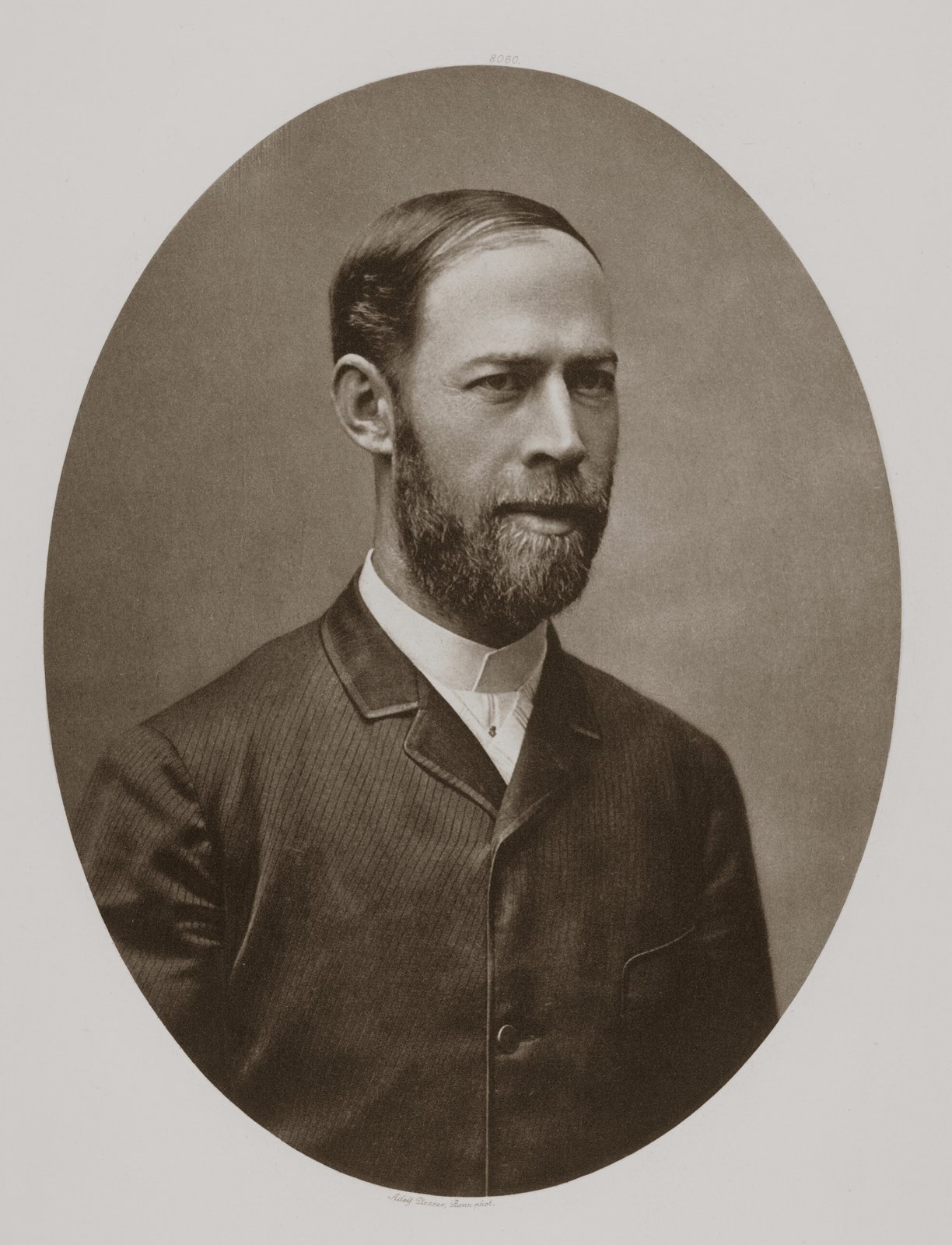

Robert Krewaldt, Kaiserplatz 16, Bonn, c. 1890 (cabinet photograph); reproduction via Wikimedia Commons · Wikimedia Commons, File:HEINRICH HERTZ.JPG (cabinet photograph by Robert Krewaldt, Bonn, c. 1890; reproduction credit Guenter Josef Radig); same portrait published in Die Gartenlaube 1894 · Public domain (photograph published in 1894 or earlier; Commons tag PD-old)
물리학자 · 19세기
하인리히 헤르츠
1857–1894
주요 업적 분야
아직 성격 매칭에 포함되지 않았습니다 — 기록된 근거가 성격 모델 전체를 다루기에는 충분하지 않습니다. 이 페이지의 다른 모든 내용은 자유롭게 확인하실 수 있습니다.
핵심 특성
주요 업적
헤르츠는 카를스루에 공과대학에서 불꽃 간극으로 빠른 전기 진동을 만들고, 공진 수신기로 이를 검출하여 전기 작용이 공기 중을 유한한 속도로 전파한다는 것을 보였다. 벽에서의 반사로 정상파를 만들어 파장과 속도를 측정했고, 이 파동이 빛처럼 반사·굴절·편광된다는 것도 보였다. 헬름홀츠는 패러데이와 맥스웰이 이런 견해를 개연성 있는 것으로 제시했으나 아직 검증되지 않았으며, 헤르츠가 그 증명을 해냈다고 썼다. 헤르츠는 1887년 11월 10일 베를린 학술원에 첫 성과를 보고했고, 논문들을 『전기파(Electric Waves)』(1892)로 묶었다. 주파수의 단위 헤르츠(hertz)는 그의 이름에서 따왔다.
헤르츠는 이 실험을 준비하는 동안 한 진동자의 불꽃이 가까이 있는 다른 진동자의 불꽃에 영향을 준다는 점을 발견했다. 유리판은 이 효과를 차단했지만 수정판은 그렇지 않았으며, 그는 이것이 1차 불꽃에서 나온 자외선 때문이라고 결론지었다. 그는 이를 「전기 방전에 미치는 자외선의 효과에 대하여」로 발표한 뒤 본래의 연구 주제로 돌아가기 위해 이 문제를 접어 두었다. 이후 리기, 할바흐스, 엘스터와 가이텔 등이 이 현상을 더 정밀하게 규명했다.
1881년 1월 헤르츠는 베를린 물리학회에서 서로 눌린 탄성체의 접촉에 관한 이론을 발표했다. 이 이론은 두 물체의 변형과 응력을 결정하며, 접촉면은 타원이고 그 크기는 힘의 세제곱근에 비례하여 커진다. 1882년에는 이를 기술 학술지용으로 확장하여 경도에 대한 정의를 제시했다. 레나르트는 이 연구가 큰 관심을 받았으며, 당시 베를린에서 계산 중이던 측지 기선 측정에서도 탄성 접촉이 불확실성을 만들고 있었다고 전한다.
헤르츠의 마지막 저작 『새로운 형식으로 제시한 역학의 원리』는 마지막 3년에 걸쳐 쓰였고, 1894년 그의 사후에 헬름홀츠의 서문과 함께 출간되었다. 이 책은 힘을 기본 개념으로 삼지 않고 단 하나의 법칙에서 출발하는 역학을 제시한다. 헬름홀츠는 그 논리적 엄밀함을 높이 평가하면서도 자신은 다른 방식을 택했다고 밝혔다. 노르트만은 이 책을 역학의 최초의 기하학화로 설명한다. 헤르츠의 접근은 물리학자들 사이에서는 널리 받아들여지지 않았으나, 루트비히 비트겐슈타인을 비롯한 과학철학자들이 이를 받아들였다.
삶의 장면들
1887년 11월 이후 몇 달 동안 헤르츠는 공기 중의 파동과 도선을 따라 가는 파동이 모든 거리에서 같은 위상으로 간섭하는지를 확인하려 했다. 위상은 거리에 따라 달랐고, 이는 공기 중 속도가 무한하다는 뜻으로 보여 그가 기대한 것과 정반대였다. 그는 몇 주 동안 실험을 중단했다. 그런 뒤 맥스웰이 틀렸다는 것을 확인하는 일도 맥스웰을 입증하는 일만큼 중요하다고 판단하고 실험을 조심스럽게 되풀이하여 결과를 발표했으며, 이를 도선 속의 느린 속도로 설명했다. 1892년에 그는 이 결론이 '옳다고 보기 어렵다'고 쓰고, 논문의 계산 오류를 푸앵카레가 지적했음을 밝혔다.
달갑지 않은 결과를 되풀이해 확인하고 발표한 뒤, 훗날 자신의 결론이 아마도 틀렸다고 직접 밝힌 일은 믿음 갱신과 부합한다. 이 서술은 헤르츠 자신의 것이며, 플랑크도 같은 정정을 별도로 기록한다. 입장 수정 성향
1883년 2월 24일 헤르츠는 베를린에서 부모에게 보낸 편지에서, 한 주 동안 사람이 올라선 떠 있는 얼음판의 평형 문제에 몰두해 왔다고 썼다. 얼음판은 사람 아래에서 가라앉고 그 둘레에서 고리 모양으로 솟은 뒤 다시 가라앉으며, 이 기복은 점점 작아진다는 것이다. 그는 이 문제가 그다지 중요하지 않다는 것도, 킬 대학 취임을 위한 논문을 써야 한다는 것도 알지만 생각이 자꾸 그 문제로 돌아간다고 덧붙였다. 그 해법은 1년 뒤 킬에서 발표되었다.
스스로 중요하지 않다고 부른 문제에 자신의 일정과 어긋나는데도 계속 매달린 일은 깊은 몰입과 부합한다. 근거는 레나르트가 고른 그 자신의 편지이다. 몰입
전환점
1877년 10월 헤르츠는 공학 공부를 이어 가려고 뮌헨으로 갔다. 11월 1일 그는 부모에게 편지를 써서 자연과학으로 돌아가고 싶다고 말했다. 이류 연구자가 되느니 이류 기술자가 되겠다고 했으며, 공학이 더 확실한 생계 수단이라는 점도 인정했고, 조언이 아니라 결정을 내려 달라고 아버지에게 청했다. 아버지는 이를 받아들였다. 헤르츠는 그해 겨울을 수학과 역학 공부에 바쳐 라플라스와 라그랑주의 원전을 읽었고, 1878년 10월 헬름홀츠와 키르히호프에게 배우러 베를린으로 갔다.
더 불안정한 길을 따져 본 뒤 택하고 그 겨울을 원전 읽기에 쓴 일은 숙달 지향과 부합한다. 숙련 지향
비슷한 인물
전체적인 프로필이 이 사람과 닮은 사람들이에요.
출처
- Heinrich Hertz (Q41257) -- verified live via wbgetentities (2026-10-05): en label 'Heinrich Hertz', description 'German physicist (1857-1894)', born 22 Feb 1857 in Hamburg, citizenship Germany, ko label '하인리히 루돌프 헤르츠'. Orientation only; not used as support for any row.
- Philipp Lenard (Hertz's assistant at Bonn and editor of his collected works), Introduction to Hertz's 'Miscellaneous Papers' (Macmillan, London, 1896; English translation by D. E. Jones and G. A. Schott), Internet Archive full text -- a narrative of Hertz's life from 1877 to 1891 built on his weekly letters to his parents, his day-book and the papers themselves: INSIDER, ADMIRING and FAMILY-SOURCED (the letters were supplied by the family, so they are Hertz's own account, not an independent observation). Read the whole Introduction and the first paper. Lenard became a notorious Nazi-era physicist decades later; none of that is used here, and only documented letters and events are relied on.
- Hermann von Helmholtz (Hertz's teacher and Berlin mentor), Preface to Hertz's 'The Principles of Mechanics Presented in a New Form' (Macmillan, London, 1899; English translation by D. E. Jones and J. T. Walley of the 1894 German edition), Internet Archive full text -- MENTOR's assessment, written within months of Hertz's death: how the Berlin prize problem arose, what the wave experiments showed, Hertz's character, and a critical reading of the mechanics book (Helmholtz states that he himself preferred a different method). Read the whole Preface, the editor's preface and Hertz's own preface; passages on his final illness were not used.
- Max Planck, 'Heinrich Rudolf Hertz: Rede zu seinem Gedaechtniss', memorial speech to the Physical Society of Berlin, 16 February 1894 (Barth, Leipzig, 1894; German), Google Books scan on the Internet Archive -- COLLEAGUE and admirer (a fellow member of the Berlin physics circle who knew him); a full chronological account of his work, with explicit comments on his method, his mistakes and his character. Read in full (German); the account of the final illness and death was not used.
- Helene Bonfort, 'Sketch of Heinrich Hertz', Popular Science Monthly vol. 45 (July 1894), Wikisource transcription -- SYMPATHETIC contemporary sketch by a writer from Hamburg who knew the family circle; it reports his schoolboy habits, why he moved to Bonn, his teaching and hospitality, and quotes the memorial speech of his Bonn colleague Hubert Ludwig. Read in full; the funeral passages were not used. Not independent in the sense of critical, but a different author and circle from Lenard and Planck.
- Alfred Nordmann (philosopher and historian of science), 'Hertz, Heinrich Rudolf', Supplementary entry in the New Dictionary of Scientific Biography (Scribner's/Gale, 2008), Internet Archive text -- INDEPENDENT modern scholarly assessment summarising the Buchwald, Doncel, Fölsing, Lützen and Mulligan literature (including Hertz's 1884 lectures and 1887 laboratory notes); it questions the old story that Hertz set out to prove Maxwell and describes the philosophy of the Principles of Mechanics. Read in full.
- 'Heinrich Hertz', Engineering and Technology History Wiki (IEEE), reproducing an article first published in Today's Engineer, July 2007 -- secondary popular history by an engineering-history publication: his career moves, the reception of his waves by British Maxwellians and 'practical' engineers such as William Preece, and the later fate of the Principles of Mechanics. Read in full; the passages on his final illness and on Nazi-era treatment of his family were not used.
- Heinrich Hertz, Introduction (1892) to 'Electric Waves: Being Researches on the Propagation of Electric Action with Finite Velocity through Space' (Macmillan, London, 1893; translation by D. E. Jones, preface by Lord Kelvin), Internet Archive full text -- SELF source: Hertz's own frank account of how the experiments arose, of his priority acknowledgements, of a failed experiment and of an error he later found in his own work. Read the whole Introduction; the individual papers were skimmed, not read in full. Never used alone for a row.