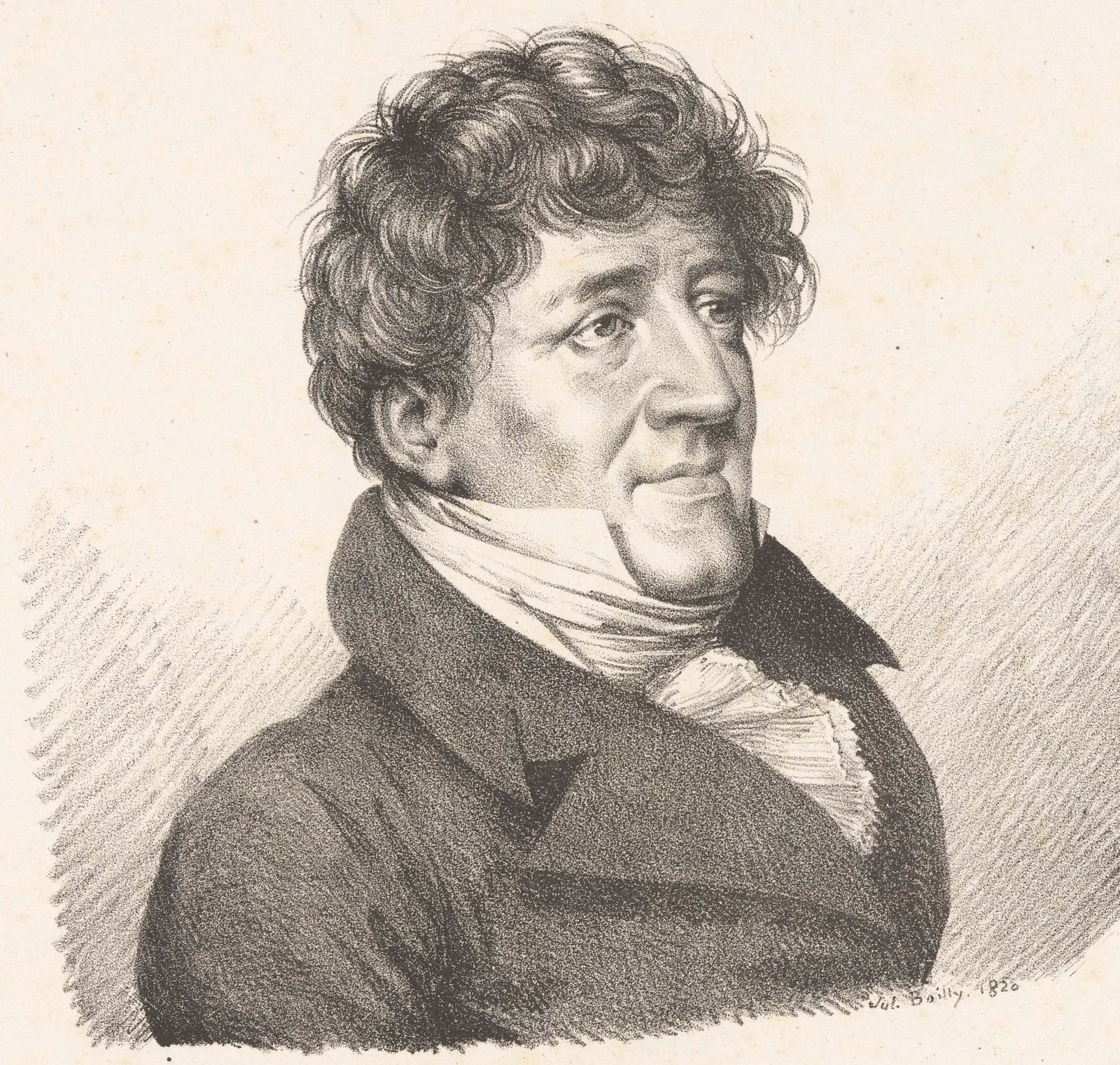

Julien-Léopold Boilly, lithograph portrait of Baron Cuvier, 1820, Rijksmuseum, Amsterdam (object number RP-P-1911-948); cropped to the portrait, without the caption text · Rijksmuseum, Amsterdam, print RP-P-1911-948, lithograph 'Le Baron Cuvier' from the series Iconographie de l'Institut royal de France; signed and dated 'Jul. Boilly 1820' on the stone · Public domain (nineteenth-century print, published in France in or after 1820; the Rijksmuseum item page gives its copyright status as public domain and the museum's reproduction is released under the CC0 public domain dedication)
박물학자 · 19세기
조르주 퀴비에
1769–1832
주요 업적 분야
아직 성격 매칭에 포함되지 않았습니다 — 기록된 근거가 성격 모델 전체를 다루기에는 충분하지 않습니다. 이 페이지의 다른 모든 내용은 자유롭게 확인하실 수 있습니다.
핵심 특성
주요 업적
1796년 4월 퀴비에는 살아 있는 코끼리와 화석 코끼리의 두개골과 이빨을 비교한 논문을 국립학사원에서 발표했다. 그는 실론의 코끼리와 희망봉의 코끼리가 서로 다른 두 종이며, 매머드와 '오하이오 동물'(그가 나중에 마스토돈이라 이름 붙인 동물)이 둘 모두와 다르다는 것을 보였다. 그리하여 이런 뼈들이 더 이상 살아 있지 않은 동물의 것이며, 어떤 대변동으로 파괴된 이전 세계의 일부라고 결론지었다. 같은 해에 그는 파라과이에서 발견된 거대한 화석을 기재하고 메가테리움이라는 이름을 붙였다. 엠브리오 프로젝트 백과사전 같은 참고 문헌은 이 코끼리 논문이 멸종이 실재함을 증명했다고 설명한다.
퀴비에는 화석 골격을 부분 상관의 원리로 풀어야 할 문제로 다루었다. 동물의 각 기관은 나머지와 맞아야 하므로 뼈 몇 개만으로도 동물 전체를 짐작할 수 있다는 것이다. 그는 이를 몽마르트르 석고 채석장과 여러 퇴적층의 화석 포유류에 적용했고, 1812년 그동안의 논문을 네 권짜리 『화석 뼈에 관한 연구』로 묶으면서 「서설」을 앞에 붙였다. 러드윅은 이 서설이 19세기에 매우 큰 영향을 끼쳤다고 평가한다. 지질학자 알렉상드르 브롱냐르와는 파리 지역의 바다와 민물 퇴적층이 번갈아 쌓인 순서를 기술해(1808년 보고서, 1811년 확대판) 화석을 지층 연구의 중심에 놓았다.
1795년 파리 자연사박물관의 비교해부학 교수를 돕는 자리에 임명된 퀴비에는 박물관의 비교해부학 표본 컬렉션을 키웠고, 뒤메릴, 이후 뒤베르누아와 함께 『비교해부학 강의』(1800~05)를 펴냈다. 그는 기관을 중요도에 따라 서열화하고 신경계를 비교하여 동물계를 척추동물, 연체동물, 관절동물, 방사동물의 네 가지 기본 체제(앙브랑슈망)로 나누었다. 이 체계는 『동물계』(1817)에 정리되었으며, 그는 연체동물의 해부에 관한 상세한 논문도 연속해서 발표했다.
삶의 장면들
1830년 프랑스 과학아카데미는 두족류의 기관을 척추동물의 기관과 비교한 논문에 대해 조프루아 생틸레르가 낸 보고를 들었다. 그는 이제 누구도 '구성의 통일'을 피할 수 없다고 결론지었다. 두 사람을 모두 알았고 퀴비에 편에 선 플루랑스에 따르면, 퀴비에는 조프루아의 앞선 발견들을 자주 칭찬했고 그 주장이 동물의 서로 다른 체제들을 가로질러 확장되었을 때에야 발언했다. 퀴비에는 '체제의 통일'과 '구성의 통일'이 무엇을 뜻하느냐고 물었고, 이 말을 동일성이라는 일상적 의미로 쓴다면 새와 물고기를 열어 보는 것만으로 반박된다고 주장했다. 바이마르에서 이 논쟁을 지켜본 괴테는 조프루아 편에 서서 퀴비에의 분석적 방법이 살아 있는 자연의 통일성을 놓친다고 보았다.
상대에게 용어의 뜻을 정의하라고 요구하고 해부학자가 실제로 확인하는 사실로 답한 태도는 분석적 엄밀성과 부합한다. 괴테의 평가는 같은 방법을 지나치게 좁다고 본 비판자도 있었음을 보여 준다. 분석적 엄밀성
1800년 12월에 퀴비에가 서명한 화석 네발짐승에 관한 논문은 호소로 끝난다. 학사원은 이 논문을 박물학자들에게 보낼 수 있도록 별도의 소책자로 인쇄했고, 퀴비에는 여기서 유럽 전역의 학자와 수집가에게 표본과 정보를 요청했다. 그는 파리 주변 채석장 노동자와 개인 소장가 등 이미 자신을 돕고 있는 사람들을 밝혔고, 이미 삼백 점이 넘는 그림이 있으며 그중 쉰 점이 판화로 새겨졌다고 알렸다. 러드윅은 이 글을 협력을 구하는 호소인 동시에 경쟁하려는 사람을 조용히 단념시키는 글로 읽는다.
유럽 전역에 도움을 청한 것은 협력과 부합하지만, 작업이 이미 얼마나 진행되었는지 밝힌 것은 그의 선점을 지키는 일이기도 했다. 러드윅은 두 의도가 모두 있었다고 읽는다. 협업 성향
전환점
퀴비에는 혁명기를 노르망디의 개신교 귀족 가문의 가정교사로 보내면서 책이 거의 없는 환경에서 해양 동물을 해부했다. 근처에 몸을 숨기고 있던 농학자 테시에를 통해 그는 조프루아 생틸레르를 비롯한 파리의 박물학자들에게 관찰 결과를 보냈고, 1795년 봄 그들의 초청을 받아들여 수도로 갔다. 그는 나이 든 비교해부학 교수 메르트뤼의 조교로 박물관에 들어갔고, 1년이 지나지 않아 코끼리 논문을 학사원에서 발표했다.
외진 곳에서 먼 곳의 전문가들에게 관찰 결과를 보내고, 파리에서 기회가 왔을 때 그것을 잡은 일은 주도적 행동성과 부합한다. 선제적 행동력
비슷한 인물
전체적인 프로필이 이 사람과 닮은 사람들이에요.
출처
- Georges Cuvier (Q171969) -- verified live via wbgetentities (2026-10-09): en label 'Georges Cuvier', description 'French naturalist, zoologist and paleontologist (1769-1832)', born 23 August 1769, died 13 May 1832, citizenship France, instance of human, ko label '조르주 퀴비에'. Orientation only; not used as support for any row.
- Sarah (Mrs. R.) Lee, 'Memoirs of Baron Cuvier' (London, 1833), Internet Archive scan -- ADMIRING, FIRSTHAND-FAMILY biography by a naturalist and friend who lived in daily contact with the Cuvier household in Paris for nearly four years (1819-23) and openly sets out to show his 'heart'; hagiographic in tone and silent on the Geoffroy debate's outcome, so used for dated actions and household observations, not for judgments of merit. Read the life narrative (Normandy, Paris, the Museum, the Institute), the account of the fossil work and the elephant papers, the Fontainebleau and anoplotherium episodes, and the whole section on his character and daily habits; the legislative sections and the bibliography were skimmed only.
- Martin J. S. Rudwick (historian of geology), 'Georges Cuvier, Fossil Bones, and Geological Catastrophes: New Translations and Interpretations of the Primary Texts' (University of Chicago Press, 1997) -- INDEPENDENT scholarly study, built on the Institut and Museum archives, that translates Cuvier's 1790s-1820s papers and prefaces each with a critical commentary (including candid remarks on his self-assurance, his circumspection toward Lamarck and his dealings with Brongniart). Read the preface, the introduction, the commentaries and translations on the elephant, megatherium and Montmartre papers, the 1800 appeal, the lectures, the Paris-basin collaboration and the Discourse chapters; the later technical appendices were not read. Read in a full-text copy of the printed book; the book itself is cited, not the copy.
- Pierre Flourens (Cuvier's successor as perpetual secretary of the Academie des sciences), 'Analyse raisonnee des travaux de Georges Cuvier, precedee de son eloge historique' (Paris, 1841), Internet Archive scan -- ADMIRING COLLEAGUE's memorial and critical analysis of the scientific work, hostile to transformism; used for what he says Cuvier did (the 1796 start, the classification, the Lamarck passage). The éloge and the sections on classification and on the species question were read; the detailed anatomy sections were skimmed.
- Pierre Flourens, 'De l'unite de composition et du debat entre Cuvier et Geoffroy Saint-Hilaire' (Paris, 1865), Internet Archive scan -- an eyewitness account of the 1830 Academie debate by a friend of both men who, on his own statement, was shown each side's papers beforehand; he sides with Cuvier on the science. Read the opening account of the origin of the quarrel, Cuvier's replies and the close of the oral debate; the later survey of comparative anatomy was skimmed.
- Johann Peter Eckermann, 'Conversations of Goethe', English translation (1850) -- CONTEMPORARY OUTSIDER/CRITICAL perspective: the entries of 1830-31 record Goethe's own reaction to the Cuvier-Geoffroy Saint-Hilaire quarrel (he sided with Geoffroy and found Cuvier's analytic method wanting) and a second-hand judgement, from the entourage of the jurist Etienne Dumont, that Cuvier expounds a fact better than anyone but 'has scarcely any philosophy'. Read the relevant entries in full.
- Valerie Racine, 'Georges Cuvier (1769-1832)', Embryo Project Encyclopedia (Arizona State University, 2013) -- scholarly reference article, independent of the Cuvier circle, that summarises the principles of correlation of parts and conditions of existence, the four embranchements, the 1796 elephant paper, the Discourse and the Geoffroy debate with references to Appel, Coleman, Outram and Rudwick. Read in full.
- Georges Cuvier, 'Extrait d'observations faites sur le cadavre d'une femme connue a Paris et a Londres sous le nom de Venus hottentote' (Memoires du Museum, 1817), as reprinted in 'Discours sur les revolutions du globe, Etudes sur l'ibis et Memoire sur la Venus hottentote' (Paris, 1864), Internet Archive scan -- PRIMARY text, Cuvier's own published anatomical report on the body of Sarah Baartman; read in the opening pages for how he frames the subject and describes her. Used only as a record of what he published, never as support for a score.
- University of Exeter, 'Cast in Stone: statues and memories of empire in post-imperial France and Britain', database entry 'Cuvier, Georges' -- a university research project's short biography that places Cuvier in the history of scientific racism and records his examination, dissection and retention of the remains of Sarah Baartman (her remains were returned to South Africa in 2002). Read in full (short entry); it cites Crais and Scully (2009), Blanckaert (2013) and Saini (2019), which could not be accessed.