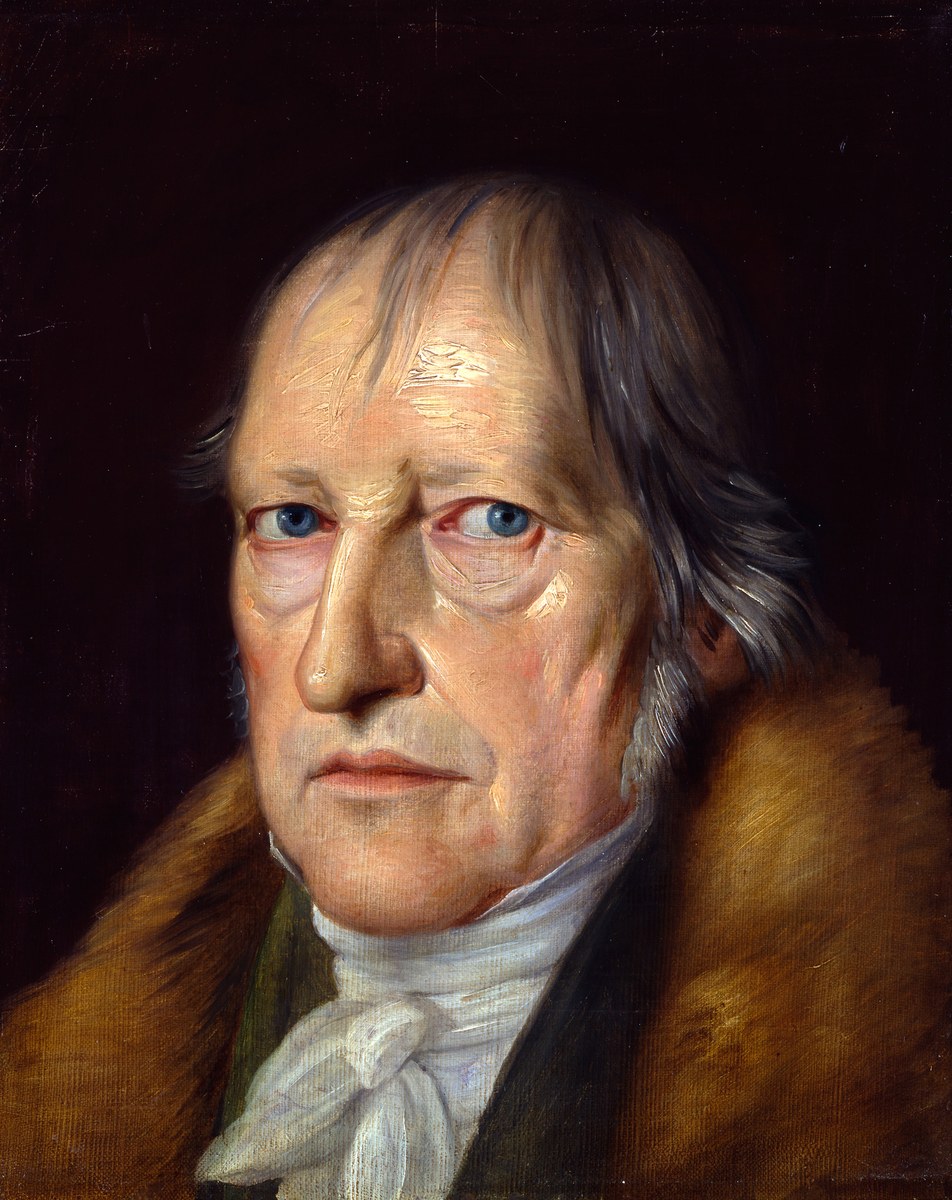
Jakob Schlesinger, Georg Wilhelm Friedrich Hegel, 1831, oil on canvas, Staatliche Museen zu Berlin, Alte Nationalgalerie, A I 556; photo: Andres Kilger, Public Domain Mark 1.0 · Portrait of the 61-year-old Hegel in oil on canvas (36 x 28.8 cm) by Jakob Schlesinger (1792-1855), dated 1831, the year Hegel died; Staatliche Museen zu Berlin, Alte Nationalgalerie, inventory A I 556, purchased 1897. The museum's catalogue page identifies the sitter as Hegel at age 61 and the painter as a conservator at the Berlin museums who may have met Hegel through the museum director Gustav Friedrich Waagen; it does not say in so many words that Hegel sat for it, so the image is recorded as a contemporary depiction rather than a documented sitting. Photograph credited to Andres Kilger and marked Public Domain Mark 1.0. The file is the museum's original 1654 x 2085 image downscaled to 952 x 1200 with no upscaling. · Public Domain Mark 1.0 (painting by Jakob Schlesinger, died 1855; photograph marked Public Domain Mark 1.0 by the Staatliche Museen zu Berlin)
철학자 · 19세기
헤겔
1770–1831
주요 업적 분야
아직 성격 매칭에 포함되지 않았습니다 — 기록된 근거가 성격 모델 전체를 다루기에는 충분하지 않습니다. 이 페이지의 다른 모든 내용은 자유롭게 확인하실 수 있습니다.
핵심 특성
주요 업적
그는 《정신현상학》(1807), 《논리의 학》(1812~16), 《철학적 학문 백과사전》(1817)에 담긴 절대적 관념론의 철학 체계를 세웠다. 참고 문헌들은 그를 근대 철학의 마지막 위대한 체계 건설자로 부른다.
그는 1818년부터 1831년 사망할 때까지 베를린 대학교 철학 교수로서 역사철학, 미학, 종교철학, 철학사를 강의해 많은 청중을 모았고, 이 강의들은 훗날 편집자들이 그의 노트와 학생 필기록으로 엮어 펴냈다.
그의 사상은 추종자와 비판자 모두를 통해 후대의 사유를 형성했다. 그의 학파는 좌파, 중도, 우파로 갈라졌고, 마르크스, 키르케고르, 영국 분석철학의 창시자들은 저마다 부분적으로 그에 대한 반응 속에서 자신의 입장을 발전시켰다.
삶의 장면들
1817년 하이델베르크에서 그는 《철학적 학문 백과사전》을 펴내 논리학, 자연철학, 정신철학을 하나의 개요로 묶었는데, 이는 1801년에 처음 밝힌 구상을 실현한 것이었다.
이는 여러 해에 걸쳐 하나의 포괄적 체계를 향해 작업한 사상가의 모습과 일치한다. 시스템적 사고
1808년부터 1816년까지 그는 뉘른베르크의 김나지움 교장으로 일하면서 그 기간에 두 권으로 된 《논리의 학》을 쓰고 출간했다.
이는 대학 밖의 직무와 병행하며 이어간 꾸준한 집필과 일치한다. 끈기
전환점
1807년 《정신현상학》이 나온 뒤에도 그는 대학 자리를 얻지 못해 신문 편집자와 학교 교장으로 9년을 보냈고, 1816년 하이델베르크 교수직과 1818년 베를린 교수직으로 비로소 대학에 돌아왔다.
이는 초기의 좌절에도 학문적 경력을 향해 오래 노력한 시기와 일치한다. 끈기
비슷한 인물
전체적인 프로필이 이 사람과 닮은 사람들이에요.
출처
- Georg Wilhelm Friedrich Hegel (Q9235), verified live via the Wikidata API (2026-11-01): label 'Georg Wilhelm Friedrich Hegel', description 'German philosopher and theologian (1770-1831)', born 27 August 1770, died 14 November 1831, citizenship Germany, Korean label 게오르크 빌헬름 프리드리히 헤겔, image the Schlesinger 1831 portrait. Orientation only; not used as support for any row.
- Stanford Encyclopedia of Philosophy, 'Georg Wilhelm Friedrich Hegel', section 1 'Life, Work, and Influence' read in full and the lists of his published works. CANONICAL SIGNIFICANCE SOURCE: tutor in Bern and Frankfurt, to Jena in 1801 where he published his first philosophical work and edited the Critical Journal of Philosophy with Schelling, the Phenomenology of Spirit completed in 1806 and published 1807, then newspaper editor in Bamberg and headmaster and philosophy teacher of a Nuremberg gymnasium 1808-1815 where he wrote the Science of Logic, a chair at Heidelberg in 1816, the Encyclopaedia of the Philosophical Sciences in 1817, the Berlin chair from 1818, the Elements of the Philosophy of Right in 1821, celebrity in Berlin until 1831; the lectures on history, religion, aesthetics and the history of philosophy were posthumously assembled by editors from his notes and student transcripts; after his death his followers split into left, centre and right, Marx and (through Schelling's critique) Kierkegaard reacted to him, and British analytic philosophy was founded partly in reaction. Scholarly institutional reference; the accounts of influence are retrospective.
- Encyclopaedia Britannica, 'Georg Wilhelm Friedrich Hegel' (T. Malcolm Knox), read only as far as the open part: the summary, the introduction and the early-life section up to his Frankfurt years; the rest sits behind the subscription wall and was not opened. Open text: Hegel is called the last of the great philosophical system builders of modern times and the pinnacle of classical German philosophy; list of posts (tutor 1793-1801, Jena 1801-07, newspaper editor, gymnasium rector 1808-16, professor at Heidelberg 1816-18 and Berlin 1818-31); the Tuebingen certificate said he was vigorous in philosophy and intermittent in theology and he was said to be poor in oral exposition; in Bern he read widely in history, politics and the classics, and studied Kant. Partial read.
- Terry Pinkard, 'Hegel, Georg Wilhelm Friedrich', Encyclopedia of Modern Europe: Europe 1789-1914 (via Encyclopedia.com), read in full (about 2,000 words). Written by Hegel's English-language biographer, so a sympathetic scholarly voice. Reports: unable to find a university post after the Phenomenology, the Bamberg editorship, success in rebuilding a once-great Nuremberg gymnasium as its director, a chair at Heidelberg in 1816 and Berlin in 1818, the Philosophy of Right of 1821 and its misreading as an apology for repression, a large audience of students and Berliners at his lectures, travels to Holland, Vienna and Paris, his role in the 1824 release of the French philosopher Victor Cousin, quarrels with liberals and with Schleiermacher, and the quick breakup of his school after 1831. Private-life detail in the entry is not used.
- New Catholic Encyclopedia, 'Hegel, Georg Wilhelm Friedrich' (via Encyclopedia.com), read in full: a Catholic theological reference that gives the life and works, summarises the dialectic against Kant, Fichte and Schelling, the Phenomenology, the Logic and the system, and ends with an 'Evaluation and Critique' which calls him a unique systematiser of German idealism and perhaps the greatest systematic philosopher of modern times while arguing that the dialectic was one-sided, that Schelling objected it provides no principle of deduction, and that his spiritual monism is hard to read as other than pantheistic. Independent and critical perspective (the counter-voice).
- George Lichtheim, 'Hegel, Georg Wilhelm Friedrich', International Encyclopedia of the Social Sciences (via Encyclopedia.com), first half read (life, works, the Philosophy of History and Philosophy of Right): the post-Kantian philosopher of history; posts at Jena, the Nuremberg rectorship 1808-16, Heidelberg and Berlin; at Berlin his courses attracted students from all over Germany and the posthumously published lectures spread his fame; his school dissolved into liberal and conservative factions after 1831; his utterances were open to rival readings and not 'totalitarian'. The political-philosophy sections are not used. Independent scholarly voice.