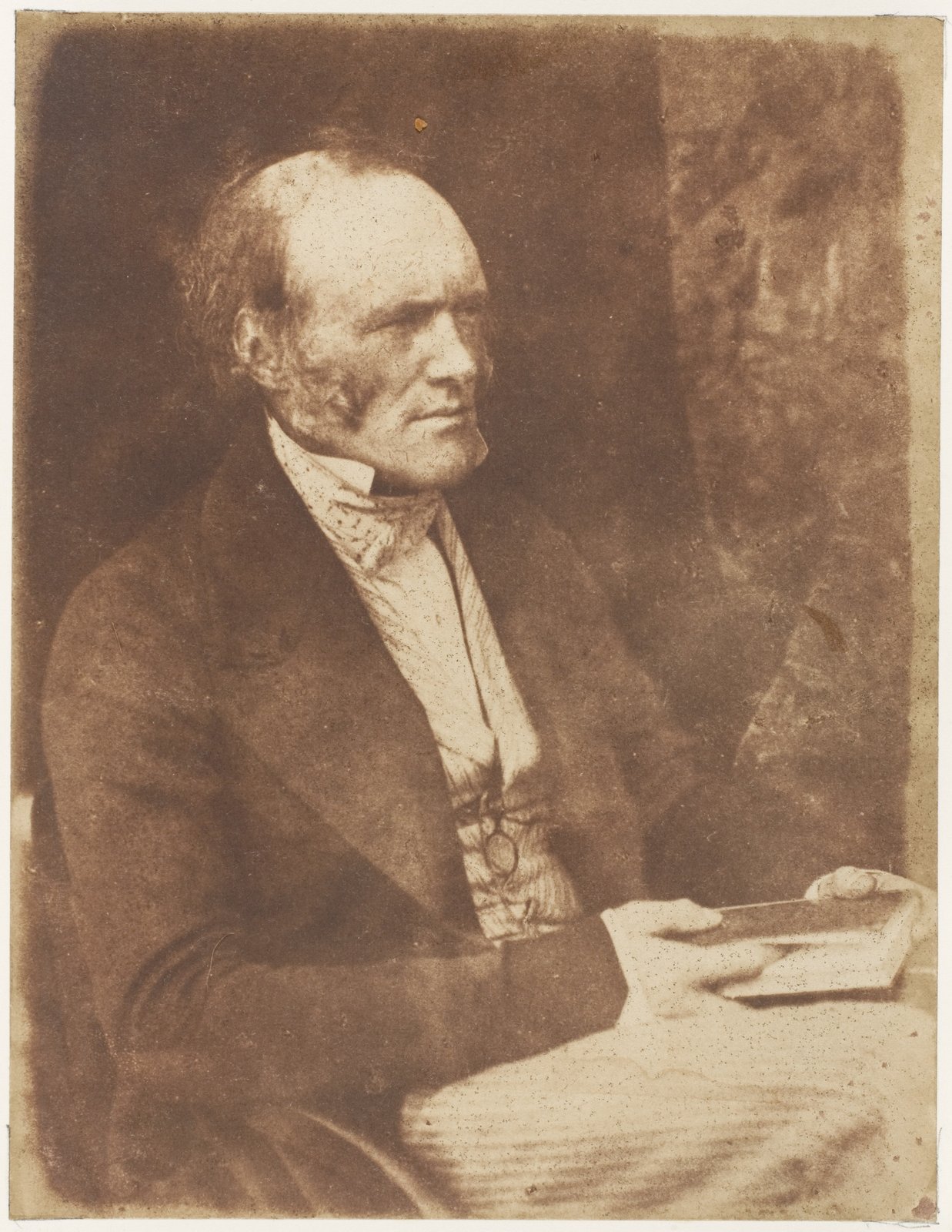
David Octavius Hill and Robert Adamson (Hill and Adamson), 'Sir Charles Lyell - Geologist', 1843-47, salted paper print from paper negative, The Metropolitan Museum of Art, Harris Brisbane Dick Fund, 1937 (37.98.2.109) · Metropolitan Museum of Art, New York, accession 37.98.2.109, 'Sir Charles Lyell - Geologist', salted paper print from paper negative, Hill and Adamson, 1843-47 (Harris Brisbane Dick Fund, 1937), Open Access · Public domain (Metropolitan Museum Open Access, CC0); photograph by Hill and Adamson, 1843-47 (Adamson d. 1848, Hill d. 1870)
과학자 · 19세기
찰스 라이엘
1797–1875
주요 업적 분야
아직 성격 매칭에 포함되지 않았습니다 — 기록된 근거가 성격 모델 전체를 다루기에는 충분하지 않습니다. 이 페이지의 다른 모든 내용은 자유롭게 확인하실 수 있습니다.
핵심 특성
주요 업적
라이엘의 『지질학 원리』(전 3권, 1830~33)는 지표면의 과거 변화를 지금도 작용하는 원인으로 설명해야 한다고 주장했고, 에트나 화산 등에서 직접 한 야외 조사를 바탕으로 했으며, 지질학을 우주 생성론과 분리해야 한다고 호소했다. 다윈은 비글호 항해에 제1권을 가져갔고, 이 책의 견해가 자신이 아는 어떤 책보다 훨씬 낫다고 평가했다. 이 책은 1830년부터 1872년까지 11판을 거듭했다.
라이엘은 『지질학 원리』 제3권(1833)에서 제3기를 화석 조개류 가운데 현생종이 차지하는 비율에 따라 여러 시기로 나누고, 이를 에오세, 마이오세, 구(舊) 플라이오세와 신(新) 플라이오세라고 불렀다. 화석 조개 표는 파리의 패류학자 제라르 폴 데샤예(Gerard Paul Deshayes)가 만들었고, 라이엘은 용어를 만드는 데 윌리엄 휴얼(William Whewell)의 도움을 받았다고 밝혔다.
『지질학 원론(Elements of Geology)』(1838)은 지질학을 한 권의 교재로 정리한 책이다. 제1부는 암석을 성질에 따라 수성암, 화산암, 심성암, 변성암의 네 부류로 나누고, 제2부는 이를 최근기와 제3기부터 시대순으로 다시 배열했으며, 화석 그림이 많이 포함된 도판 294점이 실렸다. 라이엘은 이 책을 계속 고쳐 1865년에 제6판을 냈다.
『인류의 오랜 역사에 대한 지질학적 증거』(1863)는 인류가 멸종한 포유류와 같은 시대에 살았다는 증거를 모은 책이다. 라이엘이 직접 표본을 수집한 아브빌과 아미앵의 솜(Somme) 강 자갈층의 부싯돌 도구, 데번의 브릭섬 같은 동굴 퇴적층을 다루고, 빙하 퇴적물에 관한 긴 서술과 라마르크, 다윈, 월리스의 종 기원론에 대한 논의도 담았다. 1863년에 세 판이 나왔고 1873년에 제4판이 나왔다.
삶의 장면들
1830년 6월 14일, 『지질학 원리』 출간을 열흘쯤 앞두고 라이엘은 《쿼털리 리뷰》에 서평을 쓰기로 한 풀렛 스크로프(Poulett Scrope)에게 편지를 썼다. 그는 스크로프가 서평에 '이 학문을 모세에게서 해방시킬 내용'을 담을 수 있으리라 기대하면서도, 반대자들을 이겼다고 우쭐대지는 말라고 조언했다. 또 자신의 역사 서술과 논평의 절반가량을 덜어냈다고 밝히며, 이를 그대로 드러내면 '정직한 감정이 나아갈 20~30년'을 앞질러 버리게 되기 때문이라고 설명했다.
무엇을 말하고 무엇을 덜어낼지, 서평가가 어떤 어조로 쓸지까지 미리 조율하고, 독자를 자극하기보다 끌어들이려 한 점은 계산된 전략적 설득과 일치한다. 설득력
라이엘은 1856년 다윈에게 종 이론을 충분히 정리해 쓰라고 권했고, 1858년 7월 1일에는 조지프 후커(Joseph Hooker)와 함께 다윈과 월리스의 논문을 린네 학회에서 공동으로 소개했다. 그러나 1863년 『인류의 오랜 역사에 대한 지질학적 증거』가 나왔을 때 다윈은 라이엘이 더 분명히 말하지 않은 데 실망했다. 라이엘은 후커에게 '현재의 확신이 허락하는 범위까지 말했다'고 답했고, 다윈에게는 인간이 동물에서 왔다는 주장을 한 장에 걸쳐 논증하고도 『지질학 원리』 몇 쪽을 다시 읽으면 '예전 견해로 되돌아가곤 한다'고 털어놓았다.
종의 변화에 반대하던 입장에서 이를 뒷받침하는 쪽으로 옮겨 가면서도 감정이 이성의 속도를 따라가지 못한다고 솔직히 인정한 모습은, 실제로 일어났지만 느렸던 믿음 수정과 일치하며, 그래서 다윈에게는 답답하게 느껴졌다. 입장 수정 성향
전환점
라이엘은 1831년 런던 킹스칼리지의 새 지질학 교수직에 선임되어 1832년과 1833년에 강의했다. 1831년 12월 24일에는 가족에게 '교수직에서 벗어나고 싶다는 분명한 바람'을 밝혔다. 1833년 강의를 마친 뒤 그는 사임했는데, 가족이 쓴 기록은 직무가 여행과 독자적인 연구를 방해하리라 여겼다고 전하며, 베일리(Bailey)는 여성 청강이 금지된 뒤 수강생이 줄었다고 덧붙인다. 그의 다음 장거리 여행은 1834년 스웨덴, 1841~42년 북아메리카였다.
런던의 교수직을 내려놓고 여행과 집필의 자유를 택한 것은 자기 일의 방식을 스스로 통제하려는 강한 욕구와 일치한다. 다만 베일리가 강의 참석자 감소도 언급하므로, 이 결정이 전적으로 원칙에 따른 것이라고 단정할 수는 없다. 자율성 욕구
비슷한 인물
전체적인 프로필이 이 사람과 닮은 사람들이에요.
출처
- Charles Lyell (Q5333) -- verified live via wbgetentities (2026-10-08): en label 'Charles Lyell', description 'British geologist (1797-1875)', born 14 Nov 1797, died 22 Feb 1875 (a second death value of 11 Feb 1875 also appears on the item), citizenship United Kingdom, instance of human, ko label '찰스 라이엘'. Orientation only; not used as support for any row.
- Katharine M. Lyell (his sister-in-law), ed., Life, Letters and Journals of Sir Charles Lyell, Bart., 2 vols (John Murray, 1881), Internet Archive scans -- FAMILY/PARTISAN compilation that prints Lyell's own letters and journals (so partly SELF testimony). Read for the 1831-1836 years in vol. 1 (the King's College chair and his wish to be free of it, the 1834 Sweden tour and sea-level marks) and for the 1858-1867 letters in vol. 2 (the March 1863 letters on Antiquity of Man and transmutation, the 1866 letter to Darwin); other chapters were searched by keyword, not read through.
- Sir Edward Bailey (former Director of the Geological Survey of Great Britain), Charles Lyell, British Men of Science series (Doubleday / Nelson, 1962-63), Internet Archive scan -- INDEPENDENT scholarly biography by a later geologist: admiring of Lyell's achievement but explicit about his errors (marine erosion of the Weald, floating-ice drift, fixity of species). Read chapters 7-11 (Principles volumes, the professorship, marriage, Darwin, the Elements) and 17-19 (antiquity of man, Origin of Species, closing years) in full; chapters 12-16 were only searched by keyword.
- Martin J. S. Rudwick (historian of geology), Worlds Before Adam: The Reconstruction of Geohistory in the Age of Reform (University of Chicago Press, 2008), Internet Archive copy (2010 printing) -- INDEPENDENT scholarly history that treats Lyell as one actor among many and quotes his critics (Whewell, Sedgwick, Conybeare, De la Beche). Read section 19.4 (Lyell in Sicily), chapters 22-24 on the reception of Principles (Scrope's and Whewell's reviews, Sedgwick's 1831 address, the 'catastrophists and one uniformitarian' section), the passage on the 1834 revision and the footnotes on Lyell's resistance to progression; the rest of the 38-chapter book was searched by keyword only.
- Thomas George Bonney (geologist and Cambridge professor), Charles Lyell and Modern Geology, Century Science Series (Cassell, 1895), Project Gutenberg #34502 -- ADMIRING Victorian assessment by a fellow geologist that quotes Ramsay, Hooker, Darwin and Stanley, but also records Sedgwick's criticism that Lyell was no great field observer. Read the general assessment of his character and method and the account of the tenth edition of Principles; the narrative chapters were searched by keyword.
- Charles Lyell, Principles of Geology, being an attempt to explain the former changes of the earth's surface by reference to causes now in operation, vol. 1 (John Murray, 1830) and vol. 3 (1833), Wellcome Library scans on the Internet Archive -- SELF source (his own argument and his own coinages of Eocene, Miocene and Pliocene). Read the opening chapter's statement of method and the passages of vol. 3 that define the Tertiary periods by the proportion of living species; most of the text was not read through.
- Charles Lyell, The Geological Evidences of the Antiquity of Man, with remarks on theories of the origin of species by variation (John Murray, 1863), Google Books scan on the Internet Archive -- SELF source. Read chapter 5-6 (Boucher de Perthes, Rigollot, the Brixham cave exploration and his own visit) and the closing chapters on species were searched by keyword.
- Charles Darwin, Autobiography (written 1876-81; Nora Barlow / Francis Darwin editions), Project Gutenberg #2010 -- FRIEND/ALLY and SELF-INTERESTED perspective (Darwin owed much to Lyell). Read every passage naming Lyell: his mind and candour, the 1856 advice to write out the species theory, the 1858 Wallace essay and the Linnean Society reading, and Lyell's advice to avoid controversy.
- Darwin Correspondence Project (University of Cambridge), letter from Charles Darwin to Charles Lyell, 18 [June 1858], with the editors' footnotes -- scholarly edition of the letter that forwarded Wallace's essay to Lyell, with notes that Lyell had urged Darwin in 1856 to write up his species theory and had recommended Wallace's 1855 paper. Read in full.
- Nicholas Whitley (Honorary Secretary, Royal Institution of Cornwall), The 'Flint Implements' from Drift, Not Authentic: being a reply to The Geological Evidences of the Antiquity of Man (Truro / London, 1865), Internet Archive scan -- HOSTILE contemporary critic of Lyell's 1863 book (his central claim, that the flints are natural fractures, was later overturned). Read the preface and the sections on design, number and the Moulin-Quignon episode; used only to show what opponents said of Lyell's reasoning.
- 'Sir Charles Lyell', Popular Science Monthly vol. 1 (New York, 1872), sketch with engraved portrait, Internet Archive scan (popularsciencemo01newy) -- contemporary US magazine notice, used only to check the origin of the Commons image suggested as a portrait lead; not used for any trait.